Results by title
208 books match the query 'Finance' and 3 start with g
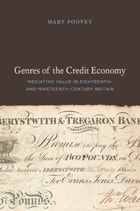
Genres of the Credit Economy
Mediating Value in Eighteenth- and Nineteenth-Century BritainMary Poovey
University of Chicago Press, 2008
How did banking, borrowing, investing, and even losing money—in other words, participating in the modern financial system—come to seem likeroutine activities of everydaylife? Genres of the Credit Economy addressesthis question by examining the history of financial instruments and representations of finance in eighteenth- and nineteenth-century Britain.
Chronicling the process by which some of our most important conceptual categories were naturalized, Mary Poovey explores complex relationships among forms of writing that are not usually viewed together, from bills of exchange and bank checks, to realist novels and Romantic poems, to economic theory and financial journalism. Taking up all early forms of financial and monetarywriting, Poovey argues that these genres mediated for early modern Britons the operations of a market system organized around credit and debt. By arguing that genre is a critical tool for historical and theoretical analysis and an agent in the events that formed the modern world, Poovey offers a new way to appreciate the character of the credit economy and demonstrates the contribution historians and literary scholars can make to understanding its operations.
Much more than an exploration of writing on and around money, Genres of the Credit Economy offers startling insights about the evolution of disciplines and the separation of factual and fictional genres.
[more]

German Film after Germany
Toward a Transnational AestheticRandall Halle
University of Illinois Press, 2007
What is the work of film in the age of transnational production? To answer that question, Randall Halle focuses on the film industry of Germany, one of Europe's largest film markets and one of the world's largest film-producing nations. In the 1990s Germany experienced an extreme transition from a state-subsidized mode of film production that was free of anxious concerns about profit and audience entertainment to a mode dominated by private interest and big capital. At the same time, the European Union began actively drawing together the national markets of Germany and other European nations, sublating their individual significances into a synergistic whole. This book studies these changes broadly, but also focuses on the transformations in their particular national context. It balances film politics and film aesthetics, tracing transformations in financing along with analyses of particular films to describe the effects on the film object itself. Halle concludes that we witness currently the emergence of a new transnational aesthetic, a fundamental shift in cultural production with ramifications for communal identifications, state cohesion, and national economies.
[more]
Globalization in an Age of Crisis
Multilateral Economic Cooperation in the Twenty-First CenturyEdited by Robert C. Feenstra and Alan M. Taylor
University of Chicago Press, 2013
Along with its painful economic costs, the financial crisis of 2008 raised concerns over the future of international policy making. As in recessions past, new policy initiatives emerged, approaches that placed greater importance on protecting national interests than promoting international economic cooperation. Whether in fiscal or monetary policies, the control of currencies and capital flows, the regulation of finance, or the implementation of protectionist policies and barriers to trade, there has been an almost worldwide trend toward the prioritizing of national economic security. But what are the underlying economic causes of this trend, and what can economic research reveal about the possible consequences?
Prompted by these questions, Robert C. Feenstra and Alan M. Taylor have brought together top researchers with policy makers and practitioners whose contributions consider the ways in which the global economic order might address the challenges of globalization that have arisen over the last two decades and that have been intensified by the recent crisis. Chapters in this volume consider the critical linkages between issues, including exchange rates, global imbalances, and financial regulation, and plumb the political and economic outcomes of past policies for what they might tell us about the future of the global economic cooperation.
[more]