Results by title
100 books match the query 'Flowers' and 7 start with g

Gardening for Love
The Market BulletinsElizabeth A. Lawrence
Duke University Press, 1987
It was Eudora Welty who awakened Elizabeth Lawrence's interest in this fascinating topic by putting her name on the mailing list of The Mississippi Market Bulletin, a twice-monthly collection of classified advertisements founded in 1928 and still published today. Lawrence soon discovered market bulletins from the Carolinas and other Southern states, as well as similar bulletins published privately in the North. She began ordering plants from the bulletins, and there ensued a lively exchange of letters wit the women who sold them.
Gardening for Love is Lawrence's exploration of this little-known side of American horticulture and her affectionate tribute to country people who shared her passion for plants. Drawing on the letters she received, sometimes a great many of them from the same persons over many years, she delves into traditional plant lore, herbal remedies, odd and often highly poetic vernacular plant names peculiar to particular regions of the South, and the herb collectors of the mountains of the Carolinas and Georgia. She focuses primarily on the Southeast and the Deep South, but her wide knowledge of both literature and botany gives Gardening for Love a dimension that transcends the category of regional writing.
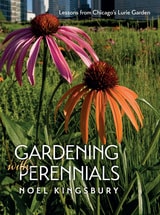
Gardening with Perennials
Lessons from Chicago's Lurie GardenNoel Kingsbury
University of Chicago Press, 2014
With Gardening with Perennials horticulturalist and garden writer Noel Kingsbury brings a global perspective to the Lurie oasis through a wonderful introduction to the world of perennial gardening. He shows how perennials have much to offer home gardeners, from sustainability—perennials require less water than their annual counterparts—to continuity, as perennials’ longevity makes them a dependable staple.
Kingsbury also explains why Lurie is a perfect case study for gardeners of all locales. The plants represented in this urban oasis were chosen specifically for reliability and longevity. The majority will thrive on a wide range of soils and across a wide climatic range. These plants also can thrive with minimal irrigation, and without fertilizers or chemical control of pests and diseases. Including a special emphasis on plants that flourish in sun, and featuring many species native to the Midwest region, Gardening with Perennials will inspire gardeners around the world to try Chicago-style sustainable gardening.
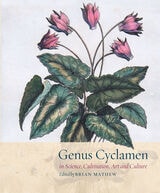
Genus Cyclamen
In Science, Cultivation, Art and CultureEdited by Brian Mathew
Royal Botanic Gardens, Kew, 2013
Genus Cyclamen is a celebration of this remarkable plant. Its science-based emphasis on botany and cultivation is complemented by sections on art and history, including twenty-five newly commissioned paintings and over seven hundred photographs. It provides a wealth of information, including taxonomic descriptions, flowering periods, distribution, and habitat, all based on the deep knowledge and practical experiences of the Cyclamen Society and other cyclamen experts. This book will find a wide audience of growers, gardeners, botanists, and enthusiasts, thanks to its all-encompassing coverage of the cyclamen and its informative, but accessible style.
Gods and Goddesses in the Garden
Greco-Roman Mythology and the Scientific Names of PlantsBernhardt, Peter
Rutgers University Press, 2008
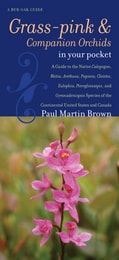
Grass-pinks and Companion Orchids in Your Pocket
A Guide to the Native Calopogon, Bletia, Arethusa, Pogonia, Cleistes, Eulophia, Pteroglossaspis, andPaul Martin Brown
University of Iowa Press, 2008
Brown provides general distributional information, time of flowering, and habitat requirements for each species as well as a complete list of hybrids and the many different growth and color forms that can make identifying orchids so intriguing. For the grass-pinks and companions he includes information on 16 species, 2 additional varieties, and 7 hybrids.
Grass-pinks, with their showy pink to white flowers, are some of the most conspicuous wild orchids encountered in the prairies, bogs, and open wetlands of eastern North America. Most of these species are easy to identify based upon their general appearance, range, and time of flowering. Answering three simple questions—when, where, and how does it grow?—and comparing the living plant with the striking photos in the backpack-friendly laminated guide should enable both professional and amateur naturalists to achieve the satisfaction of identifying a specific orchid.

Guide to the Flowers of Western China
Christopher Grey-Wilson and Phillip Cribb
Royal Botanic Gardens, Kew, 2011
Unrivaled in the temperate latitudes of the world, China’s rich flora comprises 30,000 species of plants, and nowhere is this floral richness more evident than in western China. With its lush forests, meandering rivers, and majestic mountains, the west of China has been a center of plant exploration for over two centuries, giving rise to many well-known species of trees, shrubs, perennials, and bulbs that populate our parks and botanical institutes, including rhododendron, orchids, peonies, and roses.
Guide to the Flowers of Western China describes and illustrates more than two thousand species, from the common to the endemic to the extremely rare. Plant families are arranged following the latest DNA-based classification, making this pictorial guide— the largest and most comprehensive on western China ever published—essential for gardeners and plant scientists.
Celebrating the wealth of western China’s vast flora, this magnificent volume will enable the horticulturally inclined traveler (or armchair traveler) to identify many of the plants encountered in the wild.
Guide to the Flowers of Western China
Christopher Grey-Wilson and Phillip Cribb
Royal Botanic Gardens, Kew, 2023
Since the publication of the first edition of Guide to the Flowers of Western China in 2011, there have been great strides in knowledge of the flora of China through international collaboration. Many plants included in the first edition have been revisited in the wild, while areas hitherto inaccessible have opened up, if sometimes only temporarily. Great advances in systematic botany have occurred since the publication of the first edition, particularly with the widespread availability of rapid DNA analysis. The result of this has been an influx of new photographs and data, and the need for a second edition of Guide to the Flowers of Western China.