Results by title
484 books match the query 'Foreign relations' and 16 start with g
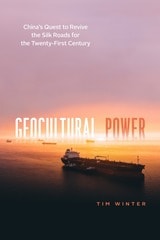
Geocultural Power
China's Quest to Revive the Silk Roads for the Twenty-First CenturyTim Winter
University of Chicago Press, 2019
Geocultural Power explores this question by considering how China is couching its strategy for building trade, foreign relations, and energy and political security in an evocative topography of history. Until now Belt and Road has been discussed as a geopolitical and geoeconomic project. This book introduces geocultural power to the analysis of international affairs. Tim Winter highlights how many countries—including Iran, Sri Lanka, Kenya, Malaysia, Indonesia, Pakistan, and others—are revisiting their histories to find points of diplomatic and cultural connection. Through the revived Silk Roads, China becomes the new author of Eurasian history and the architect of the bridge between East and West. In a diplomatic dance of forgetting, episodes of violence, invasion, and bloodshed are left behind for a language of history and heritage that crosses borders in ways that further the trade ambitions of an increasingly networked China-driven economy.

Geopolitical Exotica
Tibet in Western ImaginationDibyesh Anand
University of Minnesota Press, 2008
Geopolitical Exotica examines exoticized Western representations of Tibet and Tibetans and the debate over that land’s status with regard to China. Concentrating on specific cultural images of the twentieth century—promulgated by novels, popular films, travelogues, and memoirs—Dibyesh Anand lays bare the strategies by which “Exotica Tibet” and “Tibetanness” have been constructed, and he investigates the impact these constructions have had on those who are being represented.
Although images of Tibet have excited the popular imagination in the West for many years, Geopolitical Exotica is the first book to explore representational practices within the study of international relations. Anand challenges the parochial practices of current mainstream international relations theory and practice, claiming that the discipline remains mostly Western in its orientation. His analysis of Tibet’s status with regard to China scrutinizes the vocabulary afforded by conventional international relations theory and considers issues that until now have been undertheorized in relation to Tibet, including imperialism, history, diaspora, representation, and identity.
In this masterfully synthetic work, Anand establishes that postcoloniality provides new insights into themes of representation and identity and demonstrates how IR as a discipline can meaningfully expand its focus beyond the West.
Dibyesh Anand is a reader in international relations at the University of Westminster, London.
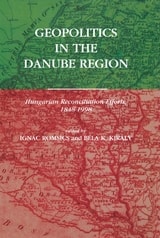
Geopolitics in the Danube Region
Hungarian Reconciliation Efforts, 1848–1998Ignác Romsics
Central European University Press, 1998
Central and Eastern Europe has a long history of, on the one hand, ethnic conflicts and, on the other, of a revolutionary tradition against expansionism. Both have their roots in the geographical situation and ethnic composition of the region. All these problems have surfaced at times when the political status quo has been upset for some reason, such as after the two world wars and after the collapse of the Soviet Union.
Both great powers bordering the Danube region-Germany and Russia-have strived to develop their own versions of confederations (Mitteleuropa and Pan-Slavic movements). Also, politicians and intellectuals of the countries affected have proposed various theories, and made initiatives for different forms of closer or looser confederative formations.
This book examines the reasons for the failure of these initiatives, these reasons including such factors as ethnically-motivated political antagonism, and the lack of economic complementarity. Contributing valuable information on the problems of political and economic integration, which should not be forgotten in a period when the countries of the region are looking towards the European Union, expecting-realistically or not-the solution of their various conflicts.

Georgia
Pawn in the New Great GamePer Gahrton
Pluto Press, 2010
The 2008 Ossetia War underlined the fact that Georgia is caught in a political struggle between East and West. Per Gahrton analyses American and Russian policy towards the country and provides a firsthand account of the Rose Revolution of 2003, its origin and aftermath.
The book traces the increasing US involvement in Georgia and the Russian reaction of anger, sanctions and, eventually, invasion. Gahrton's analysis is based on interviews with key politicians and his experience as the rapporteur of the European Parliament on South Caucasus. At centre stage is the growing opposition against authoritarian aspects of President Mikheil Saakashvili’s regime and the mysterious death of Prime Minister Zhvania in 2005. The book also asks if the Rose Revolution was a conspiracy or a genuine popular uprising.
This truly authoritative account of Georgia is a must for students studying international relations in the aftermath of The Cold War.
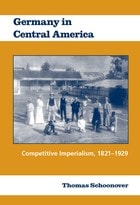
Germany in Central America
Competitive Imperialism, 1821-1929Thomas Schoonover
University of Alabama Press, 1999
Analyzes the German role in Central American domestic and international relations
Using previously untapped resources including private collections, the records of cultural institutions, and federal and state government archives, Schoonover analyzes the German role in Central American domestic and international relations.Of the four countries most active in independent Central America-Britain, the United States, France, and Germany- historians know the least about the full extent of the involvement of the Germans.German colonial expansion was based on its position as an industrialized state seeking economic well-being and security in a growing world market. German leaders were quick to recognize that ties to the cheap labor of overseas countries could compensate for some of the costs and burdens of conceding material and social privileges to their domestic labor force. The Central American societies possessed limited resource bases; smaller and poorly educated populations; and less capital, communications, and technological development than Germany. They saw the borrowing of development as a key to their social, economic, and political progress. Wary Central American leaders also saw the influx of German industrialists as assurance against excessive U.S. presence in their political economies and cultures.
Although the simplistic bargain to trade economic development for cheap labor appeared to succeed in the short term, complex issues of German domestic unemployment and social disorder filtered to Central American countries and added to their own burdens. By 1929, Germany had recovered most of its pre-World War I economic position.

Ghosts in the Neighborhood
Why Japan Is Haunted by Its Past and Germany Is NotWalter F. Hatch
University of Michigan Press, 2023
Germany, which brutalized its neighbors in Europe for centuries, has mostly escaped the ghosts of the past, while Japan remains haunted in Asia. The most common explanation for this difference is that Germany knows better how to apologize; Japan is viewed as “impenitent.” Walter F. Hatch rejects the conventional wisdom and argues that Germany has achieved reconciliation with neighbors by showing that it can be a trustworthy partner in regional institutions like the European Union and NATO; Japan has never been given that opportunity (by its dominant partner, the U.S.) to demonstrate such an ability to cooperate. This book rigorously defends the argument that political cooperation—not discourse or economic exchange—best explains Germany’s relative success and Japan’s relative failure in achieving reconciliation with neighbors brutalized by each regional power in the past. It uses paired case studies (Germany-France and Japan-South Korea; Germany-Poland and Japan-China) to gauge the effect of these competing variables on public opinion over time. With numerous charts, each of the four empirical chapters illustrates the powerful causal relationship between institution building and interstate reconciliation.

Global Heartland
Cultivating the American Century on the Midwestern FarmPeter Simons
University of Minnesota Press, 2025
Highlighting the critical role of midwestern farmers in the creation of the American Century
Though often left out of the story of the making of the American Century, the farmers of the Midwest were at its center, fueling the nation’s growing power in the midtwentieth century. In Global Heartland, Peter Simons explores how, after decades of slipping to the margins of an urbanizing economy, these farmers assumed renewed strategic and cultural importance as they produced essential sustenance for overseas troops and food rations for a domestic population.
During the mid-1900s, once-isolationist midwestern farmers came to see the continental interior not as an insulated space but as an environmentally rich landscape that mandated them to accept a larger stake in global affairs. Simons traces this transformation from an older agrarian internationalism rooted in religion and ties to family abroad to illuminate the increasing influence of the U.S. agricultural community during the Cold War. Examining regional political parties, Lend-Lease programs, wartime mass media, and farmer-led relief programs, and interspersing this history with vignettes revisiting the Mercy Wheat campaign of 1947, the postwar International Farm Youth Exchange, and the Flying Farmers organization, Simons offers an enlightening consideration of midwestern farmers’ involvement in America’s international ascent.
Unique in its focus on farmers and their work rather than the more common attention to food or agricultural commodities, Global Heartland complicates and expands ideas of the farm industry’s role in American history.

Global Shadows
Africa in the Neoliberal World OrderJames Ferguson
Duke University Press, 2006
In Global Shadows the renowned anthropologist James Ferguson moves beyond the traditional anthropological focus on local communities to explore more general questions about Africa and its place in the contemporary world. Ferguson develops his argument through a series of provocative essays which open—as he shows they must—into interrogations of globalization, modernity, worldwide inequality, and social justice. He maintains that Africans in a variety of social and geographical locations increasingly seek to make claims of membership within a global community, claims that contest the marginalization that has so far been the principal fruit of “globalization” for Africa. Ferguson contends that such claims demand new understandings of the global, centered less on transnational flows and images of unfettered connection than on the social relations that selectively constitute global society and on the rights and obligations that characterize it.
Ferguson points out that anthropologists and others who have refused the category of Africa as empirically problematic have, in their devotion to particularity, allowed themselves to remain bystanders in the broader conversations about Africa. In Global Shadows, he urges fellow scholars into the arena, encouraging them to find a way to speak beyond the academy about Africa’s position within an egregiously imbalanced world order.
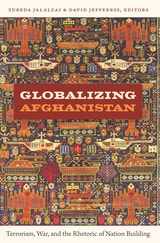
Globalizing Afghanistan
Terrorism, War, and the Rhetoric of Nation BuildingZubeda Jalalzai and David Jefferess, eds.
Duke University Press, 2011
Contributors. Gwen Bergner, Maliha Chishti, Cheshmak Farhoumand-Sims, Nigel C. Gibson, Zubeda Jalalzai, David Jefferess, Altaf Ullah Khan, Kamran Rastegar, Rodney J. Steward, Imre Szeman
Gorbachev and Bush
The Last Superpower Summits. Conversations that Ended the Cold WarThe National Security Archive Savranskaya
Central European University Press, 2020
Gorbachev and Reagan
The Last Superpower Summits. Conversations that Ended the Cold WarThe National Security Archive Savranskaya
Central European University Press, 2020
Governing Abroad
Coalition Politics and Foreign Policy in EuropeSibel Oktay
University of Michigan Press, 2022
From Austria to New Zealand, coalition governments often pave the road to foreign policy. In Western Europe, nearly 90 percent of postwar governments include two or more political parties. Israel, the Middle East’s only consolidated democracy according to many, has never experienced single-party rule in its history. Even the United Kingdom, known for its long streak of single-party rule, now navigates multiparty cabinets. Coalitions are everywhere, but we still have little understanding of how they act in foreign affairs. History shows that coalitions can sometime engage in powerful international commitments such as participating in military operations, but at other times, they postpone their decisions, water down their policy positions, or promise to do less than they otherwise would. What explains these differences in behavior?
Governing Abroad unpacks the little-known world of coalition governments to find out. Oktay argues that the specific constellation of parties in government explains why some coalitions can make more assertive foreign policy decisions than others. Building on the rich literature in political science on coalitions, legislatures, and voting behavior, the book weaves together sophisticated statistical analyses of foreign policy events across thirty European countries alongside in-depth case studies from Denmark, the Netherlands, and Finland. It brings political parties back into the study of foreign policy, demonstrating that the size of the coalition, the ideological proximity of the governing parties, and their relationship with the parliamentary opposition together influence the government’s ability to act in the international arena. This book challenges our existing perceptions about the constraints and weaknesses of coalition governments. It sheds new light on the conditions that allow them to act decisively abroad.
Grand Strategy from Truman to Trump
Benjamin Miller with Ziv Rubinovitz
University of Chicago Press, 2020
American foreign policy is the subject of extensive debate. Many look to domestic factors as the driving forces of bad policies. Benjamin Miller instead seeks to account for changes in US international strategy by developing a theory of grand strategy that captures the key security approaches available to US decision-makers in times of war and peace.
Grand Strategy from Truman to Trump makes a crucial contribution to our understanding of competing grand strategies that accounts for objectives and means of security policy. Miller puts forward a model that is widely applicable, based on empirical evidence from post-WWII to today, and shows that external factors—rather than internal concerns—are the most determinative.

Great Expectations and Interwar Realities
Cultural Diplomacy in Horthy's HungaryZsolt Nagy
Central European University Press, 2017
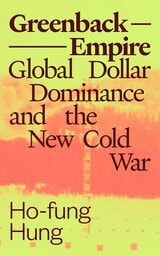
Greenback Empire
Global Dollar Dominance and the New Cold WarHo-fung Hung
University of Chicago Press, 2026
A critical history of the US dollar’s dominance in the world economy—and what has kept China’s currency from overtaking it.
The dollar is the primary currency of the world economy. With China now rivaling the United States on the world stage, a critical question hangs in the balance: will the Chinese renminbi challenge the status of the dollar and, in doing so, deprive America of its “exorbitant privilege”?
In GreenbackEmpire, Ho-fung Hung offers a powerful account of why, even as American shares of global production, ownership, and trade continue to decline, its currency has retained the support of governments and investors around the world. For six decades, Hung shows, the dominance of the dollar has rested on the security umbrella that the US offers to the world’s wealthiest countries—including oil producers. To these countries, support for the value of the dollar is tantamount to maintaining US protection. While China has become a serious geopolitical and economic rival to the US, the Chinese state’s airtight control of its financial system has delayed the free trading of the renminbi, limiting the currency’s internationalization. In short, the same strategy that engineered growth in China’s economy is restraining its currency's rise in opposition to the dollar. Hung’s Greenback Empire is an essential history of the dollar’s prowess, indispensable for understanding the future of the global monetary system.
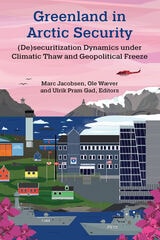
Greenland in Arctic Security
(De)securitization Dynamics under Climatic Thaw and Geopolitical FreezeMarc Jacobsen, Ole Wæver, and Ulrik Pram Gad, Editors
University of Michigan Press, 2024
By combining these different analyses, Greenland in Arctic Security provides new, theoretically informed discussions on how security politics can manifest across different scales and territorial borders. At times, these politics can have consequences beyond their original intent. With Greenland geopolitics and securitization theory of current interest to political and academic debates, this book offers timely insights for readers.