Results by title
267 books match the query 'Frontier and pioneer life' and 4 start with g
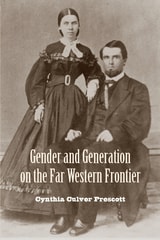
Gender and Generation on the Far Western Frontier
Cynthia Culver Prescott
University of Arizona Press, 2007
In Gender and Generation on the Far Western Frontier, Cynthia Culver Prescott expertly explores the shifting gender roles and ideologies that countless Anglo-American settlers struggled with in Oregon’s Willamette Valley between 1845 and 1900. Drawing on traditional social history sources as well as divorce records, married women’s property records, period photographs, and material culture, Prescott reveals that Oregon settlers pursued a moving target of middle-class identity in the second half of the nineteenth century.
Prescott traces long-term ideological changes, arguing that favorable farming conditions enabled Oregon families to progress from accepting flexible frontier roles to participating in a national consumer culture in only one generation. As settlers’ children came of age, participation in this new culture of consumption and refined leisure became the marker of the middle class. Middle-class culture shifted from the first generation’s emphasis on genteel behavior to a newer genteel consumption.
This absorbing volume reveals the shifting boundaries of traditional women’s spheres, the complicated relationships between fathers and sons, and the second generation’s struggle to balance their parents’ ideology with a changing national sense of class consciousness.
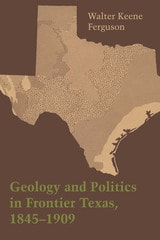
Geology and Politics in Frontier Texas, 1845–1909
By Walter Keene Ferguson
University of Texas Press, 1969
Conservation and development of natural resources are issues of critical importance throughout the world. These issues have been matters of public concern in Texas since legislators first adopted the state-sponsored geological survey as a means of extending government funds to private citizens who would help develop and advertise the mineral and agricultural wealth of Texas.
Walter Keene Ferguson examines the relation of politics to geological exploration during a critical period in Texas history—the first half-century of statehood. Although Texas shared its frontier experience with many other areas, it could not rely on federal aid in the form of land grants because the state government controlled the destiny of the public domain at all times. Acrimonious debate between farmers and urbanites of East Texas and pioneer ranchers of arid West Texas rendered the disposition of public lands even more difficult.
As tools for developing and advertising resources, the geological and agricultural surveys of 1858 and 1867 fulfilled the demands of expectant capitalism made by politicians, speculators, and railroad entrepreneurs. Reconnaissance geologists publicized the wealth of Texas.
Drought in 1886 and popular agitation against squandering of state land caused the emergence of a new concept of the geological survey as an instrument of land reform and public assistance. Lobbying by reformers and scientific organizations led to the formation of the Dumble Survey in 1888 and the University of Texas Mineral Survey in 1901. Stratigraphic analysis of the “individualities” of Texas geology helped the state realize its full economic potential and led to legislation to protect public mineral land from exploitation.
The youthful oil industry finally removed geological exploration from the political arena. As part of the University, a permanent Bureau of Economic Geology was established in 1909 to extend the benefits of scientific research to private citizens and state organizations on a nonpartisan basis.
Ferguson’s analysis of geological surveys in Texas contributes to an understanding not only of the geology and history of the state but of the urgent problem of evaluating the natural resources of underdeveloped regions.

Graham Barnett
A Dangerous ManJames L. Coffey
University of North Texas Press, 2017
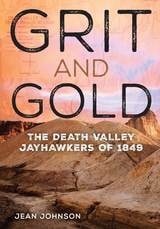
Grit and Gold
The Death Valley Jayhawkers of 1849Jean Johnson
University of Nevada Press, 2018
After leaving Salt Lake City to break a road south to the Pacific Coast that would eliminate crossing the snowy Sierra Nevada, the party veered off the Old Spanish Trail in southern Utah to follow a mountaineer’s map portraying a bogus trail that claimed to cut months and hundreds of miles off their route to the gold country. With winter coming, however, they found themselves hopelessly lost in the mountains and dry valleys of southern Nevada and California. Abandoning everything but the shirts on their backs and the few oxen that became their pitiful meals, they turned their dreams of gold to hopes of survival.
Utilizing William Lorton’s 1849 diary of the trek from Illinois to southern Utah, the reminiscences of the Jayhawkers themselves, the keen memory of famed pioneer William Lewis Manly, and the almost daily diary of Sheldon Young, Johnson paints a lively but accurate portrait of guts, grit, and determination.