Results by title
167 books match the query 'Gardening' and 17 start with g
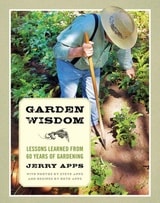
Garden Wisdom
Lessons Learned from 60 Years of GardeningJerry Apps
Wisconsin Historical Society Press, 2012
Step into the garden with writer and rural historian Jerry Apps. In this treasure trove of tips, recollections, and recipes, Jerry combines his hard-earned advice for garden success with a discussion of how tending a garden leads to a deeper understanding of nature and the land. From planning and planting to fending off critters and weeds, he walks us through the gardening year, imbuing his story with humor and passion and once again reminding us that working even a small piece of land provides many rewards.

Gardening for Love
The Market BulletinsElizabeth A. Lawrence
Duke University Press, 1987
It was Eudora Welty who awakened Elizabeth Lawrence's interest in this fascinating topic by putting her name on the mailing list of The Mississippi Market Bulletin, a twice-monthly collection of classified advertisements founded in 1928 and still published today. Lawrence soon discovered market bulletins from the Carolinas and other Southern states, as well as similar bulletins published privately in the North. She began ordering plants from the bulletins, and there ensued a lively exchange of letters wit the women who sold them.
Gardening for Love is Lawrence's exploration of this little-known side of American horticulture and her affectionate tribute to country people who shared her passion for plants. Drawing on the letters she received, sometimes a great many of them from the same persons over many years, she delves into traditional plant lore, herbal remedies, odd and often highly poetic vernacular plant names peculiar to particular regions of the South, and the herb collectors of the mountains of the Carolinas and Georgia. She focuses primarily on the Southeast and the Deep South, but her wide knowledge of both literature and botany gives Gardening for Love a dimension that transcends the category of regional writing.
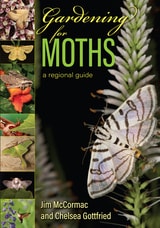
Gardening for Moths
A Regional GuideJim McCormac
Ohio University Press, 2023
This guide to moths, native plants, and their environmental roles is an indispensable resource for gardeners, conservationists, and nature enthusiasts across the midwestern United States.
Gardening for Moths is the first book to show midwestern gardeners and naturalists why they should attract specific moth species to their properties and how to do it. The book’s stunning color photographs and intriguing facts reveal the fascinating world of these insects, inspiring readers to incorporate moth-loving native plants into their landscapes. The authors emphasize the importance of moths and their caterpillars to ecological food webs, widening the book’s appeal to birders and bat lovers as well.
The book consists of three main sections, beginning with a thorough overview of moths, including their
- population decline and conservation,
- importance in ecosystems,
- relationship with native plants, and
- predators and defenses
In the next section the authors profile about 140 plant species, providing brief background, natural history, habitat, and growing notes for each along with lists of potential moths the plants may attract.
The third section highlights approximately 150 moth species, ordered taxonomically. These accounts include interesting facts about the life history of both the caterpillar and adult moth of each species. Each account also features a list of the species’ common host plants.
Throughout the volume, inset text boxes provide additional fascinating moth facts. Beautiful photographs (most by the authors) illustrate every included plant and moth species. Select references, online resources, and quick reference tables round out this valuable resource.
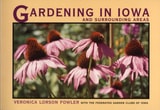
Gardening in Iowa and Surrounding Areas
Veronica Lorson Fowler
University of Iowa Press, 1997
On the East Coast, so the story goes, newcomers are asked where they come from; on the West Coast they are asked what they do for a living; in Iowa people ask them, “How's your garden doing?” Maybe this is not a true story, but it does epitomize the importance of gardening for Iowans, blessed as they are with the rich glacial soil so hospitable to corn and soybeans. Rural and urban Iowans alike start planning next summer's garden in midwinter, when their plots are still snow-covered and deep-frozen; by state fair time their trees, shrubs, vegetables—including the ubiquitous zucchini—and flowers are thriving. Veronica Fowler's month-by-month guide to gardening in Iowa is a concise, valuable resource for all novice and experienced gardeners.
Beginning in January, Fowler presents a monthly checklist to allow gardeners to prioritize seasonal tasks. Her winter chapters focus on garden design, cold-weather gardening, and starting plants from seeds; in spring she moves into soil preparation, shopping for plants, wildflower and rose cultivation, and lawn care basics; summer brings landscaping, flowers for cutting, and organic gardening; and fall involves cold frames, winter-harvest vegetables, forcing bulbs and perennials, trees and shrubs, and ground covers and vines best suited for Iowa's climate as well as information on mail-order suppliers, gardens to visit, where to go for help, and garden club memberships. Tips from some of the more than two thousand members of the Federated Garden Clubs of Iowa round out this plentiful harvest of useful advice.
On a day in February when the wind chill is, well, chilling and the forecast calls for more of the same, the arrival of the first garden catalog of the season brings warmth to any gardener. Veronica Fowler's accessible, information-packed book will become part of every gardener's life both indoors and out.
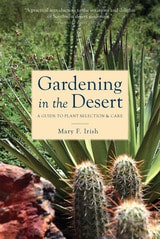
Gardening in the Desert
A Guide to Plant Selection and CareMary Irish
University of Arizona Press, 2000
Newcomers to the Southwest usually find that their favorite landscape plants aren't suited to the hot, dry climate. Many authors offer advice on adapting plants to the desert; now Mary Irish tells how gardeners can better adapt themselves to the challenge.
Drawing on her experience with public horticulture in the Phoenix metropolitan area, Irish explores the vexations and delights of desert gardening. She offers practical advice on plants and gardening practices for anyone who lives in the Southwest, from El Paso to Palm Springs, Tucson to Las Vegas.
Irish encourages readers who may be new to the desert—or desert dwellers who may be new to gardening—to stop struggling against heat, aridity, and poor soils and instead learn to use and appreciate the wonderful and well-adapted plants native to the desert. She shares information and anecdotes about trees, shrubs, perennials, agaves, cacti, and other plants that make gardening in the Southwest a unique experience, and provides further information about plants from other desert regions that will easily adapt to the Southwest. In addition to descriptions of plants, Irish also offers tips on planting, watering, pruning, and propagation.
For anyone who has struggled to maintain a patch of green or blanched at their water bill after unproductive irrigation, the answer to an attractive landscape may be as close as the desert around you. And for anyone who has bought a catalog guide to desert plants and not known which to choose, this book can set you on the right path. Mary Irish shows how to take heart in available plants of adaptable beauty in a book to enjoy while waiting for the next planting cycle.
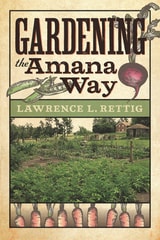
Gardening the Amana Way
Lawrence L. Rettig
University of Iowa Press, 2013
Each of the seven villages in Amana relied on the food prepared in its communal kitchens, and each kitchen depended on its communal garden for most of the dishes served (the kitchens in Rettig’s hometown produced more than four hundred gallons of sauerkraut in 1900). Rettig begins by describing the evolution of communal gardening in old Amana, focusing especially on planting, harvesting, and storing vegetables from asparagus to egg lettuce to turnips. With the passing of the old order in 1932, the number of the society’s large vegetable gardens and orchards dwindled, but Larry Rettig and his wife, Wilma, still grow some of the colonies’ heirloom varieties in their fourth-generation South Amana vegetable garden. In 1980 they founded a seed bank to preserve them for future generations.
Rettig’s chapters on modern vegetable and flower gardening in today’s Amana Colonies showcase his Cottage-in-the-Meadow Gardens, now listed with the Smithsonian in its Archives of American Gardens. Old intermingles with new across his gardens: heirloom lettuce keeps company with the latest cucumber variety, a hundred-year-old rose arches over the newest daylilies and heucheras, and ancient grapevines intertwine with newly planted wisteria, all adding up to a rich array of colorful plantings.
Rettig extends his gardening advice into the kitchen and workroom. He shares family recipes for any number of traditional dishes, including radish salad, dumpling soup, Amana pickled ham, apple bread, eleven-minute meat loaf, and strawberry rhubarb pie. Moving into the workroom, he shows us how to make hammered botanical prints, Della Robbia centerpieces, holiday wreaths, a gnome home, and a waterless fountain. Touring his gardens, with their historic and unusual plants, will make gardeners everywhere want to reproduce the groupings and varieties that surround Larry and Wilma Rettig’s 1900 red brick house.
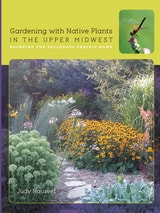
Gardening with Native Plants in the Upper Midwest
Bringing the Tallgrass Prairie HomeJudy Nauseef
University of Iowa Press, 2016
Nauseef emphasizes the need for careful planning and design to create comfortable, low-maintenance spaces that bring homeowners outside. Her designs solve problems such as a lack of privacy, shade, or sun; plan for water use; replace troublesome nonnative plants with native plants that attract pollinators; and enable homeowners to enjoy living sustainably on their land. Colorful photographs of projects around the Midwest show the wide range of possibilities, from newly created gardens using only native plants to traditional gardens that mix nonnative with native species. Whether you have a city yard, a suburban lot, or a rural acreage, there are ideas here for you, along with examples of well-designed landscapes in which native plants enhance paths, patios, pergolas, and steps.
Providing information on planting and maintaining native plants and prairies as well as seed and plant sources, organizations, and public arboretum and prairie sites, this book enables every gardener to master a new palette of plants and landforms. However small our personal landscapes, together they can slow the loss of many species of plants and wildlife and bring native flowers and grasses back where they belong. Ecologists, landscape architects and designers, master gardeners, landscape contractors, teachers, and home gardeners—everyone dedicated to conserving and improving our environment—will benefit from Nauseef’s approach.
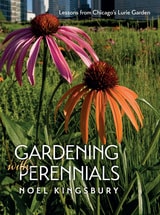
Gardening with Perennials
Lessons from Chicago's Lurie GardenNoel Kingsbury
University of Chicago Press, 2014
With Gardening with Perennials horticulturalist and garden writer Noel Kingsbury brings a global perspective to the Lurie oasis through a wonderful introduction to the world of perennial gardening. He shows how perennials have much to offer home gardeners, from sustainability—perennials require less water than their annual counterparts—to continuity, as perennials’ longevity makes them a dependable staple.
Kingsbury also explains why Lurie is a perfect case study for gardeners of all locales. The plants represented in this urban oasis were chosen specifically for reliability and longevity. The majority will thrive on a wide range of soils and across a wide climatic range. These plants also can thrive with minimal irrigation, and without fertilizers or chemical control of pests and diseases. Including a special emphasis on plants that flourish in sun, and featuring many species native to the Midwest region, Gardening with Perennials will inspire gardeners around the world to try Chicago-style sustainable gardening.

Gardens
An Essay on the Human ConditionRobert Pogue Harrison
University of Chicago Press, 2008
Humans have long turned to gardens—both real and imaginary—for sanctuary from the frenzy and tumult that surrounds them. Those gardens may be as far away from everyday reality as Gilgamesh’s garden of the gods or as near as our own backyard, but in their very conception and the marks they bear of human care and cultivation, gardens stand as restorative, nourishing, necessary havens.
With Gardens, Robert Pogue Harrison graces readers with a thoughtful, wide-ranging examination of the many ways gardens evoke the human condition. Moving from from the gardens of ancient philosophers to the gardens of homeless people in contemporary New York, he shows how, again and again, the garden has served as a check against the destruction and losses of history. The ancients, explains Harrison, viewed gardens as both a model and a location for the laborious self-cultivation and self-improvement that are essential to serenity and enlightenment, an association that has continued throughout the ages. The Bible and Qur’an; Plato’s Academy and Epicurus’s Garden School; Zen rock and Islamic carpet gardens; Boccaccio, Rihaku, Capek, Cao Xueqin, Italo Calvino, Ariosto, Michel Tournier, and Hannah Arendt—all come into play as this work explores the ways in which the concept and reality of the garden has informed human thinking about mortality, order, and power.
Alive with the echoes and arguments of Western thought, Gardens is a fitting continuation of the intellectual journeys of Harrison’s earlier classics, Forests and The Dominion of the Dead. Voltaire famously urged us to cultivate our gardens; with this compelling volume, Robert Pogue Harrison reminds us of the nature of that responsibility—and its enduring importance to humanity.
"I find myself completely besotted by a new book titled Gardens: An Essay on the Human Condition, by Robert Pogue Harrison. The author . . . is one of the very best cultural critics at work today. He is a man of deep learning, immense generosity of spirit, passionate curiosity and manifold rhetorical gifts."—Julia Keller, Chicago Tribune
"This book is about gardens as a metaphor for the human condition. . . . Harrison draws freely and with brilliance from 5,000 years of Western literature and criticism, including works on philosophy and garden history. . . . He is a careful as well as an inspiring scholar."—Tom Turner, Times Higher Education
"When I was a student, my Cambridge supervisor said, in the Olympian tone characteristic of his kind, that the only living literary critics for whom he would sell his shirt were William Empson and G. Wilson Knight. Having spent the subsequent 30 years in the febrile world of academic Lit. Crit. . . . I’m not sure that I’d sell my shirt for any living critic. But if there had to be one, it would unquestionably be Robert Pogue Harrison, whose study Forests: The Shadow of Civilization, published in 1992, has the true quality of literature, not of criticism—it stays with you, like an amiable ghost, long after you read it.
“Though more modest in scope, this new book is similarly destined to become a classic. It has two principal heroes: the ancient philosopher Epicurus . . . and the wonderfully witty Czech writer Karel Capek, apropos of whom it is remarked that, whereas most people believe gardening to be a subset of life, ‘gardeners, including Capek, understand that life is a subset of gardening.’”—Jonathan Bate, The Spectator

Gardens
An Essay on the Human ConditionRobert Pogue Harrison
University of Chicago Press, 2008
Humans have long turned to gardens—both real and imaginary—for sanctuary from the frenzy and tumult that surrounds them. Those gardens may be as far away from everyday reality as Gilgamesh’s garden of the gods or as near as our own backyard, but in their very conception and the marks they bear of human care and cultivation, gardens stand as restorative, nourishing, necessary havens.
With Gardens, Robert Pogue Harrison graces readers with a thoughtful, wide-ranging examination of the many ways gardens evoke the human condition. Moving from from the gardens of ancient philosophers to the gardens of homeless people in contemporary New York, he shows how, again and again, the garden has served as a check against the destruction and losses of history. The ancients, explains Harrison, viewed gardens as both a model and a location for the laborious self-cultivation and self-improvement that are essential to serenity and enlightenment, an association that has continued throughout the ages. The Bible and Qur’an; Plato’s Academy and Epicurus’s Garden School; Zen rock and Islamic carpet gardens; Boccaccio, Rihaku, Capek, Cao Xueqin, Italo Calvino, Ariosto, Michel Tournier, and Hannah Arendt—all come into play as this work explores the ways in which the concept and reality of the garden has informed human thinking about mortality, order, and power.
Alive with the echoes and arguments of Western thought, Gardens is a fitting continuation of the intellectual journeys of Harrison’s earlier classics, Forests and The Dominion of the Dead. Voltaire famously urged us to cultivate our gardens; with this compelling volume, Robert Pogue Harrison reminds us of the nature of that responsibility—and its enduring importance to humanity.
"I find myself completely besotted by a new book titled Gardens: An Essay on the Human Condition, by Robert Pogue Harrison. The author . . . is one of the very best cultural critics at work today. He is a man of deep learning, immense generosity of spirit, passionate curiosity and manifold rhetorical gifts."—Julia Keller, Chicago Tribune
"This book is about gardens as a metaphor for the human condition. . . . Harrison draws freely and with brilliance from 5,000 years of Western literature and criticism, including works on philosophy and garden history. . . . He is a careful as well as an inspiring scholar."—Tom Turner, Times Higher Education
"When I was a student, my Cambridge supervisor said, in the Olympian tone characteristic of his kind, that the only living literary critics for whom he would sell his shirt were William Empson and G. Wilson Knight. Having spent the subsequent 30 years in the febrile world of academic Lit. Crit. . . . I’m not sure that I’d sell my shirt for any living critic. But if there had to be one, it would unquestionably be Robert Pogue Harrison, whose study Forests: The Shadow of Civilization, published in 1992, has the true quality of literature, not of criticism—it stays with you, like an amiable ghost, long after you read it.
“Though more modest in scope, this new book is similarly destined to become a classic. It has two principal heroes: the ancient philosopher Epicurus . . . and the wonderfully witty Czech writer Karel Capek, apropos of whom it is remarked that, whereas most people believe gardening to be a subset of life, ‘gardeners, including Capek, understand that life is a subset of gardening.’”—Jonathan Bate, The Spectator
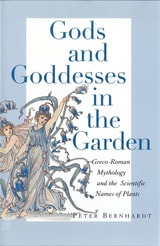
Gods and Goddesses in the Garden
Greco-Roman Mythology and the Scientific Names of PlantsBernhardt, Peter
Rutgers University Press, 2008
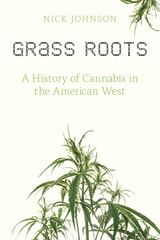
Grass Roots
A History of Cannabis in the American WestNick Johnson
Oregon State University Press, 2017
To understand how we got here and how the legal cannabis industry might become more environmentally sustainable, Grass Roots looks at the history of marijuana growing in the American West, from early Mexican American growers on sugar beet farms to today’s sophisticated greenhouse gardens. Over the past eighty years, federal marijuana prohibition has had a multitude of consequences, but one of the most important is also one of the most overlooked—environmental degradation. Grass Roots argues that the most environmentally negligent farming practices—such as indoor growing—were borne out of prohibition. Now those same practices are continuing under legalization.
Grass Roots uses the history of cannabis as a crop to make sense of its regulation in the present, highlighting current efforts to make the marijuana industry more sustainable. In exploring the agricultural history of cannabis, There are many social and political histories of cannabis, but in considering cannabis as a plant rather than as a drug, Grass Roots offers the only agriculturally focused history to date.
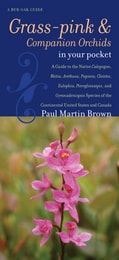
Grass-pinks and Companion Orchids in Your Pocket
A Guide to the Native Calopogon, Bletia, Arethusa, Pogonia, Cleistes, Eulophia, Pteroglossaspis, andPaul Martin Brown
University of Iowa Press, 2008
Brown provides general distributional information, time of flowering, and habitat requirements for each species as well as a complete list of hybrids and the many different growth and color forms that can make identifying orchids so intriguing. For the grass-pinks and companions he includes information on 16 species, 2 additional varieties, and 7 hybrids.
Grass-pinks, with their showy pink to white flowers, are some of the most conspicuous wild orchids encountered in the prairies, bogs, and open wetlands of eastern North America. Most of these species are easy to identify based upon their general appearance, range, and time of flowering. Answering three simple questions—when, where, and how does it grow?—and comparing the living plant with the striking photos in the backpack-friendly laminated guide should enable both professional and amateur naturalists to achieve the satisfaction of identifying a specific orchid.
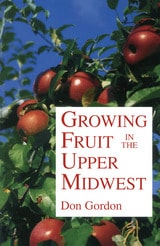
Growing Fruit in the Upper Midwest
Donald Gordon
University of Minnesota Press, 1997
The standard guide to fruit-growing success.
Despite the harsh climate that prevails in the Upper Midwest, even amateur gardeners can successfully grow fruit when armed with some basic information. Focusing on Minnesota, Wisconsin, Iowa, South Dakota, and North Dakota, Growing Fruit in the Upper Midwest is a practical how-to guide to the cultivation of a wide variety of fruit including apples, pears, plums, apricots, strawberries, blueberries, cherries, grapes, currants, gooseberries, and brambles.
To assist readers ranging from home gardeners to small commercial growers, Don Gordon covers site selection, soil types, pruning, fertilization, harvesting, pests, and preventing winter injury as well as describing literally hundreds of excellent species for this region. Many technical aspects of pruning and planting are accompanied with illustrations. Growing Fruit in the Upper Midwest includes maps that indicate the fruit hardiness zones for each state, augmented by an easy-to-use guide to cultivar selection. The introduction is a basic botany lesson, covering plant classifications, growth and development. The section on apple growing, by far the most widely adapted fruit species in this region, will help growers decide which types of trees will thrive on their land. Gordon also provides an overview of interesting and overlooked historic and economic aspects of fruit production across the Upper Midwest. This practical guide is essential reading for home gardeners, small commercial growers, and anyone who has considered this rewarding and fascinating hobby. “The concise information about plant care will assist even the most inexperienced gardener. This book is an excellent reference tool, and I would recommend it highly to anyone growing fruit in Minnesota, Wisconsin, Iowa, North Dakota or South Dakota.” Rochester Post Bulletin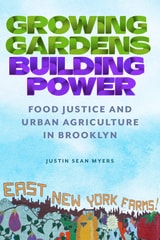
Growing Gardens, Building Power
Food Justice and Urban Agriculture in BrooklynJustin Sean Myers
Rutgers University Press, 2023

Guide To The Trees Of Utah
Michael Kuhns
Utah State University Press, 1998
For any tree enthusiast, be it homeowner, landscaper, recreationist, traveler, or student, who has needed a comprehensive, user-friendly guide to the trees of Utah and the Intermountain West, this new guide is the answer.
Tree specialist Michael Kuhns, through extensive research, has compiled a comprehensive list of virtually every native and introduced tree species from the eastern slope of the Rockies westward to the Sierra Nevada, and from north-central Oregon, the Salmon River region, and Yellowstone southward to the Grand Canyon and northern New Mexico. Included in the guide are simple and easy-to-use identification and classification keys, which are accompanied by hundreds of illustrations that introduce basic information on tree anatomy, climate/hardiness zones, and the individual species.
Accessible and informative, this book is a welcome addition to the library of any reader wanting basic information on the vast inventory of trees in this region.

Guy Wolff
Master Potter in the GardenSuzanne Staubach
University Press of New England, 2013