Results by title
93 books match the query 'Gay people' and 5 start with g
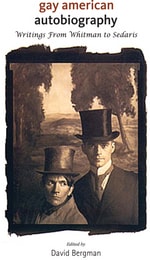
Gay American Autobiography
Writings from Whitman to SedarisDavid Bergman
University of Wisconsin Press, 2009
In the first anthology to survey the full range of gay men’s autobiographical writing from Walt Whitman to the present, Gay American Autobiography draws excerpts from letters, journals, oral histories, memoirs, and autobiographies to provide examples of the best life writing over the last century and a half.
Volume editor David Bergman guides the reader chronologically through selected writings that give voice to every generation of gay writers since the nineteenth century, including a diverse array of American men of African, European, Jewish, Asian, and Latino heritage. Documenting a range of life experiences that encompass tattoo artists and academics, composers and drag queens, hustlers and clerks, it contains accounts of turn-of-the-century transvestites, gay rights activists, men battling AIDS, and soldiers attempting to come out in the army. Each selection provides important insight on the wide spectrum of ways gay men have defined and lived their lives, highlighting how self-awareness changes an author’s experience.
The volume includes an introduction by Bergman and headnotes for each of the nearly forty entries. Bringing many out-of-print and hard-to-find works to new readers, this challenging and comprehensive anthology chronicles American gay history and life struggles over the course of the past 150 years.
Finalist, Lambda Book Award for LGBT Anthology, Lambda Literary Foundation
[more]

Gay Lives
Homosexual Autobiography from John Addington Symonds to Paul MonettePaul Robinson
University of Chicago Press, 1999
In his autobiography, John Addington Symonds relates a glorious night of passion, in which he and his lover "lay covered from the cold in bed, tasting the honey of softly spoken words and the blossoms of lips pressed on lips." Christopher Isherwood's first autobiography, on the other hand, was far less direct; he wrote a second autobiography in part because the first was "not truly autobiographical" in that "the author conceals important facts about himself." These contradictions, evasions, and explicit sexual details of the life stories of fourteen men form Gay Lives, a revealing account of homosexual autobiography.
Paul Robinson reads the memoirs of French, British, and American gay authors—André Gide, Quentin Crisp, and Martin Duberman, among others—through the prism of sexual identity, asking fascinating questions about homosexuality and its relation to literary form. How did these authors discover their sexual identity? Did they embrace it or reject it? How did they express often conflicted desires in their words, which ranged from defiant and brutally frank to ambiguous and abstract? Robinson considers the choices each made—as a man and an author—to accommodate himself to society's homophobia or live in protest against his oppression.
Despite the threads that connect these stories, Gay Lives refutes the notion that there is a typical homosexual "career" by showing that gay men have led wildly dissimilar lives—from the exuberant to the miserable—and that they have found no less dissimilar meanings in those lives.
[more]

Gay Shame
Edited by David M. Halperin and Valerie Traub
University of Chicago Press, 2009
Ever since the 1969 Stonewall Riots, “gay pride” has been the rallying cry of the gay rights movement and the political force behind the emergence of the field of lesbian and gay studies. But has something been lost, forgotten, or buried beneath the drive to transform homosexuality from a perversion to a proud social identity? Have the political requirements of gay pride repressed discussion of the more uncomfortable or undignified aspects of homosexuality?
Gay Shame seeks to lift this unofficial ban on the investigation of homosexuality and shame by presenting critical work from the most vibrant frontier in contemporary queer studies. An esteemed list of contributors tackles a range of issues—questions of emotion, disreputable sexual histories, dissident gender identities, and embarrassing figures and moments in gay history—as they explore the possibility of reclaiming shame as a new, even productive, way to examine lesbian and gay culture.
Accompanied by a DVD collection of films, performances, and archival imagery, Gay Shame constitutes nothing less than a major redefinition and revitalization of the field.
[more]

Gender Violence at the U.S.–Mexico Border
Media Representation and Public ResponseEdited by Héctor Domínguez-Ruvalcaba and Ignacio Corona
University of Arizona Press, 2012
The U.S.-Mexico border is frequently presented by contemporary media as a violent and dangerous place. But that is not a new perception. For decades the border has been constructed as a topographic metaphor for all forms of illegality, in which an ineffable link between space and violence is somehow assumed. The sociological and cultural implications of violence have recently emerged at the forefront of academic discussions about the border. And yet few studies have been devoted to one of its most disturbing manifestations: gender violence. This book analyzes this pervasive phenomenon, including the femicides in Ciudad Juárez that have come to exemplify, at least for the media, its most extreme manifestation.
Contributors to this volume propose that the study of gender-motivated violence requires interpretive and analytical strategies that draw on methods reaching across the divide between the social sciences and the humanities. Through such an interdisciplinary conversation, the book examines how such violence is (re)presented in oral narratives, newspaper reports, films and documentaries, novels, TV series, and legal discourse. It also examines the role that the media have played in this process, as well as the legal initiatives that might address this pressing social problem.
Together these essays offer a new perspective on the implications of, and connections between, gendered forms of violence and topics such as mechanisms of social violence, the micro-social effects of economic models, the asymmetries of power in local, national, and transnational configurations, and the particular rhetoric, aesthetics, and ethics of discourses that represent violence.
[more]

Genealogy Of Queer Theory
William Turner
Temple University Press, 2000
Who are queers and what do they want? Could it be that we are all queers? Beginning with such questions, William B. Turner's lucid and engaging book traces the roots of queer theory to the growing awareness that few of us precisely fit standard categories for sexual and gender identity.
Turner shows how Michal Foucault's work contributed to feminists' investigations into the ways that power relates to identity. In the last decades of the twentieth century, feminists were the first to challenge the assumption that a claim to universal identity -- the white male citizen -- should serve as the foundation of political thought and action. Difference matters. Race, ethnicity, class, gender, and sexuality interact, producing a wide array of identities that resist rigid definition and are mutable. By understanding the notion of transhistorical categories -- woman, man, homosexual, and so forth -- feminist and gay male scholars launched queer theoretical work as a new way to think about the politics of gender and sexuality.
A Geneology of Queer Theory probes the fierce debates among scholars and activists, weighing the charges that queer readings of texts and identity politics do not constitute and might inhibit radical social change. Written by a historian, it considers the implications of queer theory for historical inquiry and the distinction between philosophy and history. As such, the book will interest readers of gay/lesbian/bisexual/transgender studies, intellectual history, political theory, and the history of gender/sexuality.
[more]