Results by title
129 books match the query 'God' and 26 start with g
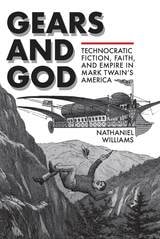
Gears and God
Technocratic Fiction, Faith, and Empire in Mark Twain's AmericaNathaniel Williams
University of Alabama Press, 2018
In Gears and God: Technocratic Fiction, Faith, and Empire in Mark Twain’s America, Nathaniel Williams analyzes the genre of technology-themed exploration novels—dime novel adventure stories featuring steam-powered and electrified robots, airships, and submersibles. This genre proliferated during the same cultural moment when evolutionary science was dismantling Americans’ prevailing, biblically based understanding of human history.
While their heyday occurred in the late 1800s, technocratic adventure novels like Twain’s A Connecticut Yankee in King Arthur’s Court inspired later fiction about science and technology. Similar to the science fiction plotlines of writers like Jules Verne and H. Rider Haggard, and anticipating the adventures of Tom Swift some decades later, these novels feature Americans using technology to visit and seize control of remote locales, a trait that has led many scholars to view them primarily as protoimperialist narratives. Their legacy, however, is more complicated. As they grew in popularity, such works became as concerned with the preservation of a fraught Anglo-Protestant American identity as they were with spreading that identity across the globe.
Many of these novels frequently assert the Bible’s authority as a historical source. Collectively, such stories popularized the notion that technology and travel might essentially “prove” the Bible’s veracity—a message that continues to be deployed in contemporary debates over intelligent design, the teaching of evolution in public schools, and in reality TV shows that seek historical evidence for biblical events. Williams argues that these fictions performed significant cultural work, and he consolidates evidence from the novels themselves, as well as news articles, sermons, and other sources of the era, outlining and mapping the development of technocratic fiction.
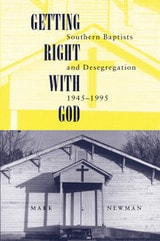
Getting Right With God
Southern Baptists and Desegregation, 1945-1995Mark Newman
University of Alabama Press, 2001
This groundbreaking study finds Southern Baptists more diverse in their attitudes toward segregation than previously assumed
Focusing on the eleven states of the old Confederacy, Getting Right with God examines the evolution of Southern Baptists’ attitudes toward African Americans during a tumultuous period of change in the United States. Mark Newman not only offers an in-depth analysis of Baptist institutions from the Southern Baptist Convention (SBC) and state conventions to colleges and churches but also probes beyond these by examining the response of pastors and lay people to changing race relations.The SBC long held that legal segregation was in line with biblical teachings, but after the Supreme Court's 1954 Brown vs. Board of Education decision in favor of desegregating public institutions, some Southern Baptists found an inconsistency in their basic beliefs. Newman identifies three major blocs of Baptist opinion about race relations: a hard-line segregationist minority that believed God had ordained slavery in the Bible; a more moderate majority that accepted the prevailing social order of racial segregation; and a progressive group of lay people, pastors, and denominational leaders who criticized and ultimately rejected discrimination as contrary to biblical teachings.
According to Newman, the efforts of the progressives to appeal to Baptists’ primary commitments and the demise of de jure segregation caused many moderate and then hard-line segregationists to gradually relinquish their views, leading to the 1995 apology by the SBC for its complicity in slavery and racism. Comparing Southern Baptists with other major white denominations, Newman concludes that lay Baptists differed little from other white southerners in their response to segregation.
God Being Nothing
Toward a TheogonyRay L. Hart
University of Chicago Press, 2016
Drawing on a lifetime of reading in philosophy and religious thought, Hart unfolds a vision of God perpetually in process: an unfinished God being self-created from nothingness. Breaking away from the traditional focus on divine persons, Hart reimagines the Trinity in terms of theogony, cosmogony, and anthropogony in order to reveal an ever-emerging Godhead who encompasses all of temporal creation and, within it, human existence. The book’s ultimate implication is that Being and Nonbeing mutually participate in an ongoing process of divine coming-to-birth and dying that implicates all things, existent and nonexistent, temporal and eternal. God’s continual generation from nothing manifests the full actualization of freedom: the freedom to create ex nihilo.

God In The Street
New York Writing from The Penny Press to MelvilleHans Bergmann
Temple University Press, 1995
In the fast changing culture of antebellum New York, writers of every stripe celebrated "the City" as a stage for the daily urban encounter between the familiar and the inexplicable. Probing into these richly varied texts, Hans Bergmann uncovers the innovations in writing that accompanied the new market society— the penny newspapers' grandiose boastings, the poetic catalogues of Walt Whitman, the sentimental realism of charity workers, the sensationalism of slum visitors, and the complex urban encounters of Herman Melville's fiction.
The period in which New York, the city itself, became firmly established as a subject invented a literary form that attempts to capture the variety of the teeming city and the flaneur, the walking observer. But Bergmann does not simply lead a parade of images and themes; he explores the ways in which these observers understood what was happening around them and to them, always attentive to class struggle and race and gender issues.
God in the Street shows how the penny press and Whitman's New York poetry create a new mass culture hero who interprets and dignifies the city's confusions. New York writers, both serious and sensationalist, meditate upon street encounters with tricksters and confidence-men and explore the meanings of encounters. Melville's "Bartleby, the Scrinever" underlines the unrelenting isolation and inability to control the interpreter. Bergmann reinterprets Melville's The Confidence Man as an example of how a complex literary form arises directly from its own historical materials and is itself socially symbolic. Bergmann sees Melville as special because he recognizes his inability to make sense of the surface of chaotic images and encounters. In mid-century New York City, Melville believes God is in the street, unavailable and unrecognizable, rather than omnipresent and guiding.
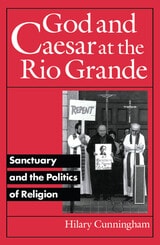
God and Caesar at the Rio Grande
Sanctuary and the Politics of ReligionHilary Cunningham
University of Minnesota Press, 1995
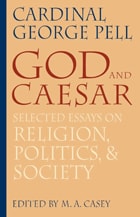
God and Caesar
Selected Essays on Religion, Politics, & SocietyGeorge Pell
Catholic University of America Press, 2007
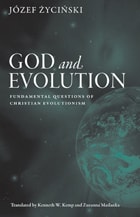
God and Evolution
Fundamental Questions of Christian EvolutionismJozef Zycinski
Catholic University of America Press, 2006
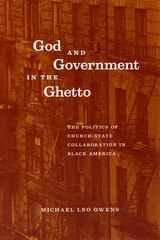
God and Government in the Ghetto
The Politics of Church-State Collaboration in Black AmericaMichael Leo Owens
University of Chicago Press, 2007
But as Michael Leo Owens demonstrates in God and Government in the Ghetto, this alliance also serves as a means for black clergy to reaffirm their political leadership and reposition moral authority in black civil society. Drawing on both survey data and fieldwork in New York City, Owens reveals that African American churches can use these newly forged connections with public agencies to influence policy and government responsiveness in a way that reaches beyond traditional electoral or protest politics. The churches and neighborhoods, Owens argues, can see a real benefit from that influence—but it may come at the expense of less involvement at the grassroots.
Anyone with a stake in the changing strategies employed by churches as they fight for social justice will find God and Government in the Ghetto compelling reading.
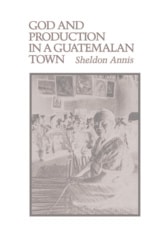
God and Production in a Guatemalan Town
By Sheldon Annis
University of Texas Press, 1988
Since the late 1970s, Protestantism has emerged as a major force in the political and economic life of rural Guatemala. Indeed, as Sheldon Annis argues in this book, Protestantism may have helped tip Guatemala's guerrilla war in behalf of the army during the early 1980s.
But what is it about Protestantism—and about Indians— that has led to massive religious conversion throughout the highlands? And in villages today, what are the dynamics that underlie the competition between Protestants and Catholics?
Sheldon Annis addresses these questions from the perspective of San Antonio Aguas Calieutes, an Indian village in the highlands of midwestern Guatemala. Annis skillfully blends economic and cultural analysis to show why Protestantism has taken root. The key "character" in his drama is the village Indian's tiny plot of corn and beans, the milpa, which Annis analyzes as an "idea" as well as an agronomic productive system. By exploring "milpa logic," Annis shows how the economic, environmental, and social shifts of the twentieth century have acted to undercut "the colonial creation of Indianness" and, in doing so, have laid the basis for new cultural identities.
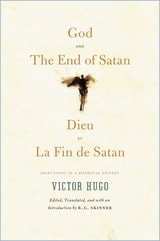
God and The End of Satan / Dieu and La Fin de Satan
Selections: In a Bilingual EditionVictor Hugo
Swan Isle Press, 2014
This book brings together abbreviated editions of these two book-length poems—unfinished and unpublished at the time of the author’s death—comprised of selections that capture their visionary and mystical essence. The poems are accompanied by an introduction framing them within the author’s experience as an exile and tracing their publication history.
Victor Hugo is one of the most important figures in the history of French literature, and this beautifully rendered translation brings two of his lesser-known works deservedly to the forefront.
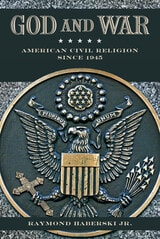
God and War
American Civil Religion since 1945Haberski, Jr., Raymond
Rutgers University Press, 2012
Americans have long considered their country to be good—a nation "under God" with a profound role to play in the world. Yet nothing tests that proposition like war. Raymond Haberski argues that since 1945 the common moral assumptions expressed in an American civil religion have become increasingly defined by the nation's experience with war.
God and War traces how three great postwar “trials”—the Cold War, the Vietnam War, and the War on Terror—have revealed the promise and perils of an American civil religion. Throughout the Cold War, Americans combined faith in God and faith in the nation to struggle against not only communism but their own internal demons. The Vietnam War tested whether America remained a nation "under God," inspiring, somewhat ironically, an awakening among a group of religious, intellectual and political leaders to save the nation's soul. With the tenth anniversary of 9/11 behind us and the subsequent wars in Iraq and Afghanistan winding down, Americans might now explore whether civil religion can exist apart from the power of war to affirm the value of the nation to its people and the world.
God and the City
D. C. Schindler
St. Augustine's Press, 2023
political theory or other, nor on the legitimacy of political action or the distinctiveness of particular regimes, but on the nature of political order as such, and how this order implicates the
fundamental questions of existence, those concerning man, being, and God.
Aristotle, and Aquinas after him, identified metaphysics and politics as “architectonic” sciences, since each concerns in some respect the whole of reality, of which the particular
sciences study a part. Chapter one of this book argues that, just as metaphysics, in studying being as a whole, cannot but address the question of God in some respect, so too does politics, the ordering of human life as a whole, necessarily implicate the existence of God. In this regard, the modern liberal project has deluded itself in attempting to render religion a private, rather than a genuinely political, matter. We cannot organize human existence without making some claim, whether implicitly or explicitly, about the nature of God and God’s relation to the world.
The second chapter approaches this theme from the anthropological dimension. As Plato affirmed, the “city is the soul writ large”: if man is religious by nature, he cannot be properly
understood, and the human good cannot be properly secured and fostered, if the “God question” is “bracketed out” of the properly political order. Moreover, if we fail to recognize the
essentially political dimension of relation to God, we will be unable properly to grasp the presence of God in the (ecclesial and sacramental) Body of Christ: God cannot be real in the
Church as Church unless he is also real in the city as city (and vice versa).
In his De regno, Aquinas famously affirms that “the king is to be in the kingdom what the soul is in the body and what God is in the world.” Chapter three offers a careful study of the
body-soul relationship in order to illuminate, on the one hand, the nature of political authority, and, on the other, the precise way that God is present in human community.
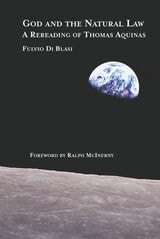
God and the Natural Law
Reading of Thomas AquinasFulvio Di Blasi
St. Augustine's Press, 2006
Blasi begins with an original analysis of the current debate in ethics, jurisprudence, and politics in order to set the stage for a sound understanding of the concept of natural law. This leads to the heart of the book: a recovery of the authentic meaning of the two main concepts of classical natural-law theory as synthesized by Thomas Aquinas – the will of God and the order of nature.
The wide revival of practical philosophy and ethics of objective-values in recent decades has involved a robust rediscovery of classical natural-law theory. This rediscovery is marked by two main traits: an emphasis on the autonomy of practical reason (as a reaction to modern voluntarism centered on the external will of the legislator); and an emphasis on the originality of practical reason (as a reaction to the idea of a rational deduction of
moral truths from the facts of nature). Without denying an autonomous character to ethics, or the need for a strong critique of moral rationalism, Di Blasi argues that Aquinas’s thought remains unintelligible if we remove from it either God or the metaphysical understanding of
nature.
God as Otherwise Than Being
Toward a Semantics of the GiftCalvin O. Schrag
Northwestern University Press, 2002
Schrag draws with grace, ease, and precision upon the history of Western metaphysics, from Plato and Aristotle through Nietzsche and Heidegger. Most important to his central question of God as "otherwise than Being," however, are such influential post-Heideggerian thinkers as Jean-Luc Marion, Jacques Derrida, and Emmanuel Levinas. Schrag's inquiry engages these thinkers at a serious level and also expands recent discussions by relating them to the work of figures hitherto overlooked or underplayed, most notably Paul Tillich.
God in the Machine
Video Games as Spiritual PursuitLiel Leibovitz
Templeton Press, 2014
Yet video games remain relatively unexplored by both scholars and pundits alike. Few have advanced beyond outmoded and futile attempts to tie gameplay to violent behavior. With this rumor now thoroughly and repeatedly disproven, it is time to delve deeper. Just as the Museum of Modern Art in Manhattan recently acquired fourteen games as part of its permanent collection, so too must we seek to add a serious consideration of virtual worlds to the pantheon of philosophical inquiry.
In God in the Machine, author Liel Leibovitz leads a fascinating tour of the emerging virtual landscape and its many dazzling vistas from which we are offered new vantage points on age-old theological and philosophical questions. Free will vs. determinism, the importance of ritual, transcendence through mastery, notions of the self, justice and sin, life, death, and resurrection all come into play in the video games that some critics so quickly write off as mind-numbing wastes of time. When one looks closely at how these games are designed, their inherent logic, and their cognitive effects on players, it becomes clear that playing these games creates a state of awareness vastly different from when we watch television or read a book. Indeed, the gameplay is a far more dynamic process that draws on various faculties of mind and body to evoke sensations that might more commonly be associated with religious experience. Getting swept away in an engaging game can be a profoundly spiritual activity. It is not to think, but rather to be, a logic that sustained our ancestors for millennia as they looked heavenward for answers.
As more and more of us look “screenward,” it is crucial to investigate these games for their vast potential as fine instruments of moral training. Anyone seeking a concise and well-reasoned introduction to the subject would do well to start with God in the Machine. By illuminating both where video game storytelling is now and where it currently butts up against certain inherent limitations, Liebovitz intriguingly implies how the field and, in turn, our experiences might continue to evolve and advance in the coming years.
God of Beer
Garret Keizer
University Press of New England, 2016

God of Many Names
Play, Poetry and Power in Hellenic Thought, From Homer to AristotleMihai I. Spariosu
Duke University Press, 1991
Building upon the scholarship of an earlier volume, Dionysus Reborn, Spariosu her continues to draw on Dionysus—the “God of many names,” of both poetic play and sacred power—as a mythical embodiment of the two sides of the classical Greek mentality. Combining philosophical reflection with close textual analysis, the author examines the divided nature of the Hellenic mentality in such primary canonic texts as the Iliad, the Odyssey, the Theogony, Works and Days, the most well-known of the Presocratic fragments, Euripides’ Bacchae, Aristophanes’ The Frogs, Plato’s Republic and Laws, and Aristotle’s Poetics and Politics.
Spariosu’s model illuminates the many of the most enduring questions in contemporary humanistic study and addresses modern questions about the nature of the interrelation of poetry, ethics, and politics.
God of River Mud
A NovelVic Sizemore
West Virginia University Press, 2024
Winner, 2025 Tennessee Book Award, Fiction
Grappling with innate desires and LGBTQ identity, a family struggles under the oppressive expectations foisted on them by fundamentalist Christianity.
Told through alternating perspectives, God of River Mud chronicles the lives of Berna Minor, her husband, their four children, and Berna’s secret lover.
To escape a life of poverty and abuse, Berna Cannaday marries Zechariah Minor, a fundamentalist Baptist preacher, and commits herself to his faith, trying to make it her own. After Zechariah takes a church beside the Elk River in rural Clay, West Virginia, Berna falls in love with someone from their congregation—Jordan, a woman who has known since childhood that he was meant to be a man. Berna keeps her secret hidden as she struggles to be the wife and mother she believes God wants her to be. Berna and Zechariah’s children struggle as well, trying to reconcile the theology they are taught at home with the fast-changing world around them. And Jordan struggles to find a community and a life that allow him both to be safely and fully himself, as Jay, and to be loved for who he is.
As the decades and stories unfold, traditional evangelical Bible culture and the values of rural Appalachia clash against innate desires, LGBTQ identity, and gender orientation. Sympathies develop—sometimes unexpectedly—as the characters begin to reconcile their faith and their love. God of River Mud delves into the quandary of those marginalized and dehumanized within a religious patriarchy and grapples with the universal issues of identity, faith, love, and belonging.

God, He Who Is
De Deo ut unoSerge-Thomas Bonino
Catholic University of America Press, 2026
God, Science, Sex, Gender
An Interdisciplinary Approach to Christian EthicsEdited by Patricia Beattie Jung and Aana Marie Vigen with John Anderson
University of Illinois Press, 2010
God, Sex, Science, Gender: An Interdisciplinary Approach to Christian Ethics is a timely, wide-ranging attempt to rescue dialogues on human sexuality, sexual diversity, and gender from insular exchanges based primarily on biblical scholarship and denominational ideology. Too often, dialogues on sexuality and gender devolve into the repetition of party lines and defensive postures, without considering the interdisciplinary body of scholarly research on this complex subject. This volume expands beyond the usual parameters, opening the discussion to scholars in the humanities, social sciences, and natural sciences to foster the development of Christian sexual ethics for contemporary times.
Essays by prominent and emerging scholars in the fields of anthropology, sociology, psychology, philosophy, literary studies, theology, and ethics reveal how faith and reason can illuminate our understanding of human sexual and gender diversity. Focusing on the intersection of theology and science and incorporating feminist theory, God, Science, Sex, Gender is a much-needed call for Christian ethicists to map the origins and full range of human sexual experience and gender identity. Essays delve into why human sexuality and gender can be so controversial in Christian contexts, investigate the complexity of sexuality in humans and other species, and reveal the implications of diversity for Christian moral theology.
Contributors are Joel Brown, James Calcagno, Francis J. Catania, Pamela L. Caughie, Robin Colburn, Robert Di Vito, Terry Grande, Frank Fennell, Anne E. Figert, Patricia Beattie Jung, Fred Kniss, John McCarthy, Jon Nilson, Stephen J. Pope, Susan A. Ross, Joan Roughgarden, and Aana Marie Vigen.
God, Science, and Humility
Ten Scientists Consider Humility TheologyRobert Hermann
Templeton Press, 2000
Editor Robert Herrmann has collected the opinions of ten scientists, all leaders in their fields, who have considered the relevance of their science to theology. The contributors bring a variety of religious experiences to the consideration of humility theology, a humble approach to our truth-seeking about God.
As a physicist, Russell Stannard provides an overview of humility theology in which truth is approached in an experimental, hypothetical mode, as is done in the sciences. Physicist and theologian Robert Russell focuses on the interaction between cosmology and theology. Charles Harper writes of the opportunity for a tremendous flowering of planetary science through a joint partnership between science and religion.
Owen Gingerich, historian of science, looks at the other side of humility theology—the possibility that we can actually arrive at unreasonable expectations— about the existence and nature of extraterrestrial intelligence. Francisco Ayala begins with the surprising contrast between the very brief period of human evolution and its remarkable and utterly unique end-product, homo sapiens. Psychologist David Myers points out that intuition can be a powerful faculty, but there are many limitations to this “inner knowing.”
Chemist Giuseppe Del Re writes an interesting view of the history of the development of chemistry as a discipline. Herbert Benson and Patricia Myers analyze the components of mind-body medicine that relate to the rubric of self-care, including relaxation procedures, nutrition, exercise, stress management, and faith. David and Susan Larson introduce the reader to a new field of medical science that focuses on the impact of spiritual values on patients' health. Fraser Watts looks at artificial intelligence research.
The discussion included in this book will significantly aid scholars and general readers in the search for greater understanding of the relationship between science and religion.
Contributors include Russell Stannard, Robert John Russell, Charles L. Harper Jr., Owen Gingerich, Francisco J. Ayala, David G. Myers, Giuseppe Del Re, Herbert Benson, Patricia Myers, David B. Larson, Susan S. Larson, and Fraser Watts.
God, Sex, and Politics
Homosexuality and Everyday TheologiesDawne Moon
University of Chicago Press, 2004
Through this compelling work we learn that the considerable turmoil surrounding homosexuality in churches has less to do with homosexuality than with the fear of weakening the church's spiritual, communal solidarity. We learn too how the church mirrors the secular world—the fear of division and politics leads members to avoid conflict in the congregations Moon examines. And so, the Protestants who are the subject of her study avoid debating the key issue of whether homosexuality is sinful because of its potentially polarizing effects. The religious culture Moon uncovers is ultimately critical of politics and of the intense moral and social discord that members believe it entails.
God, Sex, and Politics will be of enormous value to sociologists of religion and anyone interested in religious controversies over sexuality.
God, the Flesh, and the Other
From Irenaeus to Duns ScotusEmmanuel Falque Translated from the French by William Christian Hackett
Northwestern University Press, 2015
In God, the Flesh, and the Other, the philosopher Emmanuel Falque joins the ongoing debate about the role of theology in phenomenology. An important voice in the second generation of French philosophy’s “theological turn,” Falque examines philosophically the fathers of the Church and the medieval theologians on the nature of theology and the objects comprising it. Falque works phenomenology itself into the corpus of theology. Theological concepts thus translate into philosophical terms that phenomenology should legitimately question: concepts from contemporary phenomenology such as onto-theology, appearance, reduction, body/flesh, inter-corporeity, the genesis of community, intersubjectivity, and the singularity of the other find penetrating analogues in patristic and medieval thought forged through millennia of Christological and Trinitarian debate, mystical discourses, and speculative reflection. Through Falque’s wide-ranging interpretive path, phenomenology finds itself interrogated—and renewed.
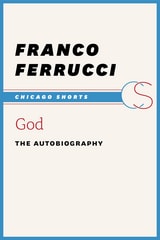
God
The AutobiographyFranco Ferrucci
University of Chicago Press, 1996
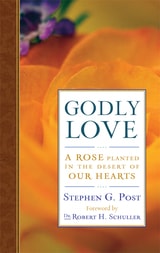
Godly Love
A Rose Planted in the Desert of Our HeartsStephen G. Post
Templeton Press, 2008
In this uplifting new book, author Stephen G. Post explores the mysteries and the wonder of Godly love. This all-important love is personal, unconditional, unlimited, generative, and omnipresent. The title alludes to Isaiah 35, how Godly love is said to plant a rose in our hearts precisely when we feel like a desert with no more love to give.
Post draws on his life experiences and works at the Institute for Research on Unlimited Love as he intersperses personal anecdotes with spiritual truths and research on human happiness. In the process, he defines the concept of Godly love and illustrates how important it can be in our lives—not only emotionally and spiritually but physically as well. "Godly love," he writes, "is the only foundation in the universe that we can really lean on."
We all have deserts in life, so we all need Godly love. Without it, the downward slide to cynicism, hostility, and cool indifference can be too easy. These meditations on the subject will nurture our confidence in the power of a love greater than our own when we need it most.
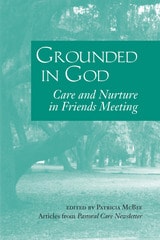
Grounded in God
Patricia McBee
QuakerPress, 2002