72 books match the query 'Hinduism' and 3 start with g
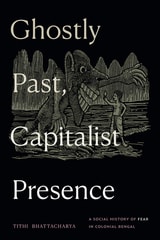
cover of Ghostly Past, Capitalist Presence: A Social History of Fear in Colonial Bengal

Ghostly Past, Capitalist Presence

A Social History of Fear in Colonial Bengal

Tithi Bhattacharya

Duke University Press, 2024
In Ghostly Past, Capitalist Presence, Tithi Bhattacharya maps the role that Bengali ghosts and ghost stories played in constituting the modern Indian nation, and the religious ideas seeded therein, as it emerged in dialogue with European science. Bhattacharya introduces readers to the multifarious habits and personalities of Bengal’s traditional ghosts and investigates and mourns their eventual extermination. For Bhattacharya, British colonization marked a transition from the older, multifaith folk world of traditional ghosts to newer and more frightening specters. These "modern" Bengali ghosts, borne out of a new rationality, were homogeneous specters amenable to "scientific" speculation and invoked at séance sessions in elite drawing rooms. Reading literature alongside the colonial archive, Bhattacharya uncovers a new reordering of science and faith from the middle of the nineteenth century. She argues that these shifts cemented the authority of a rising upper-caste colonial elite who expelled the older ghosts in order to recast Hinduism as the conscience of the Indian nation. In so doing, Bhattacharya reveals how capitalism necessarily reshaped Bengal as part of the global colonial project.
[more]
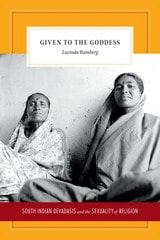
cover of Given to the Goddess: South Indian Devadasis and the Sexuality of Religion

Given to the Goddess

South Indian Devadasis and the Sexuality of Religion

Lucinda Ramberg

Duke University Press, 2014
Who and what are marriage and sex for? Whose practices and which ways of talking to god can count as religion? Lucinda Ramberg considers these questions based upon two years of ethnographic research on an ongoing South Indian practice of dedication in which girls, and sometimes boys, are married to a goddess. Called devadasis, or jogatis, those dedicated become female and male women who conduct the rites of the goddess outside the walls of her main temple and transact in sex outside the bounds of conjugal matrimony. Marriage to the goddess, as well as the rites that the dedication ceremony authorizes jogatis to perform, have long been seen as illegitimate and criminalized. Kinship with the goddess is productive for the families who dedicate their children, Ramberg argues, and yet it cannot conform to modern conceptions of gender, family, or religion. This nonconformity, she suggests, speaks to the limitations of modern categories, as well as to the possibilities of relations—between and among humans and deities—that exceed such categories.
[more]
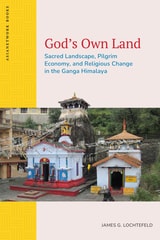
cover of God’s Own Land: Sacred Landscape, Pilgrim Economy, and Religious Change in the Ganga Himalaya

God’s Own Land

Sacred Landscape, Pilgrim Economy, and Religious Change in the Ganga Himalaya

James G. Lochtefeld

Lever Press, 2026

God’s Own Land follows the tectonic shift from traditional religious pilgrimage in the early twentieth-century to contemporary pilgrim tourism, in which ever-burgeoning visitor numbers have brought both benefits and challenges to the Garhwal region of India—the source of Hindu India’s sacred river, the Ganges. Despite Hinduism’s regional and sectarian variation, India’s Garhwal Himalaya region is one the most sacred places to Hindus, drawing pilgrims across sectarian lines from throughout the subcontinent and the world. This sacred land—dev bhumi or “land of the gods”—appears in foundational Hindu stories describing the presence and activity of gods, goddesses, saints, and cultural heroes.  

This study from James G. Lochtefeld draws out Hindu convictions regarding the Garhwal’s eternal and continuing sanctity as a holy region, based on the premise of an “imagined landscape.” This region is strongly associated with divine activity and yet this landscape is also a real place with a real history inhabited by real people, who have historically been poor because of the challenges created by the region’s geography. Juxtaposing the history of the region with its construction in the Hindu imaginary, this multidisciplinary study unpacks the nuanced image of the region, its religious significance, and the impacts of pilgrimages on the community through textual, historical, and ethnographic methods.

[more]