Results by title
28164 books match the query 'History' and 628 start with g

G Company's War
Two Personal Accounts of the Campaigns in Europe, 1944-1945Bruce E. Egger and Lee McMillian Otts, edited and with commentary by Paul Roley
University of Alabama Press, 1999
A unique account of combat in World War II provides parallel day-to-day records of the same events as seen by two men in the same company, one an enlisted man, one an officer
G Company’s War is the story of a World War II rifle company in Patton’s Third Army as detailed in the journals of S/Sgt. Bruce Egger and Lt. Lee M. Otts, both of G Company, 328th Regiment, 26th infantry Division.
Bruce Egger arrived in France in October 1944, and Lee Otts arrived in November. Both fought for G Company through the remainder of the war. Otts was wounded seriously in March 1945 and experienced an extended hospitalization in England and the United States. Both men kept diaries during the time they were in the service, and both expanded the diaries into full-fledged journals shortly after the war.
These are the voices of ordinary soldiers—the men who did the fighting—not the generals and statesmen who viewed events from a distance. Most striking is how the two distinctly different personalities recorded the combat experience. For the serious-minded Egger, the war was a grim ordeal; for Otts, with his sunny disposition, the war was a once-in-a-lifetime experience, sometimes even fun. Each account is accurate in its own right, but the combination of the two into a single, interwoven story provides a broader understanding of war and the men caught up in it.
Historian Paul Roley has interspersed throughout the text helpful overviews and summaries that place G Company's activities in the larger context of overall military operations in Europe. In addition, Roley notes what happened to each soldier mentioned as wounded in action or otherwise removed from the company and provides an appendix summarizing the losses suffered by G Company. The total impact of the work is to describe the reality of war in a frontline infantry company.

GENDER AND PETTY VIOLENCE IN LONDON, 1680-1720
JENNINE HURL-EAMON
The Ohio State University Press, 2005
Looking at a heretofore overlooked set of archival records of London in the late 17th and early 18th centuries, Hurl-Eamon reassesses the impact of gender on petty crime and its prosecution during the period. This book offers a new approach to the growing body of work on the history of violence in past societies. By focusing upon low-cost prosecutions in minor courts, Hurl-Eamon uncovers thousands of assaults on the streets of early modern London. Previous histories stressing the masculine nature of past violence are questioned here: women perpetrated one-third of all assaults. In looking at more mundane altercations rather than the homicidal attacks studied in previous histories, the book investigates violence as a physical language, with some forms that were subject to gender constraints, but many of which were available to both men and women. Quantitative analyses of various circumstances surrounding the assaults—including initial causes, weapons used, and injuries sustained—outline the patterns of violence as a language.
Hurl-Eamon also stresses the importance of focusing on the prosecutorial voice. In bringing the court’s attention to petty attacks, thousands of early modern men and women should be seen as agents rather than victims. This view is especially interesting in the context of domestic violence, where hundreds of wives and servants prosecuted patriarchs for assault, and in the Mohock Scare of 1712, where London’s populace rose up in opposition to aristocratic violence. The discussion is informed by a detailed knowledge of assault laws and the rules governing justices of the peace.

GENERATION OF BOOMERS
Shelton Stromquist
University of Illinois Press, 2000
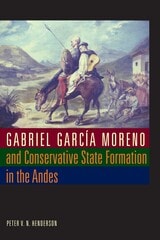
Gabriel García Moreno and Conservative State Formation in the Andes
By Peter V. N. Henderson
University of Texas Press, 2008
This book explores the life and times of Ecuador's most controversial politician within the broader context of the new political history, addressing five major themes of nineteenth-century Latin American history: the creation of political networks, the divisiveness of regionalism, the bitterness of the liberal-conservative ideological divide, the complicating problem of caudillismo, and the quest for progress and modernization.
Two myths traditionally associated with García Moreno's rule are debunked. The first is that he created a theocracy in Ecuador. Instead, the book argues that he negotiated a concordat with the Papacy giving the national government control over the church's secular responsibilities, and subordinated the clergy, many of whom were highly critical of García Moreno, to the conservative state. A second, frequently repeated generalization is that he created a conservative dictatorship out of touch with the liberal age in which he lived. Instead, the book argues that moderates held sway during the first nine years of García Moreno's period of influence, and only during his final term did he achieve the type of conservative state he thought necessary to advance his progressive nation-building agenda.
In sum, this book enriches our understanding of many of the notions of state formation by suggesting that conservatives like García Moreno envisioned a program of material progress and promoting national unity under a very different formula from that of nineteenth-century liberals.
Gabriel Harvey and the History of Reading
Essays by Lisa Jardine and othersEdited by Anthony Grafton, Nicholas Popper, and William H. Sherman
University College London, 2024
Few articles in the humanities have had the impact of Lisa Jardine and Anthony Grafton’s seminal “Studied for Action,” a study of the reading practices of Elizabethan polymath and prolific annotator Gabriel Harvey. Their excavation of the setting, methods, and ambitions of Harvey’s encounters with his books ignited a new interdisciplinary field, the history of reading, which quickly became one of the most exciting corners of the scholarly cosmos. A generation inspired by the model of Harvey fanned out across the world’s libraries and archives, seeking to reveal the many creative, unexpected, and curious ways that individuals throughout history responded to texts, and how these interpretations, in turn, illuminate past worlds.
Three decades on, Harvey’s example and Jardine’s work remain central to cutting-edge scholarship in the history of reading. By uniting “Studied for Action” with new studies on Gabriel Harvey, some of which are published here for the first time, by Jardine, Grafton, and the scholars they have influenced, this collection provides a unique lens on the place of marginalia in textual, intellectual, and cultural history. The chapters capture subsequent work on Harvey and map the fields opened by Jardine and Grafton’s original article, collectively offering a posthumous tribute to Lisa Jardine and an authoritative overview of the History of Reading.
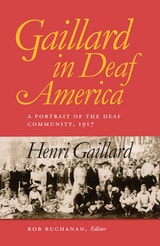
Gaillard in Deaf America
A Portrait of the Deaf Community, 1917, Henri GaillardHenri Gaillard
Gallaudet University Press, 2002
In 1917, Henri Gaillard led a delegation of deaf French men to the United States for the centennial celebration of the American School for the Deaf (ASD). The oldest school for deaf students in America, ASD had been cofounded by renowned deaf French teacher Laurent Clerc, thus inspiring Gaillard’s invitation. Gaillard visited deaf people everywhere he went and recorded his impressions in a detailed journal. His essays present a sharply focused portrait of the many facets of Deaf America during a pivotal year in its history.
Gaillard crossed the Atlantic only a few weeks after the United States entered World War I. In his writings, he reports the efforts of American deaf leaders to secure employment for deaf workers to support the war effort. He also witnesses spirited speeches at the National Association of the Deaf convention decrying the replacement of sign language by oral education. Gaillard also depicts the many local institutions established by deaf Americans, such as Philadelphia’s All Souls Church, founded in 1888 by the country’s first ordained deaf pastor, and the many deaf clubs established by the first wave of deaf college graduates in their communities. His journal stands as a unique chronicle of the American Deaf community during a remarkable era of transition.
Galateo
Or, The Rules of Polite BehaviorGiovanni Della Casa
University of Chicago Press, 2013
So begins Galateo, a treatise on polite behavior written by Giovanni Della Casa (1503–56) for the benefit of his nephew, a young Florentine destined for greatness.
Galbert of Bruges and the Historiography of Medieval Flanders
Jeff Rider
Catholic University of America Press, 2009

Galileo's Idol
Gianfrancesco Sagredo and the Politics of KnowledgeNick Wilding
University of Chicago Press, 2014
Nick Wilding uses as wide a variety of sources as possible—paintings, ornamental woodcuts, epistolary hoaxes, intercepted letters, murder case files, and others—to challenge the picture of early modern science as pious, serious, and ecumenical. Through his analysis of the figure of Sagredo, Wilding offers a fresh perspective on Galileo as well as new questions and techniques for the study of science. The result is a book that turns our attention from actors as individuals to shifting collective subjects, often operating under false identities; from a world made of sturdy print to one of frail instruments and mistranscribed manuscripts; from a complacent Europe to an emerging system of complex geopolitics and globalizing information systems; and from an epistemology based on the stolid problem of eternal truths to one generated through and in the service of playful, politically engaged, and cunning schemes.

Galileo's Instruments of Credit
Telescopes, Images, SecrecyMario Biagioli
University of Chicago Press, 2006
Galileo's Instruments of Credit proposes radical new interpretations of several key episodes of Galileo's career, including his early telescopic discoveries of 1610, the dispute over sunspots, and the conflict with the Holy Office over the relationship between Copernicanism and Scripture. Galileo's tactics during this time shifted as rapidly as his circumstances, argues Mario Biagioli, and the pace of these changes forced him to respond swiftly to the opportunities and risks posed by unforeseen inventions, further discoveries, and the interventions of his opponents.
Focusing on the aspects of Galileo's scientific life that extend beyond the framework of court culture and patronage, Biagioli offers a revisionist account of the different systems of exchanges, communication, and credibility at work in various phases of Galileo's career. Galileo's Instruments of Credit will find grateful readers among scholars of science studies, historical epistemology, visual studies, Galilean science, and late Renaissance astronomy.
Galileo, Courtier
The Practice of Science in the Culture of AbsolutismMario Biagioli
University of Chicago Press, 1993
Galileo, Courtier is a fascinating cultural and social history of science highlighting the workings of power, patronage, and credibility in the development of science.

Galileo, Science and the Church
Jerome J. Langford
University of Michigan Press, 1992
Gallus Dressler's Praecepta musicae poeticae
Gallus Dressler, New Critical Text, Translation, Annotations, and Indices by Robert Forgács
University of Illinois Press, 2007
Now available for the first time in English translation, this new edition of Gallus Dressler's Praecepta musicae poeticae corrects and expands upon earlier editions of one of the most important sixteenth-century treatments of musical theory and rhetoric. Robert Forgács’ detailed study of the Latin text reveals significant and original insights into the invention of fugues and the composition of opening, middle, and concluding sections. Forgács introduces the reader to Dressler's life and work and the design and sources of Praecepta musicae poeticae, places the treatise more fully in its humanist environment, presents additional classical sources for the text, and relates it to the work of Dressler’s contemporary music theorists. Copious annotations and indexes of words, names, and subjects place the treatise within the broader context of German theoretical discussion, the teaching and practice of music in the sixteenth century, and the musical life of the Lutheran Church.

Galveston Island, or, A Few Months off the Coast of Texas
The Journal of Francis C. Sheridan, 1839–1840Edited by Willis W. Pratt
University of Texas Press, 1954
On the last Sunday of the year 1839, Francis Sheridan, an elegant young Irishman in the British diplomatic service, sailed from Barbados for the Republic of Texas. His mission in the new nation was to contribute the opinion of an eyewitness to the deliberations going on in London concerning proposed recognition of Texas.
This jounal contains some of the material that Sheridan used for his official report and much colorful detail that he did not use. First published by the University of Texas Press in 1956, it is the travel diary of a sophisticated and discerning student of human nature.
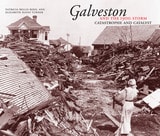
Galveston and the 1900 Storm
Catastrophe and CatalystBy Patricia Bellis Bixel and Elizabeth Hayes Turner
University of Texas Press, 2000
Runner-up, Spur Award for Best Western Nonfiction—Contemporary, Western Writers Of America, 2001
The Galveston storm of 1900 reduced a cosmopolitan and economically vibrant city to a wreckage-strewn wasteland where survivors struggled without shelter, power, potable water, or even the means to summon help. At least 6,000 of the city's 38,000 residents died in the hurricane. Many observers predicted that Galveston would never recover and urged that the island be abandoned. Instead, the citizens of Galveston seized the opportunity, not just to rebuild, but to reinvent the city in a thoughtful, intentional way that reformed its government, gave women a larger role in its public life, and made it less vulnerable to future storms and flooding.
This extensively illustrated history tells the full story of the 1900 Storm and its long-term effects. The authors draw on survivors' accounts to vividly recreate the storm and its aftermath. They describe the work of local relief agencies, aided by Clara Barton and the American Red Cross, and show how their short-term efforts grew into lasting reforms. At the same time, the authors reveal that not all Galvestonians benefited from the city's rebirth, as African Americans found themselves increasingly shut out from civic participation by Jim Crow segregation laws. As the centennial of the 1900 Storm prompts remembrance and reassessment, this complete account will be essential and fascinating reading for all who seek to understand Galveston's destruction and rebirth.
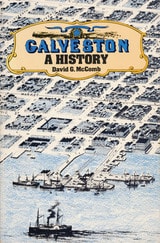
Galveston
A HistoryBy David G. McComb
University of Texas Press, 1986
On the Gulf edge of Texas between land and sea stands Galveston Island. Shaped continually by wind and water, it is one of earth's ongoing creations—time is forever new. Here, on the shoreline, embraced by the waves, a person can still feel the heartbeat of nature. And yet, for all the idyllic possibilities, Galveston's history has been anything but tranquil. Across Galveston's sands have walked Indians, pirates, revolutionaries, the richest men of nineteenth-century Texas, soldiers, sailors, bootleggers, gamblers, prostitutes, physicians, entertainers, engineers, and preservationists. Major events in the island's past include hurricanes, yellow fever, smuggling, vice, the Civil War, the building of a medical school and port, raids by the Texas Rangers, and, always, the struggle to live in a precarious location.
Galveston: A History is at the forefront of a trend in writing urban biographies emphasizing technology as the dynamic force in urban development. David McComb explores this often contradictory relationship between technology and the city, and provides a guide to both Galveston history and the dynamics of urban development.

Gambling Debt
Iceland's Rise and Fall in the Global EconomyE. Paul Durrenberger
University Press of Colorado, 2014
Gambling Debt is a game-changing contribution to the discussion of economic crises and neoliberal financial systems and strategies. Iceland’s 2008 financial collapse was the first case in a series of meltdowns, a warning of danger in the global order. This full-scale anthropology of financialization and the economic crisis broadly discusses this momentous bubble and burst and places it in theoretical, anthropological, and global historical context through descriptions of the complex developments leading to it and the larger social and cultural implications and consequences.
Chapters from anthropologists, sociologists, historians, economists, and key local participants focus on the neoliberal policies—mainly the privatization of banks and fishery resources—that concentrated wealth among a select few, skewed the distribution of capital in a way that Iceland had never experienced before, and plunged the country into a full-scale economic crisis. Gambling Debt significantly raises the level of understanding and debate on the issues relevant to financial crises, painting a portrait of the meltdown from many points of view—from bankers to schoolchildren, from fishers in coastal villages to the urban poor and immigrants, and from artists to philosophers and other intellectuals.
This book is for anyone interested in financial troubles and neoliberal politics as well as students and scholars of anthropology, sociology, economics, philosophy, political science, business, and ethics.
Publication supported in part by the National Science Foundation.
Contributors:
Vilhjálmur Árnason, Ásmundur Ásmundsson, Jón Gunnar Bernburg, James Carrier, Sigurlína Davíðsdóttir, Dimitra Doukas, Níels Einarsson, Einar Mar Guðmundsson, Tinna Grétarsdóttir, Birna Gunnlaugsdóttir, Guðný S. Guðbjörnsdóttir, Pamela Joan Innes, Guðni Th. Jóhannesson, Örn D. Jónsson, Hannes Lárusson, Kristín Loftsdóttir, James Maguire, Már Wolfgang Mixa, Evelyn Pinkerton, Hulda Proppé, James G. Rice, Rögnvaldur J. Sæmundsson, Unnur Dís Skaptadóttir, Margaret Willson
Gambling With Lives
A History of Occupational Health in Greater Las VegasMichelle Follette Turk
University of Nevada Press, 2020
A History of Occupational Health and Safety examines the work, hazards, and health and safety programs from the early building of the railroad through the construction of the Hoover Dam, chemical manufacturing during World War II, nuclear testing, and dense megaresort construction on the Las Vegas Strip. In doing so, this comprehensive chronicle reveals the long and unfortunate history of exposing workers, residents, tourists, and the environment to dangerous work—all while exposing the present and future to crises in the region. Complex interactions and beliefs among the actors involved are emphasized, as well as how the medical community interpreted and responded to the risks posed.
Few places in the United States contain this mixture of industrial and postindustrial sites, the Las Vegas area offers unique opportunities to evaluate American occupational health during the twentieth century, and reminds us all about the relevancy of protecting our workers.
Gambling on Ore
The Nature of Metal Mining in the United States, 1860–1910Kent Curtis
University Press of Colorado, 2013
In Montana, legal issues and politics—such as unexpected consequences of federal mining law and the electrification of the United States—further complicated the mining industry’s already complex relationship to geology, while government policy, legal frameworks, dominant understandings of nature, and the exigencies of profit and production drove the industry in momentous and surprising directions. Despite its many uncertainties, mining became an important part of American culture and daily life.
Gambling on Ore unpacks the tangled relationships between mining and the natural world that gave material possibility to the age of electricity. Metal mining has had a profound influence on the human ecology and the social relationships of North America through the twentieth century and throughout the world after World War II. Understanding how we forged these relationships is central to understanding the environmental history of the United States after 1850.
Gambling, Space, and Time
Shifting Boundaries and CulturesPauliina Raento
University of Nevada Press, 2011
The eight essays in Gambling, Space, and Time use a global and interdisciplinary approach to examine two significant areas of gambling studies that have not been widely explored--the ever-changing boundaries that divide and organize gambling spaces, and the cultures, perceptions, and emotions related to gambling. The contributors represent a variety of disciplines: history, geography, sociology, anthropology, political science, and law.
The essays consider such topics as the impact of technological advances on gambling activities, the role of the nation-state in the gambling industry, and the ways that cultural and moral values influence the availability of gambling and the behavior of gamblers. The case studies offer rich new insights into a gambling industry that is both a global phenomenon and a powerful engine of local change.

Gamelan Gong Kebyar
The Art of Twentieth-Century Balinese MusicMichael Tenzer
University of Chicago Press, 2000
Combining the tools of the anthropologist, composer, music theorist, and performer, Tenzer moves fluidly between ethnography and technical discussions of musical composition and structure. In an approach as intricate as one might expect in studies of Western classical music, Tenzer's rigorous application of music theory and analysis to a non-Western orchestral genre is wholly original. Illustrated throughout, the book also includes nearly 100 pages of musical transcription (in Western notation) that correlate with 55 separate tracks compiled on two accompanying compact discs.
The most ambitious work on gamelan since Colin McPhee's classic Music in Bali, this book will interest musicians of all kinds and anyone interested in the art and culture of Southeast Asia, Indonesia, and Bali.

Games of Inheritance
Kabbalah, Tradition, and Authorship in Jorge Luis BorgesYitzhak Lewis
Rutgers University Press, 2025
Gaming the Stage
Playable Media and the Rise of English Commercial TheaterGina Bloom
University of Michigan Press, 2018
Gaming the Stage also introduces a new archive for game studies: scenes of onstage gaming, which appear at climactic moments in dramatic literature. Bloom reveals plays to be systems of information for theater spectators: games of withholding, divulging, speculating, and wagering on knowledge. Her book breaks new ground through examinations of plays such as The Tempest, Arden of Faversham, A Woman Killed with Kindness, and A Game at Chess; the histories of familiar games such as cards, backgammon, and chess; less familiar ones, like Game of the Goose; and even a mixed-reality theater videogame.

Ganado Mucho / Tótsohnii Hastiin
Navajo Peace Chief in Times of War and ChangeTodd M. Compton
University of Utah Press, 2027
Gandhi and the Stoics
Modern Experiments on Ancient ValuesRichard Sorabji
University of Chicago Press, 2012
Gandhi in India
In His Own WordsMahatma Gandhi and Martin Green
Brandeis University Press, 1987
Gangrene and Glory
Medical Care during the American Civil WarFrank R. Freemon
University of Illinois Press, 1998
A medical doctor and a credentialed historian, Frank R. Freemon combines poignant, sometimes horrifying anecdotes of amputation, infection, and death with a clearheaded discussion of the state of medical knowledge, the effect of the military bureaucracy on medical supplies, and the members of the medical community who risked their lives, their health, and even their careers to provide appropriate care to the wounded. Freemon examines the impact on major campaigns--Manassas, Gettysburg, Vicksburg, Shiloh, Atlanta--of ignorance, understaffing, inexperience, overcrowded hospitals, insufficient access to ambulances, and inadequate supplies of essentials such as quinine.
Presenting the medical side of the war from a variety of perspectives--the Union, the Confederacy, doctors, nurses, soldiers, and their families--Gangrene and Glory achieves a peculiar immediacy by restricting its scope to the knowledge and perceptions available to its nineteenth-century subjects. Now available for the first time in paperback, this important volume takes a hard, close look at a neglected and crucial aspect of this bloody conflict.
Gangsters to Governors
The New Bosses of Gambling in AmericaClary, David
Rutgers University Press, 2017
Winner of the 2018 Bronze Current Events Book Award from the Independent Publisher Book Awards
Generations ago, gambling in America was an illicit activity, dominated by gangsters like Benny Binion and Bugsy Siegel. Today, forty-eight out of fifty states permit some form of legal gambling, and America’s governors sit at the head of the gaming table. But have states become addicted to the revenue gambling can bring? And does the potential of increased revenue lead them to place risky bets on new casinos, lotteries, and online games?
In Gangsters to Governors, journalist David Clary investigates the pros and cons of the shift toward state-run gambling. Unearthing the sordid history of America’s gaming underground, he demonstrates the problems with prohibiting gambling while revealing how today’s governors, all competing for a piece of the action, promise their citizens payouts that are rarely delivered.
Clary introduces us to a rogue’s gallery of colorful characters, from John “Old Smoke” Morrissey, the Irish-born gangster who built Saratoga into a gambling haven in the nineteenth century, to Sheldon Adelson, the billionaire casino magnate who has furiously lobbied against online betting. By exploring the controversial histories of legal and illegal gambling in America, he offers a fresh perspective on current controversies, including bans on sports and online betting. Entertaining and thought-provoking, Gangsters to Governors considers the past, present, and future of our gambling nation.
Author's website (http://www.davidclaryauthor.com)
Garbage Citizenship
Vital Infrastructures of Labor in Dakar, SenegalRosalind Fredericks
Duke University Press, 2018
Garbage in the Garden State
Jordan P. Howell
Rutgers University Press, 2023
Howell acknowledges that New Jersey is sometimes imagined, particularly by non-New Jerseyans, as a giant garbage dump for New York and Philadelphia. But every place has had to struggle with the challenges of waste management. New Jersey's trash history is in fact more interesting and more important than most. New Jersey’s waste history includes intensive planning, deep-seated political conflict, organized crime, and literally every level of state and federal judiciary. It is a colorful history, to say the least, and one that includes a number of firsts with regard to recycling, comprehensive planning, and the challenging economics of trash.

Garbage
The Saga of a Boss Scavenger in San FranciscoLeonard Dominic Stefanelli
University of Nevada Press, 2017
Stefanelli was trained to be a scavenger by his uncles in the 1940s and 50s at a time when rampant discrimination prevented Italian immigrants and their families from pursuing any other career. From there, he became a ‘boss scavenger’, married a garbage man’s daughter, and climbed the ranks of the Sunset Scavenger Company where he eventually took part in a corporate shakeup that made him the company’s president at only 31 years old. As one of the men at the helm of this booming industry, he became the chief advocate for increasingly innovative recycling and waste management practices in the Bay Area, and a foremost leader of environmentally-conscious business in the world.
Stefanelli’s lively memoir will enlighten readers to the waste management business, an industry that was once considered the lowest rung on the social ladder, but will also show his unparalleled capacity for transformation and vision.
Garden Apartments
The History of a Low-Rent UtopiaJoshua B. Freeman
University of Chicago Press, 2026
Eminent historian Joshua Freeman rescues garden apartments—typically low-rise multifamily residences that enclose or are surrounded by landscaped gardens—from their invisibility in the American landscape. He details their outsized influence on housing policy and social policy as they helped upgrade living standards for working people. Inspired by the architectural innovations and socialist politics of British garden cities, Red Vienna, and German modernist housing in the 1920s, these large, centrally managed projects were mostly not public housing, but their capitalist developers worked with governments to keep down rents. The results were often relatively small apartments and large communal spaces, aimed at fostering actual American community.
Garden of Egypt
Irrigation, Society, and the State in the Premodern FayyumBrendan Haug
University of Michigan Press, 2024
2025 American Society of Papyrologists Book Prize Winner
Garden of Egypt: Irrigation, Society, and the State in the Premodern Fayyūm is the first environmental history of Egypt’s Fayyūm depression. The volume studies human relationships with flowing water, from the third century BCE to the thirteenth century CE. Until the arrival of modern perennial irrigation in the nineteenth century, the Fayyūm was the only region of premodern Egypt to be irrigated by a network of artificial canals. By linking large numbers of rural communities together in shared dependence on this public irrigation infrastructure, canalization introduced to Egypt a radically new way of interacting both with the water of the Nile and with fellow farmers. Drawing upon ancient Greek papyri, medieval Arabic literature, and modern comparative evidence, this book explores the ways in which the Nile’s water, local farmers, and state power together continually reshaped this irrigated landscape over more than thirteen centuries. Following human/water relationships through both space and time further helps to erode disciplinary boundaries and bring multiple periods of Egyptian history into contact with one another.
Gardeners of Eden
Rediscovering Our Importance to NatureDan Dagget
University of Nevada Press, 2005
Dagget recommends a new kind of environmentalism based on management, science, evolution, and holism, and served by humans who enrich the environment even as they benefit from it. His new environmentalism offers hopeful solutions to the current ecological crisis and a new purpose for our human energies and ideals. This book is essential reading for anyone concerned with the earth and anyone seeking a viable way for our burgeoning human population to continue to live upon it.
Gardening the Amana Way
Lawrence L. Rettig
University of Iowa Press, 2013
Each of the seven villages in Amana relied on the food prepared in its communal kitchens, and each kitchen depended on its communal garden for most of the dishes served (the kitchens in Rettig’s hometown produced more than four hundred gallons of sauerkraut in 1900). Rettig begins by describing the evolution of communal gardening in old Amana, focusing especially on planting, harvesting, and storing vegetables from asparagus to egg lettuce to turnips. With the passing of the old order in 1932, the number of the society’s large vegetable gardens and orchards dwindled, but Larry Rettig and his wife, Wilma, still grow some of the colonies’ heirloom varieties in their fourth-generation South Amana vegetable garden. In 1980 they founded a seed bank to preserve them for future generations.
Rettig’s chapters on modern vegetable and flower gardening in today’s Amana Colonies showcase his Cottage-in-the-Meadow Gardens, now listed with the Smithsonian in its Archives of American Gardens. Old intermingles with new across his gardens: heirloom lettuce keeps company with the latest cucumber variety, a hundred-year-old rose arches over the newest daylilies and heucheras, and ancient grapevines intertwine with newly planted wisteria, all adding up to a rich array of colorful plantings.
Rettig extends his gardening advice into the kitchen and workroom. He shares family recipes for any number of traditional dishes, including radish salad, dumpling soup, Amana pickled ham, apple bread, eleven-minute meat loaf, and strawberry rhubarb pie. Moving into the workroom, he shows us how to make hammered botanical prints, Della Robbia centerpieces, holiday wreaths, a gnome home, and a waterless fountain. Touring his gardens, with their historic and unusual plants, will make gardeners everywhere want to reproduce the groupings and varieties that surround Larry and Wilma Rettig’s 1900 red brick house.
Gardens and Neighbors
Private Water Rights in Roman ItalyCynthia Jordan Bannon
University of Michigan Press, 2010
"Gardens and Neighbors will provide an important building block in the growing body of literature on the ways that Roman law, Roman society, and the economic concerns of the Romans jointly functioned in the real world."
---Michael Peachin, New York University
As is increasingly true today, fresh water in ancient Italy was a limited resource, made all the more precious by the Roman world's reliance on agriculture as its primary source of wealth. From estate to estate, the availability of water varied, in many cases forcing farmers in need of access to resort to the law. In Gardens and Neighbors: Private Water Rights in Roman Italy, Cynthia Bannon explores the uses of the law in controlling local water supplies. She investigates numerous issues critical to rural communities and the Roman economy. Her examination of the relationship between farmers and the land helps draw out an understanding of Roman attitudes toward the exploitation and conservation of natural resources and builds an understanding of law in daily Roman life.
An editor of the series Law and Society in the Ancient World, Cynthia Jordan Bannon is also Associate Professor of Classical Studies at Indiana University, Bloomington. Her previous book was The Brothers of Romulus: Fraternal Pietas in Roman Law, Literature, and Society (1997). Visit the author's website: http://www.iub.edu/~classics/faculty/bannon.shtml.
Gardens of New Spain
How Mediterranean Plants and Foods Changed AmericaBy William W. Dunmire
University of Texas Press, 2004
Gardens
An Essay on the Human ConditionRobert Pogue Harrison
University of Chicago Press, 2008
Humans have long turned to gardens—both real and imaginary—for sanctuary from the frenzy and tumult that surrounds them. Those gardens may be as far away from everyday reality as Gilgamesh’s garden of the gods or as near as our own backyard, but in their very conception and the marks they bear of human care and cultivation, gardens stand as restorative, nourishing, necessary havens.
With Gardens, Robert Pogue Harrison graces readers with a thoughtful, wide-ranging examination of the many ways gardens evoke the human condition. Moving from from the gardens of ancient philosophers to the gardens of homeless people in contemporary New York, he shows how, again and again, the garden has served as a check against the destruction and losses of history. The ancients, explains Harrison, viewed gardens as both a model and a location for the laborious self-cultivation and self-improvement that are essential to serenity and enlightenment, an association that has continued throughout the ages. The Bible and Qur’an; Plato’s Academy and Epicurus’s Garden School; Zen rock and Islamic carpet gardens; Boccaccio, Rihaku, Capek, Cao Xueqin, Italo Calvino, Ariosto, Michel Tournier, and Hannah Arendt—all come into play as this work explores the ways in which the concept and reality of the garden has informed human thinking about mortality, order, and power.
Alive with the echoes and arguments of Western thought, Gardens is a fitting continuation of the intellectual journeys of Harrison’s earlier classics, Forests and The Dominion of the Dead. Voltaire famously urged us to cultivate our gardens; with this compelling volume, Robert Pogue Harrison reminds us of the nature of that responsibility—and its enduring importance to humanity.
"I find myself completely besotted by a new book titled Gardens: An Essay on the Human Condition, by Robert Pogue Harrison. The author . . . is one of the very best cultural critics at work today. He is a man of deep learning, immense generosity of spirit, passionate curiosity and manifold rhetorical gifts."—Julia Keller, Chicago Tribune
"This book is about gardens as a metaphor for the human condition. . . . Harrison draws freely and with brilliance from 5,000 years of Western literature and criticism, including works on philosophy and garden history. . . . He is a careful as well as an inspiring scholar."—Tom Turner, Times Higher Education
"When I was a student, my Cambridge supervisor said, in the Olympian tone characteristic of his kind, that the only living literary critics for whom he would sell his shirt were William Empson and G. Wilson Knight. Having spent the subsequent 30 years in the febrile world of academic Lit. Crit. . . . I’m not sure that I’d sell my shirt for any living critic. But if there had to be one, it would unquestionably be Robert Pogue Harrison, whose study Forests: The Shadow of Civilization, published in 1992, has the true quality of literature, not of criticism—it stays with you, like an amiable ghost, long after you read it.
“Though more modest in scope, this new book is similarly destined to become a classic. It has two principal heroes: the ancient philosopher Epicurus . . . and the wonderfully witty Czech writer Karel Capek, apropos of whom it is remarked that, whereas most people believe gardening to be a subset of life, ‘gardeners, including Capek, understand that life is a subset of gardening.’”—Jonathan Bate, The Spectator
Gardens
An Essay on the Human ConditionRobert Pogue Harrison
University of Chicago Press, 2008
Humans have long turned to gardens—both real and imaginary—for sanctuary from the frenzy and tumult that surrounds them. Those gardens may be as far away from everyday reality as Gilgamesh’s garden of the gods or as near as our own backyard, but in their very conception and the marks they bear of human care and cultivation, gardens stand as restorative, nourishing, necessary havens.
With Gardens, Robert Pogue Harrison graces readers with a thoughtful, wide-ranging examination of the many ways gardens evoke the human condition. Moving from from the gardens of ancient philosophers to the gardens of homeless people in contemporary New York, he shows how, again and again, the garden has served as a check against the destruction and losses of history. The ancients, explains Harrison, viewed gardens as both a model and a location for the laborious self-cultivation and self-improvement that are essential to serenity and enlightenment, an association that has continued throughout the ages. The Bible and Qur’an; Plato’s Academy and Epicurus’s Garden School; Zen rock and Islamic carpet gardens; Boccaccio, Rihaku, Capek, Cao Xueqin, Italo Calvino, Ariosto, Michel Tournier, and Hannah Arendt—all come into play as this work explores the ways in which the concept and reality of the garden has informed human thinking about mortality, order, and power.
Alive with the echoes and arguments of Western thought, Gardens is a fitting continuation of the intellectual journeys of Harrison’s earlier classics, Forests and The Dominion of the Dead. Voltaire famously urged us to cultivate our gardens; with this compelling volume, Robert Pogue Harrison reminds us of the nature of that responsibility—and its enduring importance to humanity.
"I find myself completely besotted by a new book titled Gardens: An Essay on the Human Condition, by Robert Pogue Harrison. The author . . . is one of the very best cultural critics at work today. He is a man of deep learning, immense generosity of spirit, passionate curiosity and manifold rhetorical gifts."—Julia Keller, Chicago Tribune
"This book is about gardens as a metaphor for the human condition. . . . Harrison draws freely and with brilliance from 5,000 years of Western literature and criticism, including works on philosophy and garden history. . . . He is a careful as well as an inspiring scholar."—Tom Turner, Times Higher Education
"When I was a student, my Cambridge supervisor said, in the Olympian tone characteristic of his kind, that the only living literary critics for whom he would sell his shirt were William Empson and G. Wilson Knight. Having spent the subsequent 30 years in the febrile world of academic Lit. Crit. . . . I’m not sure that I’d sell my shirt for any living critic. But if there had to be one, it would unquestionably be Robert Pogue Harrison, whose study Forests: The Shadow of Civilization, published in 1992, has the true quality of literature, not of criticism—it stays with you, like an amiable ghost, long after you read it.
“Though more modest in scope, this new book is similarly destined to become a classic. It has two principal heroes: the ancient philosopher Epicurus . . . and the wonderfully witty Czech writer Karel Capek, apropos of whom it is remarked that, whereas most people believe gardening to be a subset of life, ‘gardeners, including Capek, understand that life is a subset of gardening.’”—Jonathan Bate, The Spectator

Gas Mask Nation
Visualizing Civil Air Defense in Wartime JapanGennifer Weisenfeld
University of Chicago Press, 2023
Airplanes, gas masks, and bombs were common images in wartime Japan. Yet amid these emblems of anxiety, tasty caramels were offered to children with paper gas masks as promotional giveaways, and magazines featured everything from attractive models in the latest civil defense fashion to futuristic weapons.
Gas Mask Nation explores the multilayered construction of an anxious yet perversely pleasurable visual culture of Japanese civil air defense—or bōkū—through a diverse range of artworks, photographs, films and newsreels, magazine illustrations, postcards, cartoons, advertising, fashion, everyday goods, government posters, and state propaganda. Gennifer Weisenfeld reveals the immersive aspects of this culture, in which Japan’s imperial subjects were mobilized to regularly perform highly orchestrated civil air defense drills throughout the country.
The war years in Japan are often portrayed as a landscape of privation and suppression under the censorship of the war machine. But alongside the horrors, pleasure, desire, wonder, creativity, and humor were all still abundantly present in a period before air raids went from being a fearful specter to a deadly reality.

Gasa Gasa Girl Goes to Camp
A Nisei Youth Behind A World War II FenceLily Yuriko Nakai Havey
University of Utah Press, 2014
In this creative memoir, Lily Havey combines storytelling, watercolor, and personal photographs to recount her youth in two Japanese-American internment camps during World War II. In short vignettes snapshots of people, recreated scenes and events a ten-year-old girl develops into a teenager while confined. Vintage photographs reveal the historical, cultural, and familial contexts of that growth and of the Nakais’ dislocation. The paintings and her animated writing together pull us into a turbulent era when America disgracefully incarcerated, without due process, thousands of American citizens because of their race.
These stories of love, loss, and discovery recall a girl balancing precariously between childhood and adolescence. In turn wrenching, funny, touching, and biting but consistently engrossing, they elucidate the daily challenges of life in the camp and the internees’ many adaptations.
Winner of the Evans Biography Award.
Selected by the American Library Association as one the Best of the Best from University Presses.
Finalist in the cover design category in the Southwest Book Design and Production Awards.
Gastrodiplomacy
Chinese Exclusion and the Ascent of Chinese Restaurants in New York City, 1870–1943Heather Ruth Lee
University of Chicago Press, 2027
Traces how Chinese migrants challenged racialization and disenfranchisement by establishing Chinese restaurants during the Gilded Age.
In Gastrodiplomacy, Heather Ruth Lee dives deep into not just the history of Chinese restaurants in early twentieth-century New York City but the delicate, inchoate, and constantly evolving dynamics among their owners, workers, and their predominantly white clientele. Lee argues that the stylistic and capitalist choices made by restaurateurs (“gastrodiplomats”) had outsized political effects on paternalistic white diners (“gastroliberals”) who patronized their establishments, particularly when it came to racial relations in cities that were growing and diversifying. Lee is not starry-eyed—satisfying white tongues and stomachs didn’t lead to an urban utopia of peace, harmony, and brotherhood—but she shows the great and subtle influences of Chinese migrants on American urban space, culture, and metropolitan identity in a defining time.
In Lee’s capable and compelling telling, the Chinese restaurant becomes a distinctive locus for the negotiation of political power, cultural influence, urban identity, and more. Gastrodiplomacy reveals much about burgeoning and increasingly cosmopolitan American cities, as well as about their dynamic relationships with the fluidities of the American character.

Gates of Freedom
Voltairine de Cleyre and the Revolution of the MindEugenia C. DeLamotte
University of Michigan Press, 2004
---Cary Nelson, University of Illinois
"The question of souls is old; we demand our bodies, now." These words are not from a feminist manifesto of the late twentieth century, but from a fiery speech given a hundred years earlier by Voltairine de Cleyre, a leading anarchist and radical thinker. A contemporary of Emma Goldman---who called her "the most gifted and brilliant anarchist woman America ever produced"---de Cleyre was a significant force in a major social movement that sought to transform American society and culture at its root. But she belongs to a group of late-nineteenth-century freethinkers, anarchists, and sex-radicals whose writing continues to be excluded from the U.S. literary and historical canon.
Gates of Freedom considers de Cleyre's speeches, letters, and essays, including her most well known essay, "Sex Slavery." Part I brings current critical concerns to bear on de Cleyre's writings, exploring her contributions to the anarchist movement, her analyses of justice and violence, and her views on women, sexuality, and the body. Eugenia DeLamotte demonstrates both de Cleyre's literary significance and the importance of her work to feminist theory, women's studies, literary and cultural studies, U.S. history, and contemporary social and cultural analysis. Part II presents a thematically organized selection of de Cleyre's stirring writings, making Gates of Freedom appealing to scholars, students, and anyone interested in Voltairine de Cleyre's fascinating life and rousing work.
Gateway to Vacationland
The Making of Portland, MaineJohn F. Bauman
University of Massachusetts Press, 2012
Situated on a peninsula jutting into picturesque Casco Bay, Portland has long been admired for its geographical setting—the “beautiful city by the sea,” as native son Henry Wadsworth Longfellow called it. At the same time, Portland's deep, ice-free port has made it an ideal site for the development of coastal commerce and industry. Much of the city's history, John F. Bauman shows, has been defined by the effort to reconcile the competing interests generated by these attributes—to balance the imperatives of economic growth with a desire to preserve Portland's natural beauty.
Caught in the crossfire of British and French imperial ambitions throughout the colonial era, Portland emerged as a prosperous shipbuilding center and locus of trade in the decades following the American Revolution. During the nineteenth century it became a busy railroad hub and winter port for Canadian grain until a devastating fire in 1866 reduced much of the city to ruins. Civic leaders responded by reinventing Portland as a tourist destination, building new hotels, parks, and promenades, and proclaiming it the “Gateway to Vacationland.”
After losing its grain trade in the 1920s and suffering through the Great Depression, Portland withered in the years following World War II as it wrestled with the problems of deindustrialization, suburbanization, and an aging downtown. Efforts at urban renewal met with limited success until the 1980s, when a concerted plan of historic preservation and the restoration of the Old Port not only revived the tourist trade but eventually established Portland as one of America's “most livable cities.”

Gateways to the Southwest
The Story of Arizona State ParksJay M. Price
University of Arizona Press, 2004
Gather Your Ancestors
Gender, Language, and Belonging in Southeast AfricaRaevin Jimenez
University of Wisconsin Press, 2026
Historically, southeasternmost Africa has been home to a large variety of speech communities, including Nguni, East Bantu, Khoi, and San—the legacy of a long and complicated history of migration, interaction, assimilation, and disaggregation between many peoples. With detailed, careful analysis, Raevin Jimenez guides readers through a thousand years of human movement, cultural contact, and social development in this region. Taking a historical linguistics approach, she sheds new light on this history by focusing on Nguni speakers’ use of gendered practices—including initiation, marriage, and avoidant speech known as hlónipha—to blend multilingual and diverse communities.
Use of gendered institutions inaugurated variable social spaces that could either elide or accommodate difference and thus enabled a multiplicity of community types. Contrary to previous assumptions about the roles of men and women in precolonial southeasternmost Africa, Jimenez shows that gender impacted life and social interactions across a large variety of important domains and became a way of forming, negotiating, and maintaining community. These developments shaped and remain visible in southeastern African speech communities today, and understanding them is vital to understanding the region’s long history and current linguistic society.
Gathered into a Church
Indigenous-English Congregationalism in Woodland New EnglandLori Rogers-Stokes
University of Massachusetts Press, 2025
Uncovering how and where Indigenous and settler communities found common ground using newly public church records
Puritans in the American colonies created Congregationalism, a Protestant denomination where power rested in each congregation rather than a larger central body. As has often been told, the official Puritan mission included outreach to Indigenous people. This may appear as nothing more than forced conversion under colonization, but church records from Massachusetts—digitized and made public for the first time—reveal the authenticity of this Indigenous religious experience, as evidenced by commonalities between the Congregational way and some aspects of local Native American cultures. The records also show how the decentralized churches stood in contrast to a growing civil government in the colonies.
Lori Rogers-Stokes focuses on the Massachusetts Bay Colony during the decades around the turn of the eighteenth century, a period bookended by King Philip’s War and the First Great Awakening. She uses as her primary source the many records kept by individual Congregational churches of the time. These records, accumulated over generations, have been missing from the historical record, allowing overly simplistic accounts of this religious community to circulate. With church records now available, Rogers-Stokes reveals a more realistic picture of diverse congregations and contrasts their internal workings—which show inherent flexibility and a focus on a shared creation of community—with a developing civil government focused on consolidating power around white landowners. The result is a story that can expand how scholars write about this period, this region, and these communities, both settler and Indigenous.
Gathering Medicines
Nation and Knowledge in China’s Mountain SouthJudith Farquhar and Lili Lai
University of Chicago Press, 2021
Over a period of six years, Judith Farquhar and Lili Lai worked with seven minority nationality groups in China’s southern mountains, observing how medicines were gathered and local healing systems codified. Gathering Medicines shares their intimate view of how people understand ethnicity, locality, the body, and nature. This ethnography of knowledge diversities in multiethnic China is a testament to the rural wisdom of mountain healers, one that theorizes, from the ground up, the dynamic encounters between formal statist knowledge and the popular authority of the wild.
Gathering Together, We Decide
Archives of Dispossession, Resistance, and Memory in Ndé HomelandsEdited by Margo Tamez, Cynthia Bejarano, and Jeffrey P. Shepherd
University of Arizona Press, 2025
In response, Dr. Eloisa Tamez and her daughter, Dr. Margo Tamez, organized a gathering of Lipan tribal members, activists, lawyers, and allies to meet in El Calaboz, South Texas. This gathering was a response to the appropriation of the Tamez family land, but it also provided an international platform to dispute the militarization of Indigenous territory throughout the U.S.-Mexico bordered lands. The gathering and years of ensuing resistance and activism produced an archive of scholarly analyses, testimonios, artwork, legal briefs, poetry, and other cultural productions.
This unique collection spotlights powerful voices and perspectives from Ndé leaders, Indigenous elders, settler-allies, Native youth, and others associated with the Tamez family, the Ndé defiance, and the larger Indigenous rights movement to document their resistance; expose, confront, and end racism and militarization; and to foreground Indigenous women–led struggles for justice.

Gathering the Ashes
Amritlal Nagar
Seagull Books, 2016
Translated from Hindi for the first time by Mrinal Pande, Gathering the Ashes is a poignant look into history, enriched by Pande’s useful afterword and a reminiscence by Nagar’s son.