Results by title
131 books match the query 'History, Local' and 8 start with g

Ghost Towns of the American West
Robert Silverberg
Ohio University Press, 1990
The story of the American mining frontier can be traced through the ghost towns that dot the western landscape to this day, from the camps of California’s forty-niners to the twentieth-century ruins in the Nevada desert. These abandoned towns mark an epoch of high adventure, of quick wealth and quicker poverty, of gambling and gunslinging and hell-raising. Those who have seen the Old West movies sometimes think that the legends of the Wild West were invented by screenwriters. The ghost towns remain, and their battered ruins testify that the legends are true. Behind the tall tales is a history where a fortune could be made in a week and lost over the course of an evening.
With a historian’s attention to fact and a novelist’s gift for dramatic storytelling, celebrated science fiction author Robert Silverberg brings these adventures back to life in the rowdy splendor of their heyday in Ghost Towns of the American West. History and travelers’ tales are woven together with clarity and wit to create a lively account of a fascinating era in our history. Lorence Bjorklund’s illustrations, rich in detail, portray the ghost towns in their glory and in their dusty decline.
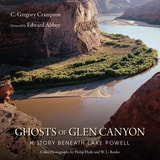
Ghosts of Glen Canyon
History beneath Lake PowellC Gregory Crampton
University of Utah Press, 2009
Author Gregory Crampton led the historical investigations of Glen and San Juan Canyons from 1957 to 1963 under contract with the National Park Service. The objective was to locate and record historical sites that would be lost to the rising waters of the reservoir. This book records that effort.
First published in 1986, this edition has been revised to include several new “ghosts” of Glen Canyon, including a never-before-published foreword by Edward Abbey. It also showcases stunning color photographs by Philip Hyde and includes hundreds of black-and-white photographs taken by the original salvage crews.
This informative guide to the historic treasures of Glen Canyon includes numbered maps keyed to each location. It is a book for both the armchair traveler and the lake enthusiast eager for a journey through the past to a place few had the privilege to know.

Ghosts of the Colorado Plains
Perry Eberhart
Ohio University Press, 1996
Since the second quarter of the nineteenth century, changing conditions have built and emptied small and large towns across the Colorado plain. At the time when Denver was little more than an overpopulated campsite along Cherry Creek there were numerous other settlements to the east and south, each with its own dreams of growth, gold or silver strikes, railroad connections, and rising influence over the surrounding territory. In Ghosts of the Colorado Plains, Eberhart traces some 150 of these ill-fated settlements, providing accounts of their birth, peak activity, and ultimate demise.
As early trapping, mining, cattle, farming, and transportation industries brought successive waves of “easterners” into the territory, they created some of the most colorful communities of their time. The trail towns Boston and Trail City were reputed to be two of the roughest towns in the entire west. Real estate schemers and promoters offered dreams of civilization and respectability in the “cow towns.” Elsewhere, the stage stations, side of the road settlements, and farm centers arose out of the basic necessities of commerce and from a simple desire of far-flung settlers, trappers, and others for a place to congregate, celebrate, trade, brawl, and receive news from the east. Though the personalities and events which animated these communities are all but forgotten, the towns themselves are the legacy of the competing forces that opened and developed the Colorado territory.
Readers of Guide to Colorado Ghost Towns and Mining Camps will welcome Ghosts of the Colorado Plains as an extension of Eberhart’s colorful blend of history and on-site information to a larger and much neglected area of the state. Through historical records, vignettes of personalities, and over 250 photos and 80 maps, Eberhart provides ready access to the towns and settlment sites of eastern Colorado’s past. For travelers, Ghosts of the Colorado Plains offers numerous pleasant excursions and investigations; for those less inclined to take to the field in search of artifacts and sites, the book offers fascinating glimpses of Colorado’s disappearing past.

Gichigami Hearts
Stories and Histories from MisaabekongLinda LeGarde Grover
University of Minnesota Press, 2021
Award-winning author Linda LeGarde Grover interweaves family and Ojibwe history with stories from Misaabekong (the place of the giants) on Lake Superior
Long before there was a Duluth, Minnesota, the massive outcropping that divides the city emerged from the ridge of gabbro rock running along the westward shore of Lake Superior. A great westward migration carried the Ojibwe people to this place, the Point of Rocks. Against this backdrop—Misaabekong, the place of the giants—the lives chronicled in Linda LeGarde Grover’s book unfold, some in myth, some in long-ago times, some in an imagined present, and some in the author’s family history, all with a deep and tenacious bond to the land, one another, and the Ojibwe culture.
Within the larger history, Grover tells the story of her ancestors’ arrival at the American Fur Post in far western Duluth more than two hundred years ago. Their fortunes and the family’s future are inextricably entwined with tales of marriages to voyageurs, relocations to reservation lands, encounters with the spirits of the lake and wood creatures, the renewal of life—in myth and in art, the search for meaning in the transformations of our day is always vital. Finally, in one man’s struggles, age-old tribulations, the intergenerational traumas of extended families and communities, and a uniquely Ojibwe appreciation for the natural and spiritual worlds converge, forging the Ojibwe worldview and will to survive as his legacy to his descendants.
Blending the seen and unseen, the old and the new, the amusing and the tragic and the hauntingly familiar, this lyrical work encapsulates a way of life forever vibrant at the Point of Rocks.

Going Back to Bisbee
Richard Shelton
University of Arizona Press, 1992
Couched within the narrative of his journey are passages revealing Shelton's deep familiarity with the region's natural and human history. Whether conveying the mystique of tarantulas or describing the mountain-studded topography, he brings a poet's eye to this seemingly desolate country. His observations on human habitation touch on Tombstone, "the town too tough to die," on ghost towns that perhaps weren't as tough, and on Bisbee itself, a once prosperous mining town now an outpost for the arts and a destination for tourists. What he finds there is both a broad view of his past and a glimpse of that city's possible future.
Going Back to Bisbee explores a part of America with which many readers may not be familiar. A rich store of information embedded in splendid prose, it shows that there are more than miles on the road to Bisbee.

Governors' Mansions of the South
Ann Liberman & Photos by Alise O'Brien
University of Missouri Press, 2008
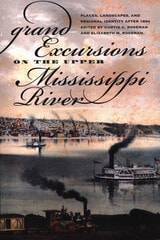
Grand Excursions on the Upper Mississippi River
Places, Landscapes, and Regional Identity after 1854Curtis C. & Elizabeth M. Roseman & Roseman
University of Iowa Press, 2004
One hundred and fifty years later, the thirteen essays in this volume examine the activities and environments of the 1854 Grand Excursion and place them in the context of an evolving regional identity for the Upper Mississippi River Valley based on the economy, culture, geography, and history of the area. In a series of “excursions,” the contributors explore the building of the Chicago and Rock Island Railroad, eastern newspaper accounts of the 1854 excursion, steamboating, the area’s pictorial landscape, passenger trains along the scenic river, the genesis and features of river towns, the control of the river for navigation, the development of preserves, parks, and recreation areas, the lumber industry, and commercial fishing. The book concludes by examining the resurgence of river-oriented development, as river towns are once again embracing the Mississippi.
Generously illustrated with maps, engravings, ephemera, and historic and present-day photographs, Grand Excursions on the Upper Mississippi River will be of interest to tourists and residents of the area, river aficionados, railroad and steamboat history buffs, as well as academics interested in the history, geography, and regional development of the area.
Guide to the Colorado Ghost Towns and Mining Camps
And Mining CampsPerry Eberhart
Ohio University Press, 1969
"This is not a history book. Rather it is a directory of towns, and compilation of known information about those towns. In undertaking the stud, I was amazed at the amount of legend and contradictory information Colorado history has collected in just one hundred years. Who was it that said: 'History is the perpetuation of saleable gossip'? (Perhaps, nobody has said it yet. In that case, it's mine, all mine.)
"As of this moment, this is the most complete compilation of Colorado mining towns—ghost or going—available.
"For the fourth edition, over 100 towns have been added. Also, I have included a new chapter (XXVI. Addendum, page 466), the first couple of pages of which can well be read as a second Preface to the book."
— Perry Eberhart, Preface, 1959 and 1969