Results by title
668 books match the query 'History & Surveys' and 11 start with g

G. W. F. Hegel
The Philosophical SystemHoward P. Kainz
Ohio University Press, 1998
Georg Wilhelm Friedrich Hegel, perhaps the most influential of all German philosophers, made one of the last great attempts to develop philosophy as an all-embracing scientific system. This system places Hegel among the “classical” philosophers—Aristotle, Aquinas, Spinoza—who also attempted to build grand conceptual edifices.
In this study, available for the first time in paperback, Howard P. Kainz emphasizes the uniqueness of Hegel’s system by focusing on his methodology, terminology, metaphorical and paradoxical language, and his special contributions to metaphysics, the philosophy of nature, philosophical anthropology, and other areas.
Kainz focuses on Hegel’s system as a whole and its seminal ideas, making generous use of representative texts. He gives special attention to the interrelationship between dialectical methodology and paradoxical propositions; the prevalence of metaphor in the philosophy of nature; and the close interrelationship between Christian doctrine and Hegelian speculation. A rich array of diagrams and tables further elucidates Kainz’s analyses.
An ideal text for the student of philosophy coming to Hegel for the first time, G. W. F. Hegel provides the reader with useful insights into Hegel’s work and illuminates Hegel’s enduring significance in the late twentieth century.
Gandhi and the Stoics
Modern Experiments on Ancient ValuesRichard Sorabji
University of Chicago Press, 2012
German Idealism as Constructivism
Tom Rockmore
University of Chicago Press, 2016
Since ancient Greece philosophers have tried to know the world in itself, an effort that Kant believed had failed. His alternative strategy—which came to be known as the Copernican revolution—was that the world as we experience and know it depends on the mind. Rockmore shows that this project was central to Kant’s critical philosophy and the later German idealists who would follow him. He traces the different ways philosophers like Fichte, Schelling, and Hegel formulated their own versions of constructivism. Offering a sweeping but deeply attuned analysis of a crucial part of the legacy of German idealism, Rockmore reinvigorates this school of philosophy and opens up promising new avenues for its study.
German Idealism
An Anthology and GuideEdited by Brian O'Connor and Georg Mohr
University of Chicago Press, 2007
Beginning with the publication of Kant’s Critique of Pure Reason and extending through to Hegel’s death, the period known as German Idealism signaled the end of an epoch of rationalism, empiricism, and enlightenment—and the beginning of a new “critical” period of philosophy. The most comprehensive anthology of this vital tradition to date, German Idealism brings together an expansive selection of readings from the tradition’s major figures like Kant, Hegel, Fichte, and Schelling.
Arranged thematically into sections on topics such as the relationships between self and knowledge, freedom and morality, law and state, and nature and science, to name a few, German Idealism discloses many of the contrasts that helped to differentiate each of the tradition’s key thinkers. Each expertly translated text comes with an editorial introduction to guide readers through many of the problems the texts specifically deal with, as well as their historical context.
The most accessible and expansive introduction to German Idealism ever, this anthology will be hailed by instructors and scholars as the most dependable guide to the tradition for years to come.
Gilles Deleuze
An Apprenticeship in PhilosophyMichael Hardt
University of Minnesota Press, 1993
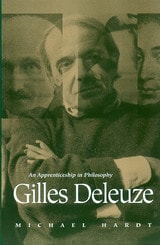
The key to understanding Deleuze's complete body of work.
"A coherent and systematic reading of a philosopher who has consistently courted the incoherent and systematic. What we must avoid are encounters with those who cultivate sad passions (the men of ressentiment in the Nietzschean formulation); and we must increase our power to compose new relationships with compatible bodies with whom we share a common notion. Hardt's exceptional book is one such joyful encounter." -Times Literary Supplement"An excellent book. The project of Gilles Deleuze is to situate Deleuze squarely in the camp of those who seek to deepen and transform our philsophical understanding and political situation. Hardt seems to me to be directly on target." -Substance"Both for its object and its method of study, here is a work that will mark the future of the field of Deleuzian studies." -Eric Alliez, Critique"Hardt's reading of Deleuze is complex and precise. He follows the intricacies of the argument and of the shifting positions with considerable skill, thus providing us with a study not only of the Deleuzian way of doing philosophy, but of Deleuzian reading-of the selectivity of its targets, of its agonistic approach to philosophy, through indirect attack on one main opponent. Reading Hardt reading Deleuze reading, we can understand, for instance, why Deleuze's exposition usually takes the form not of a dialectic but of a correlation, of a system of differences." -Radical Philosophy"How can we forget the dialectic? How an we affirm a constitutive ontology? Through its efforts to respond to these questions, Gilles Deleuze's philosophical apprenticeship presents the Bildungsroman of any contemporary philosophy that wants to break away from the destiny of modernity. Michael Hardt unravels the guiding thread of this philosophy of the future." -Antonio Negri"Hardt's interpretations are exceptionally well-grounded in the history of philosophical discourse, a discourse he exercises with discipline and rare insight. As the only major work on Deleuze in English, this book will undoubtedly set the standard for any future study of one of France's most important thinkers-and it is a very high standard, indeed." -Peggy Kamuf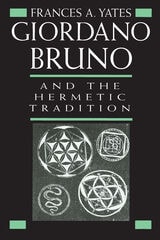
Giordano Bruno and the Hermetic Tradition
Frances A. Yates
University of Chicago Press, 1990
"Among those who have explored the intellectual world of the sixteenth century no one in England can rival Miss Yates. Wherever she looks, she illuminates. Now she has looked on Bruno. This brilliant book takes time to digest, but it is an intellectual adventure to read it. Historians of ideas, of religion, and of science will study it. Some of them, after reading it, will have to think again. . . . For Miss Yates has put Bruno, for the first time, in his tradition, and has shown what that tradition was."—Hugh Trevor-Roper, New Statesman
"A decisive contribution to the understanding of Giordano Bruno, this book will probably remove a great number of misrepresentations that still plague the tormented figure of the Nolan prophet."—Giorgio de Santillana, American Historical Review
"Yates's book is an important addition to our knowledge of Giordano Bruno. But it is even more important, I think, as a step toward understanding the unity of the sixteenth century."—J. Bronowski, New York Review of Books
Given Time II
Jacques Derrida
University of Chicago Press, 2026
The long-awaited conclusion to Derrida’s seminar on the gift and time.
In 1991, Jacques Derrida published the first half of a seminar delivered from 1978 to 1979 on gifts and time, but the second installment (though expected) was not completed in his lifetime. Given Time II completes the seminar with eight sessions that showcase Derrida’s most advanced work on the problematic of the gift in Heidegger, with deep dives into some of the most difficult texts in the Heideggerian corpus, including “The Origin of the Work of Art,” “The Thing,” and “On Time and Being.”
Beyond Heidegger, Derrida engages Claude Lévi-Strauss, Marcel Mauss, Maurice Blanchot, Jacques Lacan, and others on the act of giving and receiving, the sacrificial gift, and more. Throughout, Derrida identifies a paradox of gift giving: for the gift to be received as a gift, it must not appear as such, since gifts often involve a cycle of debt and repayment. Given Time II is a uniquely Derridean treatment of an important subject in the work of Heidegger and beyond.
Given Time
I. Counterfeit MoneyJacques Derrida
University of Chicago Press, 1992
Derrida reads the relation of time to gift through a number of texts: Heidegger's Time and Being, Mauss's The Gift, as well as essays by Benveniste and Levi-Strauss that assume Mauss's legacy. It is, however, a short tale by Baudelaire, "Counterfeit Money," that guides Derrida's analyses throughout. At stake in his reading of the tale, to which the second half of this book is devoted, are the conditions of gift and forgiveness as essentially bound up with the movement of dissemination, a concept that Derrida has been working out for many years.
For both readers of Baudelaire and students of literary theory, this work will prove indispensable.
Given Time
I. Counterfeit MoneyJacques Derrida
University of Chicago Press, 1992
Derrida reads the relation of time to gift through a number of texts: Heidegger's Time and Being, Mauss's The Gift, as well as essays by Benveniste and Levi-Strauss that assume Mauss's legacy. It is, however, a short tale by Baudelaire, "Counterfeit Money," that guides Derrida's analyses throughout. At stake in his reading of the tale, to which the second half of this book is devoted, are the conditions of gift and forgiveness as essentially bound up with the movement of dissemination, a concept that Derrida has been working out for many years.
For both readers of Baudelaire and students of literary theory, this work will prove indispensable.
God's Knowledge of the World
Medieval Theories of Divine Ideas from Bonaventure to OckhamCarl A. Vater
Catholic University of America Press, 2022
God, the Flesh, and the Other
From Irenaeus to Duns ScotusEmmanuel Falque Translated from the French by William Christian Hackett
Northwestern University Press, 2015
In God, the Flesh, and the Other, the philosopher Emmanuel Falque joins the ongoing debate about the role of theology in phenomenology. An important voice in the second generation of French philosophy’s “theological turn,” Falque examines philosophically the fathers of the Church and the medieval theologians on the nature of theology and the objects comprising it. Falque works phenomenology itself into the corpus of theology. Theological concepts thus translate into philosophical terms that phenomenology should legitimately question: concepts from contemporary phenomenology such as onto-theology, appearance, reduction, body/flesh, inter-corporeity, the genesis of community, intersubjectivity, and the singularity of the other find penetrating analogues in patristic and medieval thought forged through millennia of Christological and Trinitarian debate, mystical discourses, and speculative reflection. Through Falque’s wide-ranging interpretive path, phenomenology finds itself interrogated—and renewed.