56 books match the query 'Homosexuality in literature' and 4 start with g
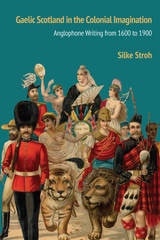
cover of Gaelic Scotland in the Colonial Imagination: Anglophone Writing from 1600 to 1900

Gaelic Scotland in the Colonial Imagination

Anglophone Writing from 1600 to 1900

Silke Stroh

Northwestern University Press, 2017
Can Scotland be considered an English colony? Is its experience and literature comparable to that of overseas postcolonial countries? Or are such comparisons no more than patriotic victimology to mask Scottish complicity in the British Empire and justify nationalism? These questions have been heatedly debated in recent years, especially in the run-up to the 2014 referendum on independence, and remain topical amid continuing campaigns for more autonomy and calls for a post-Brexit “indyref2.” Gaelic Scotland in the Colonial Imagination offers a general introduction to the emerging field of postcolonial Scottish studies, assessing both its potential and limitations in order to promote further interdisciplinary dialogue. Accessible to readers from various backgrounds, the book combines overviews of theoretical, social, and cultural contexts with detailed case studies of literary and nonliterary texts. The main focus is on internal divisions between the anglophone Lowlands and traditionally Gaelic Highlands, which also play a crucial role in Scottish–English relations. Silke Stroh shows how the image of Scotland’s Gaelic margins changed under the influence of two simultaneous developments: the emergence of the modern nation-state and the rise of overseas colonialism.
[more]
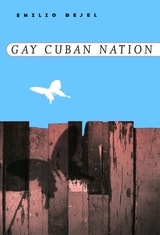
cover of Gay Cuban Nation

Gay Cuban Nation

Emilio Bejel

University of Chicago Press, 2001
With Gay Cuban Nation, Emilio Bejel looks at Cuba's markedly homoerotic culture through writings about homosexuality, placing them in the social and political contexts that led up to the Cuban Revolution. By reading against the grain of a wide variety of novels, short stories, autobiographies, newspaper articles, and films, Bejel maps out a fascinating argument about the way in which different attitudes toward power and nationalism struggle for an authoritative stance on homosexual issues. Through close readings of writers such as José Martí, Alfonso Hernández-Catá, Carlos Montenegro, José Lezama Lima, Leonardo Padura Fuentes, and Reinaldo Arenas, whose heartbreaking autobiography, Before Night Falls, has enjoyed renewed popularity, Gay Cuban Nation shows that the category of homosexuality is always lurking, ghostlike, in the shadows of nationalist discourse. The book stakes out Cuba's sexual battlefield, and will challenge the homophobia of both Castro's revolutionaries and Cuban exiles in the States.
[more]
cover of Gay and Lesbian Themes in Latin American Writing

Gay and Lesbian Themes in Latin American Writing

By David William Foster

University of Texas Press, 1991

A taboo subject in many cultures, homosexuality has been traditionally repressed in Latin America, both as a way of life and as a subject for literature. Yet numerous writers have attempted to break the cultural silence surrounding homosexuality, using various strategies to overtly or covertly discuss lesbian and gay themes. In this study, David William Foster examines more than two dozen texts that deal with gay and lesbian topics, drawing from them significant insights into the relationship between homosexuality and society in different Latin American countries and time periods.

Foster's study includes works both sympathetic and antagonistic to homosexuality, showing the range of opinion on this topic. The preponderance of his examples come from Argentina, Brazil, and Mexico, countries with historically active gay communities, although he also includes material on other countries. Noteworthy among the authors covered are Reinaldo Arenas, Adolfo Caminha, Isaac Chocrón, José Donoso, Sylvia Molloy, Alejandra Pizarnik, and Luis Zapata.
[more]
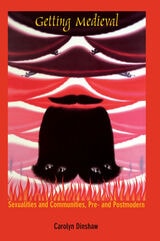
cover of Getting Medieval: Sexualities and Communities, Pre- and Postmodern

Getting Medieval

Sexualities and Communities, Pre- and Postmodern

Carolyn Dinshaw

Duke University Press, 1999

In Getting Medieval Carolyn Dinshaw examines communities—dissident and orthodox—in late-fourteenth and early-fifteenth-century England to create a new sense of queer history. Reaching beyond both medieval and queer studies, Dinshaw demonstrates in this challenging work how intellectual inquiry into pre-modern societies can contribute invaluably to current issues in cultural studies. In the process, she makes important connections between past and present cultures that until now have not been realized.

In her pursuit of historical analyses that embrace the heterogeneity and indeterminacy of sex and sexuality, Dinshaw examines canonical Middle English texts such as the Canterbury Tales and TheBook of Margery Kempe. She examines polemics around the religious dissidents known as the Lollards as well as accounts of prostitutes in London to address questions of how particular sexual practices and identifications were normalized while others were proscribed. By exploring contemporary (mis)appropriations of medieval tropes in texts ranging from Quentin Tarantino’s Pulp Fiction to recent Congressional debates on U.S. cultural production, Dinshaw demonstrates how such modern media can serve to reinforce constrictive heteronormative values and deny the multifarious nature of history. Finally, she works with and against the theories of Michel Foucault, Homi K. Bhabha, Roland Barthes, and John Boswell to show how deconstructionist impulses as well as historical perspectives can further an understanding of community in both pre- and postmodern societies.

This long-anticipated volume will be indispensable to medieval and queer scholars and will be welcomed by a larger cultural studies audience.


[more]