395 books match the query 'How' and 7 start with g

cover of Gamers…in the Library?! The Why, What, and How of Videogame Tournaments for All Ages

Gamers…in the Library?! The Why, What, and How of Videogame Tournaments for All Ages

Eli Neiburger

American Library Association, 2007
[more]
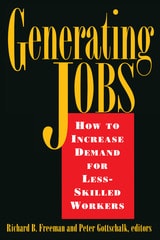
cover of Generating Jobs: How to Increase Demand for Less-Skilled Workers

Generating Jobs

How to Increase Demand for Less-Skilled Workers

Richard B. Freeman

Russell Sage Foundation, 1998
The American economy is in danger of leaving its low-skilled workers behind. In the last two decades, the wages and employment levels of the least educated and experienced workers have fallen disastrously. Where willing workers once found ready employment at reasonable wages, our computerized, service-oriented economy demands workers who can read and write, master technology, deal with customers, and much else. Improved education and training will alleviate this problem in the long run, but educating the new workforce will take a substantial national investment over many years. In the meantime, we face increasingly acute questions about how to include low-skill workers in today's economy. Generating Jobs takes a hard look at these questions, and asks whether anything can be done to improve the lot of low-skilled workers by intervening in the labor market on their behalf. These micro demand-side policies seek to improve wages and employment levels—either by lowering the costs of hiring low-skilled workers through employer subsidies, or by raising wage levels, benefit levels, or hours of employment, or by providing employment via government jobs. Although these policies are not currently popular in the U.S., they have long been used in many countries. Generating Jobs provides a clear-eyed assessment of this history, and asks if any of these policies might be applicable to the current problems of low-skilled workers in the United States. The results are surprising. Several recently touted panaceas turn out to be costly and ineffective in the American labor market. Enterprise zones, for instance, are an expensive way of moving jobs into areas of high unemployment, costing as much as $60,000 per job. Similarly, job-sharing, which has had uneven success in Europe, turns out to be ill-suited to conditions in the U.S., where wages are relatively low and workers need to work long hours to maintain income. On the other hand, a number of older, less flashy policies turn out to have real, if modest, benefits. Wage subsidies have increased employment among qualifying workers, and public employment policies can increase the number of workers from targeted groups working during the program. While acknowledging that many solutions are counterproductive, this definitive review of active labor market policies shows that many programs can offer real help. More than any rhetoric, Generating Jobs is the best guide to future action and a serious response to those who claim that nothing can be done.
[more]
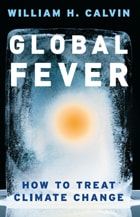
cover of Global Fever: How to Treat Climate Change

Global Fever

How to Treat Climate Change

William H. Calvin

University of Chicago Press, 2008

Every decade since 1950 has seen more floods and more wildfires on every continent. Deserts are expanding, coral reefs are dying, fisheries are declining, hurricanes are strengthening. The debate about climate change is over: there’s no question that global warming has made the Earth sick, and the outlook for the future calls for ever-warmer temperatures and deadlier results. Something must be done—but how quickly?
            With Global Fever, William H. Calvin delivers both a clear-eyed diagnosis and a strongly worded prescription. In striking, straightforward language, he first clearly sets out the current state of the Earth’s warming climate and the disastrous possibilities ahead should we continue on our current path. Increasing temperatures will kill off vegetation and dry up water resources, and their loss will lead, in an increasingly destructive feedback loop, to even more warming. Resource depletion, drought, and disease will follow, leading to socioeconomic upheaval—and accompanying violence—on a scale barely conceivable.
            It is still possible, Calvin argues, to avoid such a dire fate. But we must act now, aggressively funneling resources into jump-starting what would amount to a third industrial revolution, this one of clean technologies—while simultaneously expanding our use of existing low-emission technologies, from nuclear power to plug-in hybrid vehicles, until we achieve the necessary scientific breakthroughs.
            Passionately written, yet thoroughly grounded in the latest climate science, Global Fever delivers both a stark warning and an ambitious blueprint for saving the future of our planet.
[more]
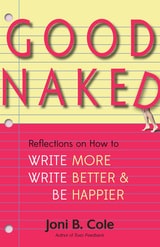
cover of Good Naked: Reflections on How to Write More, Write Better, and Be Happier

Good Naked

Reflections on How to Write More, Write Better, and Be Happier

Joni B. Cole

University Press of New England, 2017
In Good Naked, acclaimed author Joni B. Cole shows readers how to make the writing process not only more productive, but less maddening, more inviting, and even joyful, at least a good part of the time. She explains how sharing early drafts is “good naked”—you’re exposing your creative process in all its glory. Through a mix of engaging stories and practical wisdom, all delivered with sheer good humor, Cole addresses the most common challenges writers confront and offers disarmingly simple but effective solutions. She debunks popular misconceptions about how we are supposed to write and replaces them with strategies that actually work to get us started and stay motivated. (Searching for your muse? Try looking in the fridge.) With a do-this-not-that directness, she sets writers free from debilitating attitudes, counterproductive practices, and energy-draining habits that undermine confidence and creativity. Equipped with experience and a refreshing respect for anyone who wants to write, Cole also infuses every chapter with insights into craft and narrative technique—because the truly happy ending is not just that we write more, but that we write well. If you have ever experienced a sense of dread or intimidation at any stage of the creative process, or even if you simply want to write more, write better, and be happier, this intelligent, funny, and generous guide will not only inspire you to head over to your desk, but will also cheer you on once you’re there.
[more]
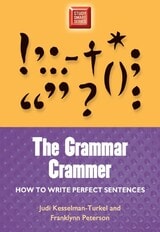
cover of Grammar Crammer: How to Write Perfect Sentences

Grammar Crammer

How to Write Perfect Sentences

Judi Kesselman-Turkel and Franklynn Peterson

University of Wisconsin Press, 2003

The Grammar Crammer is a concise, sensible grammar handbook that explains lucidly how to remember correct word forms and sentence structures. Useful as a reference tool for high school and beyond, it packs an entire grammar encyclopedia into just over a hundred pages.
[more]
cover of Greenback Planet: How the Dollar Conquered the World and Threatened Civilization as We Know It

Greenback Planet

How the Dollar Conquered the World and Threatened Civilization as We Know It

By H. W. Brands

University of Texas Press, 2011

The world runs on the U.S. dollar. From Washington to Beijing, governments, businesses, and individuals rely on the dollar to conduct commerce and invest profitably and safely—even after the global financial meltdown in 2008 revealed the potentially catastrophic cost of the dollar's hegemony. But how did the greenback achieve this planetary dominance a mere century and a half after President Lincoln issued the first currency backed only by the credit—and credibility—of the federal government?

In Greenback Planet, acclaimed historian H. W. Brands charts the dollar's astonishing rise to become the world's principal currency. Telling the story with the verve of a novelist, he recounts key episodes in U.S. monetary history, from the Civil War debate over fiat money (greenbacks) to the recent worldwide financial crisis. Brands explores the dollar's changing relations to gold and silver and to other currencies and cogently explains how America's economic might made the dollar the fundamental standard of value in world finance. He vividly describes the 1869 Black Friday attempt to corner the gold market, banker J. P. Morgan's bailout of the U.S. treasury, the creation of the Federal Reserve, and President Franklin Roosevelt's handling of the bank panic of 1933. Brands shows how lessons learned (and not learned) in the Great Depression have influenced subsequent U.S. monetary policy, and how the dollar's dominance helped transform economies in countries ranging from Germany and Japan after World War II to Russia and China today. He concludes with a sobering dissection of the 2008 world financial debacle, which exposed the power—and the enormous risks—of the dollar's worldwide reign.
[more]
cover of Greetings from New Nashville: How a Sleepy Southern Town Became "It" City

Greetings from New Nashville

How a Sleepy Southern Town Became "It" City

Steve Haruch

Vanderbilt University Press, 2020

In 1998, roughly 2 million visitors came to see what there was to see in Nashville. By 2018, that number had ballooned to 15.2 million.

In that span of two decades, the boundaries of Nashville did not change. But something did. Or rather, many somethings changed, and kept changing, until many who lived in Nashville began to feel they no longer recognized their own city. And some began to feel it wasn't their own city at all anymore as they were pushed to its fringes by rising housing costs. Between 1998 and 2018, the population of Nashville grew by 150,000. On some level, Nashville has always packaged itself for consumption, but something clicked and suddenly everyone wanted a taste. But why Nashville? Why now? What made all this change possible?

This book is an attempt to understand those transformations, or, if not to understand them, exactly, then to at least grapple with the question: What happened?
[more]