425 books match the query 'Human rights' and 8 start with g
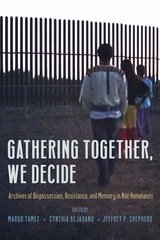
cover of Gathering Together, We Decide: Archives of Dispossession, Resistance, and Memory in Ndé Homelands

Gathering Together, We Decide

Archives of Dispossession, Resistance, and Memory in Ndé Homelands

Edited by Margo Tamez, Cynthia Bejarano, and Jeffrey P. Shepherd

University of Arizona Press, 2025

In 2007, the Department of Homeland Security began condemnation proceedings on the property of Dr. Eloisa Tamez, a Lipan Apache (Ndé) professor, veteran, and title holder to land in South Texas deeded to her ancestors under the colonial occupation and rule of King Charles III of Spain in 1761, during a time when Indigenous lands were largely taken and exploited by Spanish colonizers. Crown grants of lands to Indigenous peoples afforded them the opportunity to reclaim Indigenous title and control. The federal government wanted Tamez’s land to build a portion of the “border wall” on the U.S.-Mexico border. She refused. In 2008, the Department of Homeland Security sued her, but she countersued based on Aboriginal land rights, Indigenous inherent rights, the land grant from Spain, and human rights. This standoff continued for years, until the U.S. government forced Tamez to forfeit land for the wall.

In response, Dr. Eloisa Tamez and her daughter, Dr. Margo Tamez, organized a gathering of Lipan tribal members, activists, lawyers, and allies to meet in El Calaboz, South Texas. This gathering was a response to the appropriation of the Tamez family land, but it also provided an international platform to dispute the militarization of Indigenous territory throughout the U.S.-Mexico bordered lands. The gathering and years of ensuing resistance and activism produced an archive of scholarly analyses, testimonios, artwork, legal briefs, poetry, and other cultural productions. 

This unique collection spotlights powerful voices and perspectives from Ndé leaders, Indigenous elders, settler-allies, Native youth, and others associated with the Tamez family, the Ndé defiance, and the larger Indigenous rights movement to document their resistance; expose, confront, and end racism and militarization; and to foreground Indigenous women–led struggles for justice.
[more]
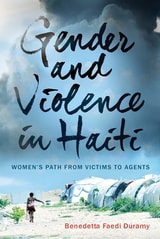
cover of Gender and Violence in Haiti: Women’s Path from Victims to Agents

Gender and Violence in Haiti

Women’s Path from Victims to Agents

Benedetta Faedi Duramy

Rutgers University Press, 2014

Women in Haiti are frequent victims of sexual violence and armed assault. Yet an astonishing proportion of these victims also act as perpetrators of violent crime, often as part of armed groups. Award-winning legal scholar Benedetta Faedi Duramy visited Haiti to discover what causes these women to act in such destructive ways and what might be done to stop this tragic cycle of violence.

Gender and Violence in Haiti is the product of more than a year of extensive firsthand observations and interviews with the women who have been caught up in the widespread violence plaguing Haiti. Drawing from the experiences of a diverse group of Haitian women, Faedi Duramy finds that both the victims and perpetrators of violence share a common sense of anger and desperation. Untangling the many factors that cause these women to commit violence, from self-defense to revenge, she identifies concrete measures that can lead them to feel vindicated and protected by their communities.

Faedi Duramy vividly conveys the horrifying conditions pervading Haiti, even before the 2010 earthquake. But Gender and Violence in Haiti also carries a message of hope—and shows what local authorities and international relief agencies can do to help the women of Haiti.
[more]
cover of Genocide Studies: Pathways Ahead

Genocide Studies

Pathways Ahead

Jeffrey S. Bachman

Rutgers University Press, 2025
In recent years, the world has been shaken by numerous events that have caused and continue to cause massive human suffering, from the COVID-19 pandemic to intrastate and interstate armed conflicts. Moreover, climate change continues to plow ahead, contributing to growing tensions, population movements, and resource scarcity. Meanwhile, the methods by which groups and group life are threatened, and the means by which violence is incited and perpetrated, continue to evolve. Such divergent crises, even when they overlap or intersect, confound definition and label. This book seeks not to answer the question "What is genocide?" but rather "What is genocide studies?" When Raphael Lemkin coined the term "genocide" in 1944, he could not have foreseen what the world would look like today. Now is the time to think about current manifestations of genocide and those likely to emerge in the future.
 
[more]
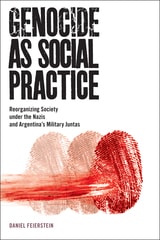
cover of Genocide as Social Practice: Reorganizing Society under the Nazis and Argentina's Military Juntas

Genocide as Social Practice

Reorganizing Society under the Nazis and Argentina's Military Juntas

by Daniel Feierstein, Translated by Douglas Andrew Town

Rutgers University Press, 2014

Genocide not only annihilates people but also destroys and reorganizes social relations, using terror as a method. In Genocide as Social Practice, social scientist Daniel Feierstein looks at the policies of state-sponsored repression pursued by the Argentine military dictatorship against political opponents between 1976 and 1983 and those pursued by the Third Reich between 1933 and 1945. He finds similarities, not in the extent of the horror but in terms of the goals of the perpetrators.

The Nazis resorted to ruthless methods in part to stifle dissent but even more importantly to reorganize German society into a Volksgemeinschaft, or people’s community, in which racial solidarity would supposedly replace class struggle. The situation in Argentina echoes this. After seizing power in 1976, the Argentine military described its own program of forced disappearances, torture, and murder as a “process of national reorganization” aimed at remodeling society on “Western and Christian” lines.

For Feierstein, genocide can be considered a technology of power—a form of social engineering—that creates, destroys, or reorganizes relationships within a given society. It influences the ways in which different social groups construct their identity and the identity of others, thus shaping the way that groups interrelate. Feierstein establishes continuity between the “reorganizing genocide” first practiced by the Nazis in concentration camps and the more complex version—complex in terms of the symbolic and material closure of social relationships —later applied in Argentina. In conclusion, he speculates on how to construct a political culture capable of confronting and resisting these trends.

First published in Argentina, in Spanish, Genocide as Social Practice has since been translated into many languages, now including this English edition. The book provides a distinctive and valuable look at genocide through the lens of Latin America as well as Europe.

Download open access ebook here.
[more]
cover of Genocide: Truth, Memory, and Representation

Genocide

Truth, Memory, and Representation

Alexander Laban Hinton and Kevin Lewis O Neill, eds.

Duke University Press, 2009

What happens to people and the societies in which they live after genocide? How are the devastating events remembered on the individual and collective levels, and how do these memories intersect and diverge as the rulers of postgenocidal states attempt to produce a monolithic “truth” about the past? In this important volume, leading anthropologists consider such questions about the relationship of genocide, truth, memory, and representation in the Balkans, East Timor, Germany, Guatemala, Indonesia, Nigeria, Rwanda, Sudan, and other locales.

Specialists on the societies about which they write, these anthropologists draw on ethnographic research to provide on-the-ground analyses of communities in the wake of mass brutality. They investigate how mass violence is described or remembered, and how those representations are altered by the attempts of others, from NGOs to governments, to assert “the truth” about outbreaks of violence. One contributor questions the neutrality of an international group monitoring violence in Sudan and the assumption that such groups are, at worst, benign. Another examines the consequences of how events, victims, and perpetrators are portrayed by the Rwandan government during the annual commemoration of that country’s genocide in 1994. Still another explores the silence around the deaths of between eighty and one hundred thousand people on Bali during Indonesia’s state-sponsored anticommunist violence of 1965–1966, a genocidal period that until recently was rarely referenced in tourist guidebooks, anthropological studies on Bali, or even among the Balinese themselves. Other contributors consider issues of political identity and legitimacy, coping, the media, and “ethnic cleansing.” Genocide: Truth, Memory, and Representation reveals the major contribution that cultural anthropologists can make to the study of genocide.

Contributors. Pamela Ballinger, Jennie E. Burnet, Conerly Casey, Elizabeth Drexler, Leslie Dwyer, Alexander Laban Hinton, Sharon E. Hutchinson, Uli Linke, Kevin Lewis O’Neill, Antonius C. G. M. Robben, Debra Rodman, Victoria Sanford

[more]
cover of Ghosts Over the Boiler: Voices from Alabama's Death Row

Ghosts Over the Boiler

Voices from Alabama's Death Row

Project Hope to Abolish the Death Penalty; Edited by Katie Owens-Murphy

Vanderbilt University Press, 2023

From a donated typewriter that frequently breaks down, people on Alabama's death row have literally cut and pasted together a newsletter, On Wings of Hope, for the last three decades to educate the public about the death penalty. This newsletter, a labor of love, documents decades of work, wisdom, activism, and lived experience of those who have been executed, or are scheduled to be executed, by the state of Alabama. The writings also chart the changing policy and practice of capital punishment in the state that sentences more people to death per capita than any other in the US.

Ghosts Over the Boiler is a curated collection of poetry, visual art, photographs, essays, creative writings, and other archival materials that have emerged from Alabama's death row from the organization Project Hope to Abolish the Death Penalty (PHADP). This group was founded at Holman Correctional Facility and has been operating autonomously since 1989 toward its mission to abolish the death penalty in Alabama and in the nation.
[more]
cover of Global Child: Children and Families Affected by War, Displacement, and Migration

Global Child

Children and Families Affected by War, Displacement, and Migration

Myriam Denov

Rutgers University Press, 2023
Armed conflicts continue to wreak havoc on children and families around the world with profound effects. In 2017, 420 million children—nearly one in five—were living in conflict-affected areas, an increase in 30 million from the previous year. The recent surge in war-induced migration, referred to as a “global refugee crisis” has made migration a highly politicized issue, with refugee populations and host countries facing unique challenges. We know from research related to asylum seeking families that it is vital to think about children and families in relation to what it means to stay together, what it means for parents to be separated from their children, and the kinds of everyday tensions that emerge in living in dangerous, insecure, and precarious circumstances. In Global Child, the authors draw on what they have learned through their collaborative undertakings, and highlight the unique features of participatory, arts-based, and socio-ecological approaches to studying war-affected children and families, demonstrating the collective strength as well as the limitations and ethical implications of such research. Building on work across the Global South and the Global North, this book aims to deepen an understanding of their tri-pillared approach, and the potential of this methodology for contributing to improved practices in working with war-affected children and their families.
[more]
cover of Global Visions of Violence: Agency and Persecution in World Christianity

Global Visions of Violence

Agency and Persecution in World Christianity

Jason Bruner

Rutgers University Press, 2023

In Global Visions of Violence, the editors and contributors argue that violence creates a lens, bridge, and method for interdisciplinary collaboration that examines Christianity worldwide in the twentieth and twenty-first centuries. By analyzing the myriad ways violence, persecution, and suffering impact Christians and the imagination of Christian identity globally, this interdisciplinary volume integrates the perspectives of ethicists, historians, anthropologists, and ethnographers to generate new conversations. Taken together, the chapters in this book challenge scholarship on Christian growth that has not accounted for violence while analyzing persecution narratives that can wield data toward partisan ends.  This allows Global Visions of Violence to push urgent conversations forward, giving voice to projects that illuminate wide and often hidden landscapes that have been shaped by global visions of violence, and seeking solutions that end violence and turn toward the pursuit of justice, peace, and human rights among suffering Christians. 
[more]