Results by title
221 books match the query 'Imperialism' and 6 start with g

Games of Empire
Global Capitalism and Video GamesNick Dyer-Witheford
University of Minnesota Press, 2009
In the first decade of the twenty-first century, video games are an integral part of global media culture, rivaling Hollywood in revenue and influence. No longer confined to a subculture of adolescent males, video games today are played by adults around the world. At the same time, video games have become major sites of corporate exploitation and military recruitment.
In Games of Empire, Nick Dyer-Witheford and Greig de Peuter offer a radical political critique of such video games and virtual environments as Second Life, World of Warcraft, and Grand Theft Auto, analyzing them as the exemplary media of Empire, the twenty-first-century hypercapitalist complex theorized by Michael Hardt and Antonio Negri. The authors trace the ascent of virtual gaming, assess its impact on creators and players alike, and delineate the relationships between games and reality, body and avatar, screen and street.
Games of Empire forcefully connects video games to real-world concerns about globalization, militarism, and exploitation, from the horrors of African mines and Indian e-waste sites that underlie the entire industry, the role of labor in commercial game development, and the synergy between military simulation software and the battlefields of Iraq and Afghanistan exemplified by Full Spectrum Warrior to the substantial virtual economies surrounding World of Warcraft, the urban neoliberalism made playable in Grand Theft Auto, and the emergence of an alternative game culture through activist games and open-source game development.
Rejecting both moral panic and glib enthusiasm, Games of Empire demonstrates how virtual games crystallize the cultural, political, and economic forces of global capital, while also providing a means of resisting them.

George Galphin's Intimate Empire
The Creek Indians, Family, and Colonialism in Early AmericaBryan C. Rindfleisch
University of Alabama Press, 2019
A native of Ireland, George Galphin arrived in South Carolina in 1737 and quickly emerged as one of the most proficient deerskin traders in the South. This was due in large part to his marriage to Metawney, a Creek Indian woman from the town of Coweta, who incorporated Galphin into her family and clan, allowing him to establish one of the most profitable merchant companies in North America. As part of his trade operations, Galphin cemented connections with Indigenous and European peoples across the South, while simultaneously securing links to merchants and traders in the British Empire, continental Europe, and beyond.
In George Galphin’s Intimate Empire: The Creek Indians, Family, and Colonialism in Early America, Bryan C. Rindfleisch presents a complex narrative about eighteenth-century cross-cultural relationships. Reconstructing the multilayered bonds forged by Galphin and challenging scholarly understandings of life in the Native South, the American South more broadly, and the Atlantic World, Rindfleisch looks simultaneously at familial, cultural, political, geographical, and commercial ties—examining how eighteenth-century people organized their world, both mentally and physically. He demonstrates how Galphin’s importance emerged through the people with whom he bonded. At their most intimate, Galphin’s multilayered relationships revolved around the Creek, Anglo-French, and African children who comprised his North American family, as well as family and friends on the other side of the Atlantic.
Through extensive research in primary sources, Rindfleisch reconstructs an expansive imperial world that stretches across the American South and reaches into London and includes Indians, Europeans, and Africans who were intimately interconnected and mutually dependent. As a whole, George Galphin’s Intimate Empire provides critical insights into the intensely personal dimensions and cross-cultural contours of the eighteenth-century South and how empire-building and colonialism were, by their very nature, intimate and familial affairs.
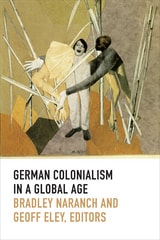
German Colonialism in a Global Age
Bradley Naranch and Geoff Eley, eds.
Duke University Press, 2015
Contributors. Dirk Bönker, Jeff Bowersox, David Ciarlo, Sebastian Conrad, Christian S. Davis, Geoff Eley, Jennifer Jenkins, Birthe Kundus, Klaus Mühlhahn, Bradley Naranch, Deborah Neill, Heike Schmidt, J. P. Short, George Steinmetz, Dennis Sweeney, Brett M. Van Hoesen, Andrew Zimmerman
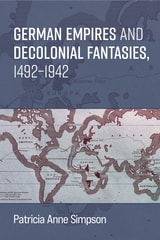
German Empires and Decolonial Fantasies, 1492–1942
Patricia Anne Simpson
University of Michigan Press, 2025
2026 DAAD/GSA Prize for the Best Book in History and Social Sciences Winner
German Empires and Decolonial Fantasies, 1492–1942 investigates the ways German-speaking Europe’s cultural narratives reflect histories of entanglement with the colonial world. Drawing from an impressive range of sources, Patricia Anne Simpson decodes the ironclad colonial logic that reproduces and inflects tropes of the conquistador, scientific explorer, and pioneers. She brings them into dialogue with a cast of historical agents who reimagine the cannibal, the enslaved, the conquered, Indigenous interlocutors, and the ungovernable. Throughout, intersectional attributes of race, gender, ethnicity, and religion reconfigure around shades of European whiteness. Individual chapters explore the Hohenzollern legacy in early modernity; debates about sovereignty and enslavement; recruitment literature, prose and fiction about migration and colonization in Africa and the Americas; and colonial memoirs driven by recolonial fantasies after 1918. German Empires and Decolonial Fantasies advances efforts to decolonize the multiple disciplines that intersect the field of German studies, including literary criticism, history, philosophy, art history, and anthropology.
German Empires and Decolonial Fantasies, 1492–1942 draws from a wide range of sources, from a seventeenth-century Brandenburg fort on the coast of Ghana to a novella about a beleaguered colonial administrator in German East Africa, to advance an interdisciplinary discourse at the nexus of colonial narratives and national imaginaries. Through detailed case studies, Simpson argues for the inclusion of voices that pushed back against imperialist expansion or intervention, as well as those historical actors who disputed the supremacy of whiteness and the persuasive power of German-centric national history.

Global Trade and Visual Arts in Federal New England
Patricia Johnston
University of New Hampshire Press, 2014
This book will appeal to a broad audience of historians and students of American visual art, as well as scholars and students of fine and decorative arts.
Hardcover is un-jacketed.

Globalization, Nationalism, and Imperialism
A New History of Eastern EuropeJames W. Peterson
Central European University Press, 2023
The authors of this book retell the political and economic history of East-Central Europe, the post-communist Balkans, and the Baltic states and speculate about their future from the vantage point of three competing forces operating in the region: territorial imperialism, globalization, and nationalism.
Exposed to imperial aspirations, the geographic area from the Baltic Sea to the Black Sea has in the past 150 years been subject to alternating waves of globalization and nationalism. The nineteenth century Eastern European empires were open to forces of economic globalization, but all collapsed at the end of World War One. Emerging nation-states embraced the logic of Western-led globalization but were subjugated by Nazi and Soviet empires, which pursued policies of economic autarchy. The demise of the Soviet empire marked the revival of pre-1939 nation-states and the re-entry of forces of liberalism and globalization into the region, with multiple crises of economic transition, ethnic militancy, new forms of authoritarianism, and external security threats. By 2010 negative, nationalist-populist reactions against crises that globalization brought to Eastern Europe became the dominant political trend. The analysis involves the consideration about the very contemporary factors of Brexit and COVID, as well as Russia’s and China’s influences, and their effects on Eastern Europe.