110 books match the query 'Italian' and 3 start with g
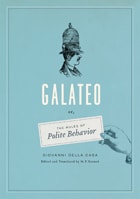
cover of Galateo: Or, The Rules of Polite Behavior

Galateo

Or, The Rules of Polite Behavior

Giovanni Della Casa

University of Chicago Press, 2013

“Since it is the case that you are now just beginning that journey that I have for the most part as you see completed, that is, the one through mortal life, and loving you so very much as I do, I have proposed to myself—as one who has been many places—to show you those places in life where, walking through them, I fear you could easily either fall or take the wrong direction.”

So begins Galateo, a treatise on polite behavior written by Giovanni Della Casa (1503–56) for the benefit of his nephew, a young Florentine destined for greatness.
           
In the voice of a cranky yet genial old uncle, Della Casa offers the distillation of what he has learned over a lifetime of public service as diplomat and papal nuncio. As relevant today as it was in Renaissance Italy, Galateo deals with subjects as varied as dress codes, charming conversation and off-color jokes, eating habits and hairstyles, and literary language. In its time, Galateo circulated as widely as Machiavelli’s Prince and Castiglione’s Book of the Courtier. Mirroring what Machiavelli did for promoting political behavior, and what Castiglione did for behavior at court, Della Casa here creates a picture of the refined man caught in a world in which embarrassment and vulgarity prevail. Less a treatise promoting courtly values or a manual of savoir faire, it is rather a meditation on conformity and the law, on perfection and rules, but also an exasperated—often theatrical—reaction to the diverse ways in which people make fools of themselves in everyday social situations.
           
With renewed interest in etiquette and polite behavior growing both inside and outside the academy, the time is right for a new, definitive edition of this book. More than a mere etiquette book, this restored edition will be entertaining (and even useful) for anyone making their way in modern civilized and polite society, and a subtle gift for the rude neighbor, the thoughtless dinner guest, or the friend or relative in need of a refresher on proper behavior.
[more]
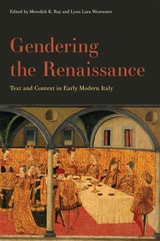
cover of Gendering the Renaissance: Text and Context in Early Modern Italy

Gendering the Renaissance

Text and Context in Early Modern Italy

Meredith K. Ray

University of Delaware Press, 2023
The essays in this volume revisit the Italian Renaissance to rethink spaces thought to be defined and certain: from the social spaces of convent, court, or home, to the literary spaces of established genres such as religious plays or epic poetry. Repopulating these spaces with the women who occupied them but have often been elided in the historical record, the essays also remind us to ask what might obscure our view of texts and archives, what has remained marginal in the texts and contexts of early modern Italy and why. The contributors, suggesting new ways of interrogating gendered discourses of genre, identities, and sanctity, offer a complex picture of gender in early modern Italian literature and culture. Read in dialogue with one another, their pieces provide a fascinating survey of currents in gender studies and early modern Italian studies and point to exciting future directions in these fields.
[more]
cover of Gratis!: A Flipped Classroom and Active Learning Approach to Italian, Introductory Level

Gratis!

A Flipped Classroom and Active Learning Approach to Italian, Introductory Level

Carmelo A, Galati

Temple University Press, 2026

Gratis! A Flipped-Classroom and Active Learning Approach to Italian is an open textbook intended for students with no previous knowledge of Italian. The textbook follows a thematic outline in which each chapter presents topics in a contextualized manner to allow students to communicate simply and effectively in the target language while introducing them to Italian culture. The textbook covers all the major grammar topics that allow students to communicate simply and effectively in the present tense of regular, irregular, and reflexive verbs. Students will also be able to narrate events in the past by using the present perfect and imperfect tenses. The second half of the textbook expands students' communicative skills by introducing the future tense, the imperative mood, the present and past conditional, and the present and past subjunctive. Gratis! offers students and educators a book that complements a flipped classroom and integrated course design to improve students' learning.

[more]