Results by title
412 books match the query 'Japan' and 11 start with g

Gas Mask Nation
Visualizing Civil Air Defense in Wartime JapanGennifer Weisenfeld
University of Chicago Press, 2023
Airplanes, gas masks, and bombs were common images in wartime Japan. Yet amid these emblems of anxiety, tasty caramels were offered to children with paper gas masks as promotional giveaways, and magazines featured everything from attractive models in the latest civil defense fashion to futuristic weapons.
Gas Mask Nation explores the multilayered construction of an anxious yet perversely pleasurable visual culture of Japanese civil air defense—or bōkū—through a diverse range of artworks, photographs, films and newsreels, magazine illustrations, postcards, cartoons, advertising, fashion, everyday goods, government posters, and state propaganda. Gennifer Weisenfeld reveals the immersive aspects of this culture, in which Japan’s imperial subjects were mobilized to regularly perform highly orchestrated civil air defense drills throughout the country.
The war years in Japan are often portrayed as a landscape of privation and suppression under the censorship of the war machine. But alongside the horrors, pleasure, desire, wonder, creativity, and humor were all still abundantly present in a period before air raids went from being a fearful specter to a deadly reality.
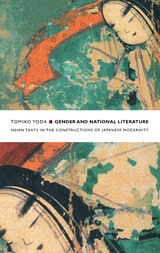
Gender and National Literature
Heian Texts in the Constructions of Japanese ModernityTomiko Yoda
Duke University Press, 2004
Moving back and forth between a critique of modern discourses on Heian literature and close analyses of the Heian texts themselves, Yoda sheds light on some of the most persistent interpretive models underwriting Japanese literary studies, particularly the modern paradigm of a masculine national subject. She proposes new directions for disciplinary critique and suggests that historicized understandings of premodern texts offer significant insights into contemporary feminist theories of subjectivity and agency.
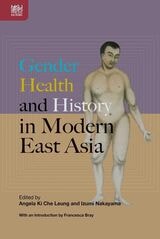
Gender, Health, and History in Modern East Asia
Edited by Angela Ki Che Leung and Izumi Nakayama
Hong Kong University Press, 2017
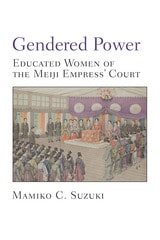
Gendered Power
Educated Women of the Meiji Empress' CourtMamiko C. Suzuki
University of Michigan Press, 2019

Ghosts and The Japanese
Cultural Experience in Japanese Death LegendsMichiko Iwasaka & Barre Toelken
Utah State University Press, 1994
The Japanese have ambivalent attitudes toward death, deeply rooted in pre-Buddhist traditions. In this scholarly but accessible work, authors Iwasaka and Toelken show that everyday beliefs and customs--particularly death traditions--offer special insight into the living culture of Japan.

Ghosts in the Neighborhood
Why Japan Is Haunted by Its Past and Germany Is NotWalter F. Hatch
University of Michigan Press, 2023
Germany, which brutalized its neighbors in Europe for centuries, has mostly escaped the ghosts of the past, while Japan remains haunted in Asia. The most common explanation for this difference is that Germany knows better how to apologize; Japan is viewed as “impenitent.” Walter F. Hatch rejects the conventional wisdom and argues that Germany has achieved reconciliation with neighbors by showing that it can be a trustworthy partner in regional institutions like the European Union and NATO; Japan has never been given that opportunity (by its dominant partner, the U.S.) to demonstrate such an ability to cooperate. This book rigorously defends the argument that political cooperation—not discourse or economic exchange—best explains Germany’s relative success and Japan’s relative failure in achieving reconciliation with neighbors brutalized by each regional power in the past. It uses paired case studies (Germany-France and Japan-South Korea; Germany-Poland and Japan-China) to gauge the effect of these competing variables on public opinion over time. With numerous charts, each of the four empirical chapters illustrates the powerful causal relationship between institution building and interstate reconciliation.
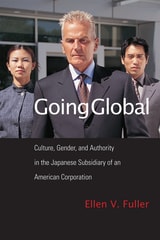
Going Global
Culture, Gender, and Authority in the Japanese Subsidiary of an American CorporationEllen V. Fuller
Temple University Press, 2009
In this intriguing ethnography, Ellen Fuller investigates how issues of gender and identity as they relate to authority are addressed in a globalizing corporate culture. Going Global goes behind the office politics, turf wars and day-to-day workings of a transnational American company in Japan in the late 1990s as employees try to establish a comfortable place within the company.
Fuller looks at how relationships among Asians and between Asians and Americans are tested as individuals are promoted to positions of power and authority. Is there pressure for the Japanese to be more “American” to get ahead in business? Do female employees have to subscribe to certain stereotypes to be promoted or respected? How these American and Japanese workers assess one another raises important questions about international business management and human resources.

Going to Court to Change Japan
Social Movements and the Law in Contemporary JapanPatricia G. Steinhoff, Editor
University of Michigan Press, 2014

Great Negotiations
Agreements that Changed the Modern WorldFredrik Stanton
Westholme Publishing, 2010
Lessons in Diplomacy from Colonial America to the Cold War
"In a time when negotiations, both great and small, continue to shape our world, this book provides an excellent opportunity to learn from the past and understand the present.”—Kofi Annan, Nobel Peace Prize Winner and former Secretary General of the United Nations
“A thought-provoking, informative book, highly recommended for all readers interested in international affairs.”—Library Journal
“For anyone with an interest in diplomacy and political history, Stanton's book is both entertaining and informative.” —Foreign Policy Watch
“Every professional concerned with dispute resolution and every student of negotiation has much to learn from Fredrik Stanton's lively stories of eight history-shaping negotiations.”—Robert H. Mnookin, Chair Program on Negotiation, Harvard Law School
“An excellent introduction into some of the great triumphs and failures of modern diplomacy.”—Seattle Post-Intelligencer
“An interesting, informative study well worth reading and pondering.” —American Diplomacy
“Stanton deftly illustrates that the power of haggling can easily rival that of any army or warhead.”—Roll Call
“Exhaustive research and careful thought have enabled Stanton to employ an extraordinary writing talent to produce a contribution to history and a source of enjoyable reading.”—New York Law Journal
“Stanton brings back to life both famous and some long forgotten personalities in the history of major American, European, and Asian negotiations. He persuasively makes his case for the importance of negotiators and negotiations both when wars can be kept from beginning and when wars end. He weaves in deft descriptions of the personal strengths and foibles of negotiators and homes in on the ability of the best to improvise when maneuvering on unfamiliar terrain.” —Ambassador Richard W. Murphy, Council on Foreign Relations
Words as much as weapons have shaped the course of history. Whether to avert, resolve, assist, or secure the outcome of a conflict, diplomacy in the modern age has had great triumphs and bitter failures, from the Cuban Missile Crisis in 1962, which narrowly spared humanity from a nuclear Armageddon, to the Treaty of Versailles after World War I, which created problems that still confront us today. Drawing on primary sources, transcripts, and interviews, Great Negotiations: Agreements that Changed the Modern World tells the stories of eight key episodes in modern diplomacy. From Benjamin Franklin securing crucial French support for the American revolution to Reagan and Gorbachev laying the groundwork to eliminate an entire class of nuclear weapons, Fredrik Stanton explains what each party brought to the negotiating table, the stakes, the obstacles to success, and how they were overcome.
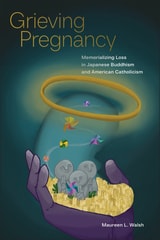
Grieving Pregnancy
Memorializing Loss in Japanese Buddhism and American CatholicismMaureen L. Walsh
Rutgers University Press, 2025
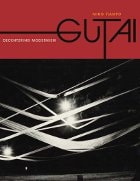
Gutai
Decentering ModernismMing Tiampo
University of Chicago Press, 2011
Gutai is the first book in English to examine Japan’s best-known modern art movement, a circle of postwar artists whose avant-garde paintings, performances, and installations foreshadowed many key developments in American and European experimental art.
Working with previously unpublished photographs and archival resources, Ming Tiampo considers Gutai’s pioneering transnational practice, spurred on by mid-century developments in mass media and travel that made the movement’s field of reception and influence global in scope. Using these lines of transmission to claim a place for Gutai among modernist art practices while tracing the impact of Japan on art in Europe and America, Tiampo demonstrates the fundamental transnationality of modernism. Ultimately, Tiampo offers a new conceptual model for writing a global history of art, making Gutai an important and original contribution to modern art history.