Results by title
356 books match the query 'Jewish Studies' and 11 start with g
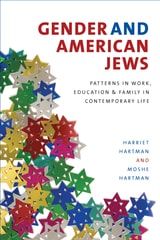
Gender and American Jews
Patterns in Work, Education, and Family in Contemporary LifeHarriet Hartman and Moshe Hartman
Brandeis University Press, 2009
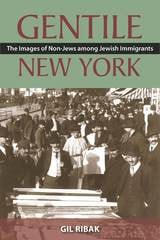
Gentile New York
The Images of Non-Jews among Jewish ImmigrantsRibak, Gil
Rutgers University Press, 2012
The very question of “what do Jews think about the goyim” has fascinated Jews and Gentiles, anti-Semites and philo-Semites alike. Much has been written about immigrant Jews in nineteenth- and twentieth-century New York City, but Gil Ribak’s critical look at the origins of Jewish liberalism in America provides a more complicated and nuanced picture of the Americanization process.
Gentile New York examines these newcomers’ evolving feelings toward non-Jews through four critical decades in the American Jewish experience. Ribak considers how they perceived Gentiles in general as well as such different groups as “Yankees” (a common term for WASPs in many Yiddish sources), Germans, Irish, Italians, Poles, and African Americans. As they discovered the complexity of America’s racial relations, the immigrants found themselves at odds with “white” American values or behavior and were drawn instead into cooperative relationships with other minorities. Sparked with many previously unknown anecdotes, quotations, and events, Ribak’s research relies on an impressive number of memoirs, autobiographies, novels, newspapers, and journals culled from both sides of the Atlantic.
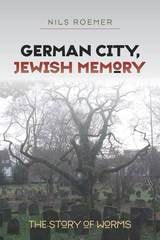
German City, Jewish Memory
The Story of WormsNils Roemer
Brandeis University Press, 2010
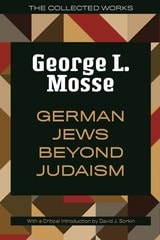
German Jews Beyond Judaism
George L. Mosse, With a critical introduction by David J. Sorkin
University of Wisconsin Press, 2025
German Jews Beyond Judaism was, in Mosse’s own estimation, his “most personal book, almost a confession of faith.” David J. Sorkin’s new critical introduction illustrates how Mosse’s life and values both shaped and exemplified his historical analysis and offers potential meanings of his intellectual legacy for the present day.
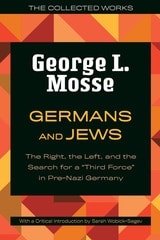
Germans and Jews
The Right, the Left, and the Search for a "Third Force" in Pre-Nazi GermanyGeorge L. Mosse
University of Wisconsin Press, 2023
This innovative perspective has implications for understanding not only the rise of fascism and Nazism in Germany but also the rise and fall of the New Left in the United States and Europe, which was occurring at the time of Mosse’s writing. A new critical introduction by Sarah Wobick-Segev, research associate at the University of Hamburg, places Mosse’s work in its historical and intellectual contexts and draws lessons for students and scholars today.
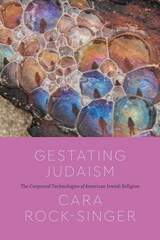
Gestating Judaism
The Corporeal Technologies of American Jewish ReligionCara Rock-Singer
University of Chicago Press, 2026
An ethnography of how people use reproductive practices to transmit and reinvent American Judaism.
In Gestating Judaism, Cara Rock-Singer develops a new analytic technique called ethnodrashy (a combination of rabbinical midrash and sociological ethnography) to explore the centrality of reproductive bodies to the intellectual, political, and spiritual life of American Judaism. She considers how, in reproduction, religious practices like the mikveh combine with secular practices like fertility treatments in ways that challenge the popular idea that religion occupies a separate sphere of life from politics or science. In fact, Rock-Singer shows how Jewish feminists have leveraged the work of reproduction to intervene in important conversations about both politics and theology. Drawing together religious studies, gender studies, and science and technology studies, Gestating Judaism shows how Jewish tradition is transmitted and reinvented through the ongoing labor of reproduction.

Glikl
Memoirs 1691-1719Annotated by and with an Introduction by Chava Turniansky
Brandeis University Press, 2019
These words from the memoirs Glikl bas Leib wrote in Yiddish between 1691 and 1719 shed light on the life of a devout and worldly woman. Writing initially to seek solace in the long nights of her widowhood, Glikl continued to record the joys and tribulations of her family and community in an account unique for its impressive literary talents and strong invocation of self. Through intensely personal recollections, Glikl weaves stories and traditional tales that express her thoughts and beliefs. While influenced by popular Yiddish moral literature, Glikl’s frequent use of first person and the significance she assigns her own life experience set the work apart. Informed by fidelity to the original Yiddish text, this authoritative new translation is fully annotated to explicate Glikl’s life and times, offering readers a rich context for appreciating this classic work.
Glorious, Accursed Europe
Jehuda Reinharz and Yaacov Shavit
Brandeis University Press, 2010

Gregg Bordowitz
I Wanna Be WellEdited by Robyn Farrell and Solveig Nelson
University of Chicago Press, 0
The first monograph to trace artist and activist Gregg Bordowitz’s visual practice.
For over four decades, Gregg Bordowitz has been a force in contemporary art, recognized for his work as an AIDS activist and an artist working in video, conceptual art, and institutional critique. During the 1980s, Bordowitz made vital contributions in the early years of ACT UP (AIDS Coalition to Unleash Power) in New York, where he cofounded video collectives including Testing the Limits and DIVA (Damn Interfering Video Activists). His collaborative activist work formed the foundation of his art practice—a sprawling, diverse, and deeply human endeavor that has explored his gay and Jewish identities within the context of the ongoing AIDS crisis.
Despite his expansive artistic production, activism, and influence, there has yet to be a full monographic exploration of Bordowitz’s work. This landmark volume serves as the first publication dedicated exclusively to his visual work, offering a comprehensive portrait of an artist in constant motion. I Wanna Be Well—named after the 1977 Ramones song—traces the emergence of his visual art practice. Developed in close collaboration with Bordowitz and a team of art historians, curators, scholars, poets, and artists who have worked with him over the years, this book reveals Bordowitz’s practice as an evolving investigation of how to live, teach, and make art through sustained acts of care, critique, and remembrance. Lavishly illustrated with color throughout, the essays, interviews, poetry, and other writings gathered here present a rich look at Bordowitz’s life and career.
Growing Up Ethnic
Nationalism and the Bildungsroman in African American and Jewish American FictionJaptok, Martin
University of Iowa Press, 2005
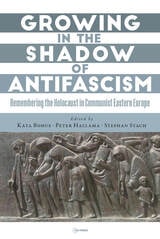
Growing in the Shadow of Antifascism
Remembering the Holocaust in State-Socialist Eastern EuropeKata Bohus
Central European University Press, 2022
Reined into the service of the Cold War confrontation, antifascist ideology overshadowed the narrative about the Holocaust in the communist states of Eastern Europe. This led to the Western notion that in the Soviet Bloc there was a systematic suppression of the memory of the mass murder of European Jews. Going beyond disputing the mistaken opposition between “communist falsification” of history and the “repressed authentic” interpretation of the Jewish catastrophe, this work presents and analyzes the ways as the Holocaust was conceptualized in the Soviet-ruled parts of Europe.
The authors provide various interpretations of the relationship between antifascism and Holocaust memory in the communist countries, arguing that the predominance of an antifascist agenda and the acknowledgment of the Jewish catastrophe were far from mutually exclusive. The interactions included acts of negotiation, cross-referencing, and borrowing. Detailed case studies describe how both individuals and institutions were able to use anti-fascism as a framework to test and widen the boundaries for discussion of the Nazi genocide. The studies build on the new historiography of communism, focusing on everyday life and individual agency, revealing the formation of a great variety of concrete, local memory practices.