Results by title
169 books match the query 'Juvenile Nonfiction' and 6 start with g

Gaylord Nelson
Champion for Our EarthSheila Terman Cohen
Wisconsin Historical Society Press, 2010
Born in Clear Lake, Wisconsin, in 1916, Gaylord grew up as immersed in his parents' political work and community service as he was in playing practical jokes and exploring the natural world surrounding his home town. Along the way he encountered experiences that would shape him in fundamental ways: as a man who stood up for what he believed in the face of opposition and yet who also understood how to treat his opponents with respect. Both traits would serve him well as he rose from law student to state senator to Wisconsin governor and finally to three terms as a United States Senator.
Nelson fought to treat all races equally and to condemn McCarthy-era paranoia, but his greatest contribution was to sound the alarm about another battle: the fight to save the natural world and the earth itself. It was his idea to use teach-ins to let people know that the environment needed their help. Thanks to him, more natural resources were conserved and new laws demanded clean air and water. Now, every year on April 22, people all over the world plant trees and pick up litter to celebrate Earth Day. The Earth and its inhabitants aren't safe yet, but Gaylord Nelson demonstrated that even one person can help to save the world.
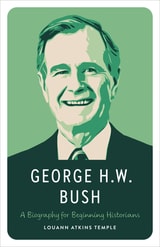
George H.W. Bush
A Biography for Beginning HistoriansLouann Atkins Temple
University of Texas Press, 2025
A brief biography of George H.W. Bush for young readers.
Louann Temple is a lifelong Texan with a personal passion for arts and education who believes that biography, with its emphasis on personalities, is ideal for introducing young people to history, with its focus on events. Temple is uniquely situated to write this biography for young readers, as she has been personally acquainted with many important people in presidential history, President George H. W. Bush included, and she has mentored countless middle and high school students, preparing them for college admission.
George H. W. Bush highlights the key events in the life of the forty-first president; explores the life lessons afforded by his legacy; and reflects on the broad historical issues during his time in the White House as president from 1989 to 1993. George H. W. Bush’s legacy as president is remarkable as he guided America through the end of the Cold War and helped to reunite a divided Germany. Enhanced with a carefully curated selection of black and white photographs from three presidential libraries, this biography for beginning historians is poised to bring the best of biography and history to a new generation of readers.
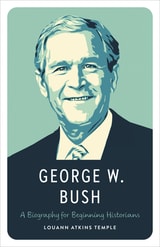
George W. Bush
A Biography for Beginning HistoriansLouann Atkins Temple
University of Texas Press, 2025
A brief biography of George W. Bush for young readers.
Louann Temple is a lifelong Texan with a personal passion for arts and education who believes that biography, with its emphasis on personalities, is ideal for introducing young people to history, with its focus on events. Temple is uniquely situated to write this biography for young readers, as she has been personally acquainted with many important people in presidential history, President George W. Bush included, and she has mentored countless middle and high school students, preparing them for college admission.
George W. Bush highlights the key events in the life of the forty-third president; explores the life lessons afforded by his legacy; and reflects on the broad historical issues during his time in the White House as president from 2001 to 2009. George W. Bush’s legacy as president is significant as he guided America through the events of 9/11. Enhanced with a carefully curated selection of black and white photographs from three presidential libraries, this biography for beginning historians is poised to bring the best of biography and history to a new generation of readers.

Gone Again Ptarmigan
Jonathan London
University of Alaska Press, 2013
Great Ships on the Great Lakes Teacher's Guide
A Maritime HistoryCathy Green
Wisconsin Historical Society Press, 2013
Great Ships on the Great Lakes explores the history of the region’s rivers, lakes, and inland seas—and the people and ships who navigated them. Read along as the first peoples paddle tributaries in birch bark canoes. Follow as European voyageurs pilot rivers and lakes to get beaver pelts back to the eastern market. Watch as settlers build towns and eventually cities on the shores of the Great Lakes. Listen to the stories of sailors, lighthouse keepers, and shipping agents whose livelihoods depended on the dangerous waters of Lake Michigan, Superior, Huron, Erie, and Ontario. Give an ear to their stories of unexpected tragedy and miraculous rescue, and heed their tales of risk and reward on the low seas.
Great Ships also tells the story of sea battles and gunships, of the first vessels to travel beyond the Niagara, and of the treacherous storms and cold weather that caused thousands of ships to sink in the Great Lakes. Watch as underwater archaeologists solve the mysteries of Great Lakes shipwrecks today. And learn how the shift from sail to steam forever changed the history of shipping, as schooners made way for steamships and bulk freighters, and sailing became a recreation, not a hazardous way of life.
Designed for the upper elementary classroom with emphasis on Michigan and Wisconsin, Great Ships on the Great Lakes includes a timeline of events, on-page vocabulary, and a list of resources and places to visit. Over 20 maps highlight the region’s maritime history. The accompanying Teacher’s Guide includes 18 classroom activities, arranged by chapter, including lessons on exploring shipwrecks and learning how glaciers moved across the landscape.
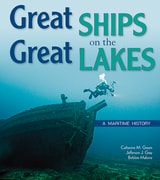
Great Ships on the Great Lakes
A Maritime HistoryBobbie Malone
Wisconsin Historical Society Press, 2013
In this highly accessible history of ships and shipping on the Great Lakes, upper elementary readers are taken on a rip-roaring journey through the waterways of the upper Midwest.
Great Ships on the Great Lakes explores the history of the region’s rivers, lakes, and inland seas—and the people and ships who navigated them. Read along as the first peoples paddle tributaries in birch bark canoes. Follow as European voyageurs pilot rivers and lakes to get beaver pelts back to the eastern market. Watch as settlers build towns and eventually cities on the shores of the Great Lakes. Listen to the stories of sailors, lighthouse keepers, and shipping agents whose livelihoods depended on the dangerous waters of Lake Michigan, Superior, Huron, Erie, and Ontario. Give an ear to their stories of unexpected tragedy and miraculous rescue, and heed their tales of risk and reward on the low seas.
Great Ships also tells the story of sea battles and gunships, of the first vessels to travel beyond the Niagara, and of the treacherous storms and cold weather that caused thousands of ships to sink in the Great Lakes. Watch as underwater archaeologists solve the mysteries of Great Lakes shipwrecks today. And learn how the shift from sail to steam forever changed the history of shipping, as schooners made way for steamships and bulk freighters, and sailing became a recreation, not a hazardous way of life.
Designed for the upper elementary classroom with emphasis on Michigan and Wisconsin, Great Ships on the Great Lakes includes a timeline of events, on-page vocabulary, and a list of resources and places to visit. Over 20 maps highlight the region’s maritime history. The accompanying Teacher’s Guide includes 18 classroom activities, arranged by chapter, including lessons on exploring shipwrecks and learning how glaciers moved across the landscape.