Results by title
486 books match the query 'LGBTQ+' and 15 start with g
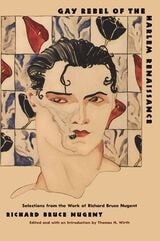
Gay Rebel of the Harlem Renaissance
Selections from the Work of Richard Bruce NugentRichard Bruce Nugent
Duke University Press, 2002
Thomas H. Wirth, a close friend of Nugent’s during the last years of the artist’s life, has assembled a selection of Nugent’s most important writings, paintings, and drawings—works mostly unpublished or scattered in rare and obscure publications and collected here for the first time. Wirth has written an introduction providing biographical information about Nugent’s life and situating his art in relation to the visual and literary currents which influenced him. A foreword by Henry Louis Gates Jr. emphasizes the importance of Nugent for African American history and culture.
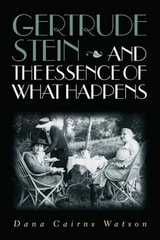
Gertrude Stein and the Essence of What Happens
Dana Cairns Watson
Vanderbilt University Press, 2005
Seeking to sustain Stein's lively, pleasant, populist spirit, Watson shows how the writer's playful entanglement of sight and sound--of silent reading and social speaking--reveals the crucial ambiguity by which reading and conversation build communities of meaning, and thus form not only personal relationships but also our very selves and the larger political structures we inhabit. Stein reminds us that the residual properties of words and the implications behind the give-and-take of ordinary conversation offer alternatives to linear structures of social order, alternatives especially precious in times of political oppression. For example, her novels Mrs. Reynolds and Brewsie and Willie, both written in embattled Vichy France, contemplate the speech patterns of totalitarian leaders and the ways in which everyday discourse might capitulate to--or resist--such verbal tyranny.
Like recent theorists, Stein recognized the repressiveness of conventional order--carried in language and thus in thought and social organization--but as Watson persuasively shows, she also insisted that the free will of individuals can persist in language and enable change. In the play of literary aesthetics, Stein saw a liberating force.
Given Up for You
A Memoir of Love, Belonging, and BeliefErin O. White
University of Wisconsin Press, 2018
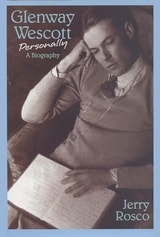
Glenway Wescott Personally
A BiographyJerry Rosco
University of Wisconsin Press, 2002
As a writer, Glenway Wescott (1901–1987) left behind several novels, including The Grandmothers and The Pilgrim Hawk, noted for their remarkable lyricism. As a literary figure, Wescott also became a symbol of his times. Born on a Wisconsin farm in 1901, he associated as a young writer with Hemingway, Stein, and Fitzgerald in 1920s Paris and subsequently was a central figure in New York’s artistic and gay communities. Though he couldn’t finish a novel after the age of forty-five, he was just as famous as an arts impresario, as a diarist, and for the company he kept: W. H. Auden, Christopher Isherwood, Marianne Moore, Somerset Maugham, E. M. Forster, Joseph Campbell, and scores of other luminaries.
In Glenway Wescott Personally, Jerry Rosco chronicles Wescott’s long and colorful life, his early fame and later struggles to write, the uniquely privileged and sometimes tortured world of artistic creation. Rosco sensitively and insightfully reveals Wescott’s private life, his long relationship with Museum of Modern Art curator Monroe Wheeler, his work with sex researcher Alfred Kinsey that led to breakthrough findings on homosexuality, and his kinship with such influential artists as Jean Cocteau, George Platt-Lynes, and Paul Cadmus.
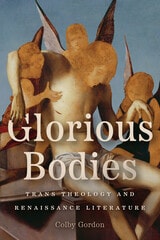
Glorious Bodies
Trans Theology and Renaissance LiteratureColby Gordon
University of Chicago Press, 2024
In this striking contribution to trans history, Colby Gordon challenges the prevailing assumption that trans life is a byproduct of recent medical innovation by locating a cultural imaginary of transition in the religious writing of the English Renaissance. Marking a major intervention in early modern gender studies, Glorious Bodies insists that transition happened, both socially and surgically, hundreds of years before the nineteenth-century advent of sexology. Pairing literary texts by Shakespeare, Webster, Donne, and Milton with a broad range of primary sources, Gordon examines the religious tropes available to early modern subjects for imagining how gender could change. From George Herbert’s invaginated Jesus and Milton’s gestational Adam to the ungendered “glorious body” of the resurrection, early modern theology offers a rich conceptual reservoir of trans imagery.
In uncovering early modern trans theology, Glorious Bodies mounts a critique of the broad consensus that secularism is a necessary precondition for trans life, while also combating contemporary transphobia and the right-wing Christian culture war seeking to criminalize transition. Developing a rehabilitative account of theology’s value for positing trans lifeworlds, this book leverages premodern religion to imagine a postsecular transness in the present.
Glorious Indiscretions
Virginia M. Scott
University of Wisconsin Press, 2027
Spanning nearly six decades and three continents, this engrossing memoir traces one woman’s sexual awakening amid a reckoning with family secrets. After a teenage Virginia stumbles onto her father’s closeted homosexuality and rampant infidelity, she spends the next few years suppressing memories of the discovery and the traumatic night when she first realized her family had a secret. Simultaneously, the glamorous jet-setting existence she had known throughout her childhood—following her father’s business ventures in France, Kenya, and Denmark—comes to a sudden end.
Years later, when Virginia Scott confides in her father about her own lesbian awakening, he advises her to “live it on the side” as he had. The consequences of this advice are disastrous: A failed marriage results in loss of custody of her children, forcing her to reckon with her sexuality and its place in her life. Forthright and unflinching, Scott’s memoir follows her path from trauma to healing, from secrets to truth, and from denying to embracing her identity.
Glory Hole
Stephen Beachy
University of Alabama Press, 2017
It’s 2006, and a cloud of darkness seems to have descended over the Earth—or at least over the minds of a ragtag assortment of Bay Area writers, drug dealers, social workers, porn directors, and Melvin, a street kid and refugee from his Mormon family. A shooter runs amok in an Amish schoolhouse, the president runs amok in the Middle East, a child is kidnapped from Disneyland, and on the local literary scene, a former child prostitute and wunderkind author that nobody has ever met has become a media sensation.
But something is fishy about this author, Huey Beauregard, and so Melvin and his friends Felicia and Philip launch an investigation into the webs of self-serving stories, lies, rumors, and propaganda that have come to constitute our sad, fractured reality.
Glory Hole is a novel about the ravages of time and the varied consequences of a romantic attitude toward literature and life. It is about AIDS, meth, porn, fake biographies, street outreach, the study of Arabic verb forms, Polish transgender modernists, obsession, and future life forms. It’s about getting lost in the fog, about prison as both metaphor and reality, madness, evil clowns, and mystical texts.
Vast and ambitious, comic and tragic, the novel also serves as a version of the I Ching, meaning it can be used as an oracle.
Glory Hole
Kim Hyun
Seagull Books, 2022
Kim Hyun’s Glory Hole is the first Korean queer poetry collection. Featuring gay teens, elders, cats, caterpillars, robots, and other unexpected characters, Kim’s fifty-one eccentric poems trace themes of love, sexual desire, abandonment, destitution, and death. In recounting the splendid yet tragic journeys of his speakers, Kim defies meaningful sense-making. His poems are a mishmash of dystopian sci-fi and pornography, storytelling and poetry, fictive references, and real figures. They are not embellished with elegant imagery; in fact, they are antithetical to it, opting instead for incoherent tense, unidiomatic expressions, and never-ending puns. After all, like LGBTQ+ people in many cultures, Korean queers live in this site of violence. Bewilderment, deliberately, is Kim Hyun’s form. Glory Hole invites readers into a very queer world.
God of River Mud
A NovelVic Sizemore
West Virginia University Press, 2024
Winner, 2025 Tennessee Book Award, Fiction
Grappling with innate desires and LGBTQ identity, a family struggles under the oppressive expectations foisted on them by fundamentalist Christianity.
Told through alternating perspectives, God of River Mud chronicles the lives of Berna Minor, her husband, their four children, and Berna’s secret lover.
To escape a life of poverty and abuse, Berna Cannaday marries Zechariah Minor, a fundamentalist Baptist preacher, and commits herself to his faith, trying to make it her own. After Zechariah takes a church beside the Elk River in rural Clay, West Virginia, Berna falls in love with someone from their congregation—Jordan, a woman who has known since childhood that he was meant to be a man. Berna keeps her secret hidden as she struggles to be the wife and mother she believes God wants her to be. Berna and Zechariah’s children struggle as well, trying to reconcile the theology they are taught at home with the fast-changing world around them. And Jordan struggles to find a community and a life that allow him both to be safely and fully himself, as Jay, and to be loved for who he is.
As the decades and stories unfold, traditional evangelical Bible culture and the values of rural Appalachia clash against innate desires, LGBTQ identity, and gender orientation. Sympathies develop—sometimes unexpectedly—as the characters begin to reconcile their faith and their love. God of River Mud delves into the quandary of those marginalized and dehumanized within a religious patriarchy and grapples with the universal issues of identity, faith, love, and belonging.
Good Night, Beloved Comrade
The Letters of Denton Welch to Eric OliverEdited and with an introduction by Daniel J. Murtaugh
University of Wisconsin Press, 2017
Though German bombs were ravaging Britain, Welch wrote in his published work about the idyllic landscapes and local people he observed in Kent. There, in 1943, he met and fell in love with Eric Oliver, a handsome, intelligent, but rather insecure "landboy"—an agricultural worker with the wartime Land Army. Oliver would become a companion, comrade, lover, and caretaker during the last six years of Welch's life. All fifty-one letters that Welch wrote to Oliver are collected and annotated here for the first time. They offer a historical record of life amidst the hardship, deprivation, and fear of World War II, and also are a timeless testament of one young man's tender and intimate emotions, his immense courage in adversity, and his continual struggle for love and creative existence.
Grant Wood’s Secrets
Sue Taylor
University of Delaware Press, 2011
Published by University of Delaware Press. Distributed worldwide by Rutgers University Press.
Greasepaint Puritan
Boston to 42nd Street in the Queer Backstage Novels of Bradford RopesMaya Cantu
University of Michigan Press, 2024
Greasepaint Puritan aims to find out and reclaim his story. Descended from Mayflower Pilgrims, Ropes rebelled against the “Proper Bostonian” life, in a career that touched upon the Jazz Age, American vaudeville, and theater censorship. We follow Ropes’s successful career as both a performer and the author of the trilogy of backstage novels: 42nd Street, Stage Mother, and Go Into Your Dance. Populated by scheming stage mothers, precocious stage children, grandiose bit players, and tart-tongued chorines, these novels centered on the lives and relationships of gay men on Broadway during the Jazz Age and Prohibition era. Rigorously researched, Greasepaint Puritan chronicles Ropes’s career as a successful screenwriter in 1930s and ’40s Hollywood, where he continued to be a part of a dynamic gay subculture within the movie industry before returning to obscurity in the 1950s. His legacy lives on in the Hollywood and Broadway incarnations of 42nd Street—but Greasepaint Puritan restores the “forgotten melody” of the man who first envisioned its colorful characters.

Gregg Bordowitz
I Wanna Be WellEdited by Robyn Farrell and Solveig Nelson
University of Chicago Press, 0
The first monograph to trace artist and activist Gregg Bordowitz’s visual practice.
For over four decades, Gregg Bordowitz has been a force in contemporary art, recognized for his work as an AIDS activist and an artist working in video, conceptual art, and institutional critique. During the 1980s, Bordowitz made vital contributions in the early years of ACT UP (AIDS Coalition to Unleash Power) in New York, where he cofounded video collectives including Testing the Limits and DIVA (Damn Interfering Video Activists). His collaborative activist work formed the foundation of his art practice—a sprawling, diverse, and deeply human endeavor that has explored his gay and Jewish identities within the context of the ongoing AIDS crisis.
Despite his expansive artistic production, activism, and influence, there has yet to be a full monographic exploration of Bordowitz’s work. This landmark volume serves as the first publication dedicated exclusively to his visual work, offering a comprehensive portrait of an artist in constant motion. I Wanna Be Well—named after the 1977 Ramones song—traces the emergence of his visual art practice. Developed in close collaboration with Bordowitz and a team of art historians, curators, scholars, poets, and artists who have worked with him over the years, this book reveals Bordowitz’s practice as an evolving investigation of how to live, teach, and make art through sustained acts of care, critique, and remembrance. Lavishly illustrated with color throughout, the essays, interviews, poetry, and other writings gathered here present a rich look at Bordowitz’s life and career.
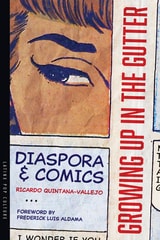
Growing Up in the Gutter
Diaspora and ComicsRicardo Quintana-Vallejo; Foreword by Frederick Luis Aldama
University of Arizona Press, 2024
While the most traditional iteration of the bildungsroman—the coming-of-age story—follows middle-class male heroes who forge their identities in a process of complex introspection, contemporary graphic coming-of-age narratives represent formative processes that fit into, resist, or even disregard narratives of socialization under capitalism, of citizenship, and of nationhood.
Quintana-Vallejo delves into several important themes: how the coming-of-age genre can be used to study adulthood, how displacement and international or global heritage are fundamental experiences, how multidiasporic approaches foreground lived experiences, and how queerness opens narratives of development to the study of adulthood as fundamentally diverse and nonconforming to social norms. Quintana-Vallejo shows how openness enables belonging among chosen families and, perhaps most importantly, freedom to disidentify. And, finally, how contemporary authors writing for the instruction of BIPOC children (and children otherwise affected by diaspora and displacement) use the didactic power of the coming-of-age genre, combined with the hybrid language of graphic narratives, to teach difficult topics in accessible ways.
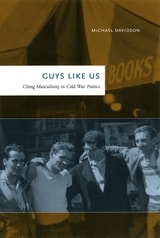
Guys Like Us
Citing Masculinity in Cold War PoeticsMichael Davidson
University of Chicago Press, 2003