Results by title
128 books match the query 'Language and languages' and 3 start with g
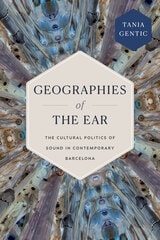
Geographies of the Ear
The Cultural Politics of Sound in Contemporary BarcelonaTania Gentic
Duke University Press, 2025
In Geographies of the Ear, Tania Gentic examines the language and soundscape of post-Franco Barcelona to listen for the remnants of a globalized colonial ear. She theorizes “echoic memory” to understand how sound circulates from the past to the present—and from neighborhood to nation to globe—to trace how sonic practices produce and contest modernity, community identity, and democracy. Focusing on migrant and tourist accents, free radio stations, punk music, drag performances, and antigentrification protests, Gentic shows how the underground sounds in Barcelona complicate a modernizing aural imaginary of place. By thinking through the auralities present in literature, fanzines, comic books, documentary films, television and print media, popular music, public protests, and even everyday conversation, Gentic outlines the difficulties of considering the contemporary city as either the product of a monolingual national identity or a lived space easily circumscribed by geographical categories such as North, South, East, or West.
[more]
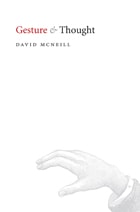
Gesture and Thought
David McNeill
University of Chicago Press, 2005
Gesturing is such an integral yet unconscious part of communication that we are mostly oblivious to it. But if you observe anyone in conversation, you are likely to see his or her fingers, hands, and arms in some form of spontaneous motion. Why? David McNeill, a pioneer in the ongoing study of the relationship between gesture and language, set about answering this question over twenty-five years ago. In Gesture and Thought he brings together years of this research, arguing that gesturing, an act which has been popularly understood as an accessory to speech, is actually a dialectical component of language.
Gesture and Thought expands on McNeill’s acclaimed classic Hand and Mind. While that earlier work demonstrated what gestures reveal about thought, here gestures are shown to be active participants in both speaking and thinking. Expanding on an approach introduced by Lev Vygotsky in the 1930s, McNeill posits that gestures are key ingredients in an “imagery-language dialectic” that fuels both speech and thought. Gestures are both the “imagery” and components of “language.” The smallest element of this dialectic is the “growth point,” a snapshot of an utterance at its beginning psychological stage. Utilizing several innovative experiments he created and administered with subjects spanning several different age, gender, and language groups, McNeill shows how growth points organize themselves into utterances and extend to discourse at the moment of speaking.
An ambitious project in the ongoing study of the relationship of human communication and thought, Gesture and Thought is a work of such consequence that it will influence all subsequent theory on the subject.
[more]
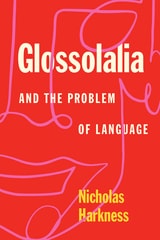
Glossolalia and the Problem of Language
Nicholas Harkness
University of Chicago Press, 2021
Speaking in tongues, also known as glossolalia, has long been a subject of curiosity as well as vigorous theological debate. A worldwide phenomenon that spans multiple Christian traditions, glossolalia is both celebrated as a supernatural gift and condemned as semiotic alchemy. For some it is mystical speech that exceeds what words can do, and for others it is mere gibberish, empty of meaning. At the heart of these differences is glossolalia’s puzzling relationship to language.
Glossolalia and the Problem of Language investigates speaking in tongues in South Korea, where it is practiced widely across denominations and congregations. Nicholas Harkness shows how the popularity of glossolalia in Korea lies at the intersection of numerous, often competing social forces, interwoven religious legacies, and spiritual desires that have been amplified by Christianity’s massive institutionalization. As evangelicalism continues to spread worldwide, Glossolalia and the Problem of Language analyzes one of its most enigmatic practices while marking a major advancement in our understanding of the power of language and its limits.
Glossolalia and the Problem of Language investigates speaking in tongues in South Korea, where it is practiced widely across denominations and congregations. Nicholas Harkness shows how the popularity of glossolalia in Korea lies at the intersection of numerous, often competing social forces, interwoven religious legacies, and spiritual desires that have been amplified by Christianity’s massive institutionalization. As evangelicalism continues to spread worldwide, Glossolalia and the Problem of Language analyzes one of its most enigmatic practices while marking a major advancement in our understanding of the power of language and its limits.
[more]