Results by title
88 books match the query 'Lawyers' and 2 start with g
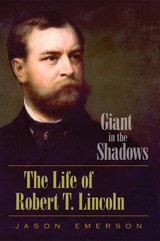
Giant in the Shadows
The Life of Robert T. LincolnJason Emerson
Southern Illinois University Press, 2012
University Press Books for Public and Secondary Schools, 2013 edition
Book of the Year by the Illinois State historical Society, 2013
Although he was Abraham and Mary Lincoln’s oldest and last surviving son, the details of Robert T. Lincoln’s life are misunderstood by some and unknown to many others. Nearly half a century after the last biography about Abraham Lincoln’s son was published, historian and author Jason Emerson illuminates the life of this remarkable man and his achievements in Giant in the Shadows: The Life of Robert T. Lincoln. Emerson, after nearly ten years of research, draws upon previously unavailable materials to offer the first truly definitive biography of the famous lawyer, businessman, and statesman who, much more than merely the son of America’s most famous president, made his own indelible mark on one of the most progressive and dynamic eras in United States history.
Born in a boardinghouse but passing his last days at ease on a lavish country estate, Robert Lincoln played many roles during his lifetime. As a president’s son, a Union soldier, an ambassador to Great Britain, and a U.S. secretary of war, Lincoln was indisputably a titan of his age. Much like his father, he became one of the nation’s most respected and influential men, building a successful law practice in the city of Chicago, serving shrewdly as president of the Pullman Car Company, and at one time even being considered as a candidate for the U.S. presidency.
Along the way he bore witness to some of the most dramatic moments in America’s history, including Robert E. Lee’s surrender at Appomattox Courthouse; the advent of the railroad, telephone, electrical, and automobile industries; the circumstances surrounding the assassinations of three presidents of the United States; and the momentous presidential election of 1912. Giant in the Shadows also reveals Robert T. Lincoln’s complex relationships with his famous parents and includes previously unpublished insights into their personalities. Emerson reveals new details about Robert’s role as his father’s confidant during the brutal years of the Civil War and his reaction to his father’s murder; his prosecution of the thieves who attempted to steal his father’s body in 1876 and the extraordinary measures he took to ensure it would never happen again; as well as details about the painful decision to have his mother committed to a mental facility. In addition Emerson explores the relationship between Robert and his children, and exposes the actual story of his stewardship of the Lincoln legacy—including what he and his wife really destroyed and what was preserved. Emerson also delves into the true reason Robert is not buried in the Lincoln tomb in Springfield but instead was interred at Arlington National Cemetery.
Meticulously researched, full of never-before-seen photographs and new insight into historical events, Giant in the Shadows is the missing chapter of the Lincoln family story. Emerson’s riveting work is more than simply a biography; it is a tale of American achievement in the Gilded Age and the endurance of the Lincoln legacy.
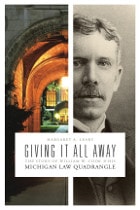
Giving It All Away
The Story of William W. Cook and His Michigan Law QuadrangleMargaret A. Leary
University of Michigan Press, 2011
“Margaret Leary's carefully researched book illuminates a complex man who marked his university in a truly enduring way."
---Francis X. Blouin Jr., Director, Bentley Historical Library, and Professor, School of Information and Department of History, University of Michigan
“Generations of Michigan Law grads have passed on myths about their generous but eccentric benefactor. . . . Now Margaret Leary has given us the real story, and it reads like a gripping whodunit."
---Theodore J. St. Antoine, James E. and Sarah A. Degan Professor Emeritus of Law and Past Dean, University of Michigan Law School
“In an absorbing book, Margaret Leary unstintingly investigates unpublished, archival material to unravel enigmas surrounding William Wilson Cook. She brings to life Cook's brilliant interactions with powerful moguls of the early twentieth century as she traces his lofty, philanthropic mission to elevate the legal profession."
---Ilene H. Forsyth, Arthur F. Thurnau Professor of the History of Art, emerita, University of Michigan
William W. Cook, born in 1858 and a graduate of the University of Michigan and of its law school, made his fortune by investing in the burgeoning telegraph and communications industry, as well as in representing the Mackay Company in their frequent tumultuous battles with Western Union and the U.S. government. Though Cook entered New York society and never returned to Michigan after receiving his law degree, he decided not just to give his alma mater the finest physical facility of any existing law school, but to donate permanent resources that would permit the law school to engage in groundbreaking legal research. However, his generosity proved controversial and eventually very litigious. Margaret A. Leary places Cook's story in the rich social and cultural context of his time and paints a fascinating portrait of a complex figure whose legacy continues to shape the University of Michigan.
Cover photographs: (left) Gregory Fox Photography; (right) Ann B. Cook collection, photo by Russell R. Serbay