Results by title
276 books match the query 'Legal History' and 3 start with g
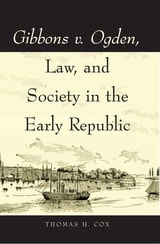
Gibbons v. Ogden, Law, and Society in the Early Republic
Thomas H. Cox
Ohio University Press, 2009
Gibbons v. Ogden, Law, and Society in the Early Republic examines a landmark decision in American jurisprudence, the first Supreme Court case to deal with the thorny legal issue of interstate commerce.
Decided in 1824, Gibbons v. Ogden arose out of litigation between owners of rival steamboat lines over passenger and freight routes between the neighboring states of New York and New Jersey. But what began as a local dispute over the right to ferry the paying public from the New Jersey shore to New York City soon found its way into John Marshall’s court and constitutional history. The case is consistently ranked as one of the twenty most significant Supreme Court decisions and is still taught in constitutional law courses, cited in state and federal cases, and quoted in articles on constitutional, business, and technological history.
Gibbons v. Ogden initially attracted enormous public attention because it involved the development of a new and sensational form of technology. To early Americans, steamboats were floating symbols of progress—cheaper and quicker transportation that could bring goods to market and refinement to the backcountry. A product of the rough-and-tumble world of nascent capitalism and legal innovation, the case became a landmark decision that established the supremacy of federal regulation of interstate trade, curtailed states’ rights, and promoted a national market economy. The case has been invoked by prohibitionists, New Dealers, civil rights activists, and social conservatives alike in debates over federal regulation of issues ranging from labor standards to gun control. This lively study fills in the social and political context in which the case was decided—the colorful and fascinating personalities, the entrepreneurial spirit of the early republic, and the technological breakthroughs that brought modernity to the masses.

Giving It All Away
The Story of William W. Cook and His Michigan Law QuadrangleMargaret A. Leary
University of Michigan Press, 2011
“Margaret Leary's carefully researched book illuminates a complex man who marked his university in a truly enduring way."
---Francis X. Blouin Jr., Director, Bentley Historical Library, and Professor, School of Information and Department of History, University of Michigan
“Generations of Michigan Law grads have passed on myths about their generous but eccentric benefactor. . . . Now Margaret Leary has given us the real story, and it reads like a gripping whodunit."
---Theodore J. St. Antoine, James E. and Sarah A. Degan Professor Emeritus of Law and Past Dean, University of Michigan Law School
“In an absorbing book, Margaret Leary unstintingly investigates unpublished, archival material to unravel enigmas surrounding William Wilson Cook. She brings to life Cook's brilliant interactions with powerful moguls of the early twentieth century as she traces his lofty, philanthropic mission to elevate the legal profession."
---Ilene H. Forsyth, Arthur F. Thurnau Professor of the History of Art, emerita, University of Michigan
William W. Cook, born in 1858 and a graduate of the University of Michigan and of its law school, made his fortune by investing in the burgeoning telegraph and communications industry, as well as in representing the Mackay Company in their frequent tumultuous battles with Western Union and the U.S. government. Though Cook entered New York society and never returned to Michigan after receiving his law degree, he decided not just to give his alma mater the finest physical facility of any existing law school, but to donate permanent resources that would permit the law school to engage in groundbreaking legal research. However, his generosity proved controversial and eventually very litigious. Margaret A. Leary places Cook's story in the rich social and cultural context of his time and paints a fascinating portrait of a complex figure whose legacy continues to shape the University of Michigan.
Cover photographs: (left) Gregory Fox Photography; (right) Ann B. Cook collection, photo by Russell R. Serbay
Glossators and Commentators at the Strahov Library
Marek Novák
Karolinum Press, 2026
Private law in the Czech Republic, as in many countries, has its roots in Roman law, which reached its peak through codification by Emperor Justinian. However, modern civil codes are not directly based on Roman law source texts but rather on their later reception by medieval and modern jurists. In Glossators and Commentators at the Strahov Library, Marek Novák identifies the earliest jurists of Roman law as he sorts through the previously unorganized collection of the library of the Royal Canonry of Premonstratensians at Strahov, analyzing manuscripts, incunabula, and old prints.
With updated shelf marks and catalogue corrections, Novák has created the perfect practical guide to the Strahov Library’s legal collection for scholars of legal history and manuscript studies.