Results by title
138 books match the query 'Meaning' and 4 start with g
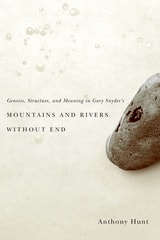
Genesis, Structure, and Meaning in Gary Snyder's Mountains and Rivers Without End
Anthony Hunt
University of Nevada Press, 2016
When Gary Snyder’s long poem Mountains and Rivers Without End was published in 1996, it was hailed as a masterpiece of American poetry. Anthony Hunt offers a detailed historical and explicative analysis of this complex work using, among his many sources, Snyder’s personal papers, letters, and interviews. Hunt traces the work’s origins, as well as some of the sources of its themes and structure, including Nō drama; East Asian landscape painting; the rhythms of storytelling, chant, and song; Jungian archetypal psychology; world mythology; Buddhist philosophy and ritual; Native American traditions; and planetary geology, hydrology, and ecology. His analysis addresses the poem not merely by its content, but through the structure of individual lines and the arrangement of the parts, examining the personal and cultural influences on Snyder’s work. Hunt’s benchmark study will be rewarding reading for anyone who enjoys the contemplation of Snyder’s artistry and ideas and, more generally, for those who are intrigued by the cultural and intellectual workings of artistic composition.
[more]
Geometry and Meaning
Dominic Widdows
CSLI, 2004
From Pythagoras's harmonic sequence to Einstein's theory of relativity, geometric models of position, proximity, ratio, and the underlying properties of physical space have provided us with powerful ideas and accurate scientific tools. Currently, similar geometric models are being applied to another type of space—the conceptual space of information and meaning, where the contributions of Pythagoras and Einstein are a part of the landscape itself. The rich geometry of conceptual space can be glimpsed, for instance, in internet documents: while the documents themselves define a structure of visual layouts and point-to-point links, search engines create an additional structure by matching keywords to nearby documents in a spatial arrangement of content. What the Geometry of Meaning provides is a much-needed exploration of computational techniques to represent meaning and of the conceptual spaces on which these representations are founded.
[more]
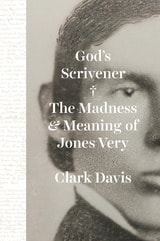
God's Scrivener
The Madness and Meaning of Jones VeryClark Davis
University of Chicago Press, 2023
A biography of a long-forgotten but vital American Transcendentalist poet.
In September of 1838, a few months after Ralph Waldo Emerson delivered his controversial Divinity School address, a twenty-five-year-old tutor and divinity student at Harvard named Jones Very stood before his beginning Greek class and proclaimed himself “the second coming.” Over the next twenty months, despite a brief confinement in a mental hospital, he would write more than three hundred sonnets, many of them in the voice of a prophet such as John the Baptist or even of Christ himself—all, he was quick to claim, dictated to him by the Holy Spirit.
Befriended by the major figures of the Transcendentalist movement, Very strove to convert, among others, Elizabeth and Sophia Peabody, Bronson Alcott, Nathaniel Hawthorne, and most significantly, Emerson himself. Though shocking to some, his message was simple: by renouncing the individual will, anyone can become a “son of God” and thereby usher in a millennialist heaven on earth. Clark Davis’s masterful biography shows how Very came to embody both the full radicalism of Emersonian ideals and the trap of isolation and emptiness that lay in wait for those who sought complete transcendence.
God’s Scrivener tells the story of Very’s life, work, and influence in depth, recovering the startling story of a forgotten American prophet, a “brave saint” whose life and work are central to the development of poetry and spirituality in America.
[more]

Green Nature/Human Nature
THE MEANING OF PLANTS IN OUR LIVESCharles A. Lewis
University of Illinois Press, 1996
"Our ties to the green world are often subtle and unexpected. It is not merely that hemoglobin and chlorophyll bear a striking similarity in structure, or that plants provide the pleasure of food and flowers."--from the Preface
Why do gardeners delight in the germination and growth of a seed? Why are our spirits lifted by flowers, our feelings of tension allayed by a walk in a forest or park? What other positive influences can green nature
bring to humanity?
In Green Nature/Human Nature Charles A. Lewis describes the psychological, sociological, and physiological responses of people to vegetation in cities and forests, as well as in horticultural therapy programs in hospitals, geriatric institutions, physical rehabilitation centers, drug rehabilitation programs, and correctional institutions. He presents an evolutionary basis for the human attraction to plants. People-plant interactions are presented from two perspectives: participatory, in which the individual is involved in planting and maintaining the vegetation, and observational, in which the individual bears no responsibility for establishing or maintaining the vegetation.
In what amounts to a straightforward catalog of well-documented and tangible benefits, Lewis brings the latest and best research into plant/human interaction to bear on questions of how green nature is intertwined with the human psyche and how that interaction can lead to enhanced well-being and an appreciation of the human dimension in environmental concerns.
Lewis's work will be essential reading for anyone interested in plants
and how they affect people.
A volume in the series The Environment and the Human Condition
[more]