Results by title
178 books match the query 'Media' and 7 start with g
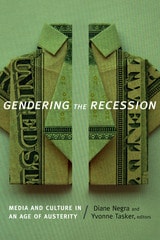
Gendering the Recession
Media and Culture in an Age of AusterityDiane Negra and Yvonne Tasker, eds.
Duke University Press, 2014
Contributors. Sarah Banet-Weiser, Hamilton Carroll, Hannah Hamad, Anikó Imre, Suzanne Leonard, Isabel Molina-Guzmán, Sinéad Molony, Elizabeth Nathanson, Diane Negra, Tim Snelson, Yvonne Tasker, Pamela Thoma

Global Activism, Global Media
Edited by Wilma de Jong, Martin Shaw, and Neil Stammers
Pluto Press, 2005
This book brings together activists and academics in one volume, to explore the theory and practice of global activism's relation to all forms of media, mainstream and otherwise. The contributors examine how global activism is represented in the mainstream press and explain the strategies that activists adopt to spread their own ideas.
Investigating Indymedia and internet activism, they show how transformations in communications technology offer new possibilities, and explain how activists have successfully used and developed their own media. Case studies and topics include the world social forums, an example of a campaign from the NGO Action Aid, a campaign strategy from an internet activist, Greenpeace and the Brent Spar conflict, the World Development Movement and representations in the mainstream press, the Independent Media Centre, transgender activism on the net, Amnesty International, Oxfam and the internet.
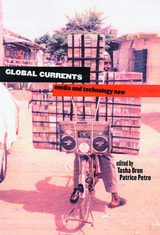
Global Currents
Media and Technology NowOren, Tasha G
Rutgers University Press, 2004
Rhetoric about media technology tends to fall into two extreme categories: unequivocal celebration or blanket condemnation. This is particularly true in debate over the clash of values when first world media infiltrate third world audiences.
Bringing together the best new work on contemporary media practices, technologies, and policies, the essayists in Global Currents argue that neither of these extreme views accurately represents the role of media technology today. New ways of thinking about film, television, music, and the internet demonstrate that it is not only media technologies that affect the cultures into which they are introduced—it is just as likely that the receiving culture will change the media.
Topics covered in the volume include copyright law and surveillance technology, cyber activism in the African Diaspora, transnational monopolies and local television industries, the marketing and consumption of “global music,” “click politics” and the war on Afghanistan, the techno-politics of distance education, artificial intelligence and global legal institutions, and traveling and “squatting” in digital space. Balanced between major theoretical positions and original field research, the selections address the political and cultural meanings that surround and configure new technologies.
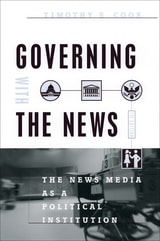
Governing With the News, Second Edition
The News Media as a Political InstitutionTimothy E. Cook
University of Chicago Press, 2005
"Provocative and often wise. . . . Cook, who has a complex understanding of the relationship between governing and the news, provides a fascinating account of the origins of this complicity."—James Bennet, Washington Monthly
"[Governing with the News] addresses central issues of media impact and power in fresh, illuminating ways. . . . Cook mines a wealth of historical and organizational literature to assert that the news media are a distinct political institution in our democratic system."—Robert Schmuhl, Commonweal

Governing with the News
The News Media as a Political InstitutionTimothy E. Cook
University of Chicago Press, 1998
The formation of the press as a political institution began in the early days of the republic when newspapers were sponsored by political parties; the relationship is now so central that press offices are found wherever one turns. Cook demonstrates not only how the media are structured as an institution that exercises collective power but also how the role of the media has become institutionalized within the political process, affecting policy and instigating, rather than merely reflecting, political actions. Cook's analysis is a powerful and fascinating guide to our age when newsmaking and governing are inseparable.
"This is a wonderful analysis of a highly important topic. Tim Cook is resoundingly right that we need to look at the media as political institutions and their operatives as political actors."—David R. Mayhew, author of Divided We Govern
"This meticulously researched and well reasoned work proposes to take seriously a thesis which flies in the face of both journalistic lore and political myth. Governing with the News is an innovative contribution to our understanding of media."—W. Lance Bennett, author of News: The Politics of Illusion
"This book should be read by journalists . . . by mass communication faculty teaching courses in media structure or effects and journalism faculty as a supplemental text to courses in media history and media management."—Benjamin J. Burns, Journalism & Mass Communication Quarterly
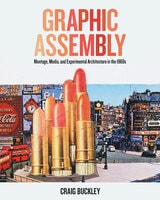
Graphic Assembly
Montage, Media, and Experimental Architecture in the 1960sCraig Buckley
University of Minnesota Press, 2018
An innovative look at the contribution of montage to twentieth-century architecture—now in paperback
Graphic Assembly unearths the role played by montage and collage in the development of architectural culture over the past century, revealing their unexamined yet crucial significance. Craig Buckley brings together experimental architectural practices based in London, Paris, Vienna, and Florence, showing how breakthroughs in optical media and printing technologies enabled avant-garde architects to reimagine their field.
Graphic Assembly considers a range of architects and movements from the 1950s through the early ’70s, including Theo Crosby, Hans Hollein, and John McHale; the magazine Clip-Kit; and the groups Archigram, Superstudio, and Utopie. It gives a thorough account of how montage concepts informed the design of buildings, prototypes, models, exhibitions, and multimedia environments, accompanied by Buckley’s insightful interpretations of the iconic images, exhibitions, and buildings of the 1960s that mark how the decade is remembered.
Richly illustrated with never-before-published material from more than a dozen archives and private collections, Graphic Assembly offers a comparative overview of the network of experimental architectural practice in Europe. It provides a deep historical account of the cut-and-paste techniques now prevalent with architecture’s digital turn, demonstrating the great importance of montage to architecture past, present, and future.

Gurus and Media
Sound, Image, Machine, Text and the DigitalEdited by Jacob Copeman, Arkotong Longkumer, and Koonal Duggal
University College London, 2023
Illuminating the mediatization of guruship and the guruization of media, this book bridges the gap between scholarship on gurus and the disciplines of media and visual culture studies. It investigates guru iconographies in and across various time periods and also the distinctive ways in which diverse gurus engage with and inhabit different forms of media: statuary, games, print publications, photographs, portraiture, films, machines, social media, bodies, words, graffiti, dolls, sound, verse, tombs, and more.
The book’s interdisciplinary chapters advance, both conceptually and ethnographically, our understanding of the function of media in the dramatic production of guruship and reflect on the corporate branding of gurus and on mediated guruship as a series of aesthetic traps for the captivation of devotees and others. They show how different media can further enliven the complex plurality of guruship, for instance in instantiating notions of “absent-present” guruship and demonstrating the mutual mediation of gurus, caste, and Hindutva.
Gurus and Media foregrounds contested visions of the guru in the development of devotional publics and pluriform guruship across time and space. Thinking through the guru’s many media entanglements in a single place, this book contributes new insights to the study of South Asian religions and to the study of mediation more broadly.