Results by title
1414 books match the query 'Medical' and 25 start with g
Gathering Medicines
Nation and Knowledge in China’s Mountain SouthJudith Farquhar and Lili Lai
University of Chicago Press, 2021
Over a period of six years, Judith Farquhar and Lili Lai worked with seven minority nationality groups in China’s southern mountains, observing how medicines were gathered and local healing systems codified. Gathering Medicines shares their intimate view of how people understand ethnicity, locality, the body, and nature. This ethnography of knowledge diversities in multiethnic China is a testament to the rural wisdom of mountain healers, one that theorizes, from the ground up, the dynamic encounters between formal statist knowledge and the popular authority of the wild.
Gendering Disability
Smith, Bonnie G
Rutgers University Press, 2004
Disability and gender, terms that have previously seemed so clear-cut, are becoming increasingly complex in light of new politics and scholarship. These words now suggest complicated sets of practices and ways of being.
Contributors to this innovative collection explore the intersection of gender and disability in the arts, consumer culture, healing, the personal and private realms, and the appearance of disability in the public sphere—both in public fantasies and in public activism. Beginning as separate enterprises that followed activist and scholarly paths, gender and disability studies have reached a point where they can move beyond their boundaries for a common landscape to inspire new areas of inquiry. Whether from a perspective in the humanities, social sciences, sciences, or arts, the shared subject matter of gender and disability studies—the body, social and cultural hierarchy, identity, discrimination and inequality, representation, and political activism—insistently calls for deeper conversation. This volume provides fresh findings not only about the discrimination practiced against women and people with disabilities, but also about the productive parallelism between these two categories.
Generalism in Clinical Practice and Education
Edited by Sophie Park and Kay Leedham-Green
University College London, 2024
Generalism is a key approach to healthcare organization and delivery that enables person-centered, dynamic, and cost-effective patient care. With its emphasis on adaptability, generalism requires expansive, nurturing, and personalized approaches to clinical education in which a generalist attends to and explores patient priorities.
Generalism in Clinical Practice and Education outlines a generalist philosophy of practice, which is brought to life through interleaved examples. Written by a range of international clinicians, patients, and academics this book does not prescribe a single way to do generalism properly. Rather, it seeks to inspire readers’ future engagement with generalism in practice and education through sharing underpinning concepts, values, and principles. This ‘big picture’ attention to generalism across public health, social determinants of health, and clinical care is at the heart of sustainable and efficient use of resources to prioritize those in need. The book explores four key principles that aim to achieve creative, inclusive, and agile approaches to clinical care. Its goal is to support generalism in clinical practice and education and to produce clinical practitioners and learners who enjoy, embrace, and enhance future clinical care.
Genes in Development
Re-reading the Molecular ParadigmEva M. Neumann-Held and Christoph Rehmann-Sutter, eds.
Duke University Press, 2006
Contributors discuss alternatives to the programmatic view of dna, including the developmental systems approach, methodical culturalism, the molecular process concept of the gene, the hermeneutic theory of description, and process structuralist biology. None of the approaches cast doubt on the notion that dna is tremendously important to biological life on earth; rather, contributors examine different ideas of how dna should be represented, evaluated, and explained. Just as ideas about genetic codes have reached far beyond the realm of science, the reconceptualizations of genetic theory in this volume have broad implications for ethics, philosophy, and the social sciences.
Contributors. Thomas Bürglin, Brian C. Goodwin, James Griesemer, Paul Griffiths, Jesper Hoffmeyer, Evelyn Fox Keller, Gerd B. Müller, Eva M. Neumann-Held, Stuart A. Newman, Susan Oyama, Christoph Rehmann-Sutter, Sahotra Sarkar, Jackie Leach Scully, Gerry Webster, Ulrich Wolf
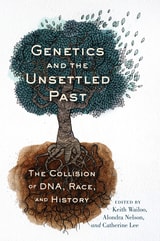
Genetics and the Unsettled Past
The Collision of DNA, Race, and HistoryWailoo, Keith
Rutgers University Press, 2012
Our genetic markers have come to be regarded as portals to the past. Analysis of these markers is increasingly used to tell the story of human migration; to investigate and judge issues of social membership and kinship; to rewrite history and collective memory; to right past wrongs and to arbitrate legal claims and human rights controversies; and to open new thinking about health and well-being. At the same time, in many societies genetic evidence is being called upon to perform a kind of racially charged cultural work: to repair the racial past and to transform scholarly and popular opinion about the “nature” of identity in the present.
Genetics and the Unsettled Past considers the alignment of genetic science with commercial genealogy, with legal and forensic developments, and with pharmaceutical innovation to examine how these trends lend renewed authority to biological understandings of race and history.
This unique collection brings together scholars from a wide range of disciplines—biology, history, cultural studies, law, medicine, anthropology, ethnic studies, sociology—to explore the emerging and often contested connections among race, DNA, and history. Written for a general audience, the book’s essays touch upon a variety of topics, including the rise and implications of DNA in genealogy, law, and other fields; the cultural and political uses and misuses of genetic information; the way in which DNA testing is reshaping understandings of group identity for French Canadians, Native Americans, South Africans, and many others within and across cultural and national boundaries; and the sweeping implications of genetics for society today.

Genius Belabored
Childbed Fever and the Tragic Life of Ignaz SemmelweisTheodore G. Obenchain
University of Alabama Press, 2016
The fascinating story of Ignaz Semmelweis, a nineteenth-century obstetrician ostracized for his strident advocacy of disinfection as a way to prevent childbed fever.
In Genius Belabored: Childbed Fever and the Tragic Life of Ignaz Semmelweis, Theodore G. Obenchain traces the life story of a nineteenth-century Hungarian obstetrician who was shunned and marginalized by the medical establishment for advancing a far-sighted but unorthodox solution to the appalling mortality rates that plagued new mothers of the day.
In engrossing detail, Obenchain recreates for readers the sights, smells, and activities within a hospital of that day. In an era before the acceptance of modern germ science, physicians saw little need for cleanliness or hygiene. As a consequence, antiseptic measures were lax and rudimentary. Especially vulnerable to contamination were new mothers, who frequently contracted and died from childbed fever (puerperal fever). Genius Belabored follows Semmelweis’s awakening to the insight that many of these deaths could be avoided with basic antiseptic measures like hand washing.
The medical establishment, intellectually unprepared for Semmelweis’s prescient hypothesis, rejected it for a number of reasons. It was unorthodox and went against the lingering Christian tradition that the dangers of childbirth were inherent to the lives of women. Complicating matters, colleagues did not consider Semmelweis an easy physician to work with. His peers described him as strange and eccentric. Obenchain offers an empathetic and insightful argument that Semmelweis suffered from bipolar disorder and illuminates how his colleagues, however dedicated to empirical science they might have been, misjudged Semmelweis’s methods based upon ignorance and their emotional discomfort with him.
In Genius Belabored, Obenchain identifies Semmelweis’s rightful place in the pantheon of scientists and physicians whose discoveries have saved the lives of millions. Obenchain’s biography of Semmelweis offers unique insights into the practice of medicine and the mindsets of physicians working in the premodern era. This fascinating study offers much of interest to general readers as well as those interested in germ theory, the history of medicine and obstetrics, or anyone wishing to better understand the trajectory of modern medicine.

Geographic Medicine for the Practitioner
Algorithms in the Diagnosis and Management of Exotic DiseasesKenneth D. Warren and Adel A. F. Mahmoud
University of Chicago Press, 1978
"The algorithms in this book have been developed by Drs. Warren and Mahmoud, as the result of a systematic effort to produce such guides. The book is presented as another in the series "Studies in Infectious Disease Research" and is a most welcome addition, certain to supply a major and hitherto inadequately fulfilled need."—from the Foreword, by Edward H. Kass, M. D., Ph.D

Giving Birth in Eighteenth-Century England
Sarah Fox
University of London Press, 2022
This fascinating new book radically rewrites all that we know about eighteenth-century childbirth by placing women’s voices at the center of the story. Examining childbirth from the perspective of the birthing woman, this research offers new perspectives on the history of the family, the social history of medicine, community and neighborhood studies, and the study of women’s lives in eighteenth-century England.
From “quickening” through to “confinement,” “giving caudle,” delivery, and “lying-in,” birth was once a complex ritual that involved entire communities. Drawing on an extensive and under-researched body of materials, such as letters, diaries, and recipe books, this book offers critical new perspectives on the history of the family, community, and the lives of women in the coming age of modern medicine. It unpacks the rituals of contemporary childbirth—from foods traditionally eaten before and after birth, birthing clothing, and how a woman’s relationship with her family, husband, friends, and neighbors changed during and after pregnancy. In this important and deeply moving study, we are invited onto a detailed and emotional journey through motherhood in an age of immense socio-cultural and intellectual change.
Global Health for All
Knowledge, Politics, and PracticesJean-Paul Gaudillière
Rutgers University Press, 2022
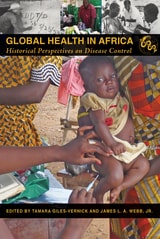
Global Health in Africa
Historical Perspectives on Disease ControlTamara Giles-Vernick
Ohio University Press, 2013
Global Health in Africa is a first exploration of selected histories of global health initiatives in Africa. The collection addresses some of the most important interventions in disease control, including mass vaccination, large-scale treatment and/or prophylaxis campaigns, harm reduction efforts, and nutritional and virological research.The chapters in this collection are organized in three sections that evaluate linkages between past, present, and emergent. Part I, “Looking Back,” contains four chapters that analyze colonial-era interventions and reflect upon their implications for contemporary interventions. Part II, “The Past in the Present,” contains essays exploring the historical dimensions and unexamined assumptions of contemporary disease control programs. Part III, “The Past in the Future,” examines two fields of public health intervention in which efforts to reduce disease transmission and future harm are premised on an understanding of the past.
This much-needed volume brings together international experts from the disciplines of demography, anthropology, and historical epidemiology. Covering health initiatives from smallpox vaccinations to malaria control to HIV campaigns, Global Health in Africa offers a first comprehensive look at some of global health’s most important challenges.
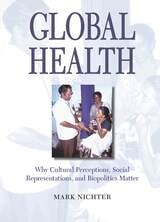
Global Health
Why Cultural Perceptions, Social Representations, and Biopolitics MatterMark Nichter
University of Arizona Press, 2008
The book examines the perceptions of three groups whose points of view on illness, health care, and the politics of responsibility often differ and frequently conflict: local populations living in developing countries, public health practitioners working in international health, and health planners/policy makers. The book is written for both health social scientists working in the fields of international health and development and public health practitioners interested in learning practical lessons they can put to good use when engaging communities in participatory problem solving.
Global Health critically examines representations that frame international health discourse. It also addresses the politics of what is possible in a world compelled to work together to face emerging and re-emerging diseases, the control of health threats associated with political ecology and defective modernization, and the rise of new assemblages of people who share a sense of biosociality. The book proposes research priorities for a new program of health social science research. Nichter calls for greater involvement by social scientists in studies of global health and emphasizes how medical anthropologists in particular can better involve themselves as scholar activists.
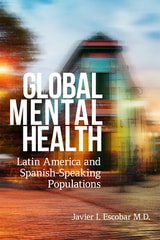
Global Mental Health
Latin America and Spanish-Speaking PopulationsJavier I Escobar
Rutgers University Press, 2020
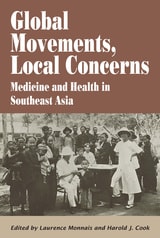
Global Movements, Local Concerns
Medicine and Health in Southeast AsiaEdited by Laurence Monnais and Harold J. Cook
National University of Singapore Press, 2012
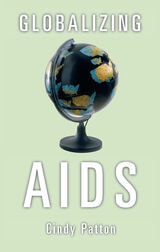
Globalizing Aids
Cindy Patton
University of Minnesota Press, 2002
A long-awaited look at responses to the AIDS epidemic in relation to globalization
As AIDS began to appear around the "global village" in the early 1980s, the closeness brought by new technologies no longer promised wondrous cultural exchange; instead it made possible the transmission of a frightening new kind of disease. International scientific institutions and news organizations quickly constructed a "place" for AIDS in the global imaginary: from the heart of Africa and gay bathhouses in San Francisco to the back streets of Southeast Asia and poverty-stricken neighborhoods in the United States. Such simplistic accounts helped recycle racist ideas about Africans and Asians, intensified homophobic visions of irresponsible gay sexuality, and ignored the scientific and human reality of local experiences of the epidemic.
In Globalizing AIDS, pioneering cultural critic Cindy Patton looks at the complex interaction between modern science, media coverage, and local activism during the first decade of the epidemic. Patton's critique of both the production of scientific credibility and the implementation of public health policy at the local level offers a bold reevaluation of how we think about AIDS and an innovative approach to the reality of the disease.
Globalizing Chocolate and Tobacco
Medical Exchange in the Early Modern WorldSusan G. Polansky
Bucknell University Press, 2026
This groundbreaking volume explores two early and opposing Spanish medical perspectives on chocolate and other New World substances. In the early 1600s, doctors Bartolomé Marradón and Antonio Colmenero de Ledesma returned from travels to the Americas with starkly different views: Marradón cautioned against tobacco and offered only limited approval of chocolate, while Colmenero vigorously defended chocolate’s health benefits. Their writings, translated and circulated across Europe, helped transform chocolate from a medicinal drink into a global commodity. Featuring the first bilingual edition of Marradón’s Dialogue (1618)—in full Spanish and English—and a new bilingual presentation of Colmenero’s influential Curious Treatise (1631), this book provides rare insight into early modern medical thought, cultural exchange, and the globalization of taste. Essential for readers of food history, early modern medicine, and transatlantic interchange, it uniquely reveals how debates over health, culture, and commerce brewed in a cup of chocolate.
Published by Bucknell University Press. Distributed worldwide by Rutgers University Press.

Glyphosate and the Swirl
An Agroindustrial Chemical on the MoveVincanne Adams
Duke University Press, 2022

God's Waiting Room
Racial Reckoning at Life's EndCasey Golomski
Rutgers University Press, 2025
Winner of the Elliott P. Skinner Award from the Association of Africanist Anthropology, part of the American Anthropological Association
Third Place in the Victor Turner Prize in Ethnographic Writing from the American Anthropological Association's Society for Humanistic Anthropology
Can older racists change their tune, or will they haunt us further once they're gone? Rich in mystery and life's lessons, God's Waiting Room considers what matters in the end for older white adults and the younger Black nurses who care for them. An innovation in creative nonfiction, Casey Golomski's story of his years of immersive research at a nursing home in South Africa, thirty years after the end of apartheid, is narrated as a one-day, room-by-room tour. The story is told in breathtakingly intimate and witty conversations with the home's residents and nurses, including the untold story of Nelson Mandela's Robben Island prison nurse, and readers learn how ageism, sexism, and racism intersect and impact health care both in South Africa and in the United States, as well as create conditions in which people primed to be enemies find grace despite the odds.
Course or Book Club Reading and Discussion Guide (https://dhjhkxawhe8q4.cloudfront.net/rup-wp-v2/wp-content/uploads/2025/02/04135941/gods-waiting-room_reading-questions.pdf)
For copyright reasons, this edition is not available in the South African Development Community and Kenya.
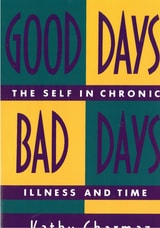
Good Days, Bad Days
The Self and Chronic Illness in TimeKathy C Charmaz
Rutgers University Press, 1993
Illness provides a mirror that allows sufferers to see themselves and to become more introspective. As they struggle for control over illness and control over time, they also struggle to control the central images of the self. For example, the chronically ill may situate their self-concepts in the past, present, or future. Charmaz examines under what conditions they situate their self-concepts in each of those timeframes. People may say they live one day at a time. They may bracket certain experiences, such as a heart attack, as timemarkers or turning points in the past. Or they may look ahead to recovering their health. Or ahead to death.
Charmaz artfully combines near jargon-free analysis with moving stories about how people have experienced illness, usually told in the sufferers' own words. She enters the world of the chronically ill, and brings us into it.
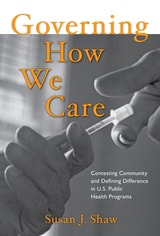
Governing How We Care
Contesting Community and Defining Difference in U.S. Public Health ProgramsSusan J. Shaw
Temple University Press, 2012
As local governments and organizations assume more responsibility for ensuring the public health, identity politics play an increasing yet largely unexamined role in public and policy attitudes toward local problems. In Governing How We Care, medical anthropologist Susan Shaw examines the relationship between government and citizens using case studies of needle exchange and Welfare-to-Work programs to illustrate the meanings of cultural difference, ethnicity, and inequality in health care.
Drawing on ethnographic research conducted over six years in a small New England city, Shaw presents critical perspectives on public health intervention efforts. She looks at online developments in health care and makes important correlations between poverty and health care in the urban United States. Shaw also highlights the new concepts of community and forms of identity that emerge in our efforts to provide effective health care. Governing How We Care shows how government-sponsored community health and health care programs operate in an age of neoliberalism.
Governing the Global Clinic
HIV and the Legal Transformation of MedicineCarol A. Heimer
University of Chicago Press, 2025
A deep examination of how new, legalistic norms affected the trajectory of global HIV care and altered the practice of medicine.
HIV emerged in the world at a time when medicine and healthcare were undergoing two major transformations: globalization and a turn toward legally inflected, rule-based ways of doing things. It accelerated both trends. While pestilence and disease are generally considered the domain of biological sciences and medicine, social arrangements—and law in particular—are also crucial.
Drawing on years of research in HIV clinics in the United States, Thailand, South Africa, and Uganda, Governing the Global Clinic examines how growing norms of legalized accountability have altered the work of healthcare systems and how the effects of legalization vary across different national contexts. A key feature of legalism is universalistic language, but, in practice, rules are usually imported from richer countries (especially the United States) to poorer ones that have less adequate infrastructure and fewer resources with which to implement them. Challenging readers to reconsider the impulse to use law to organize and govern social life, Governing the Global Clinic poses difficult questions: When do rules solve problems, and when do they create new problems? When do rules become decoupled from ethics, and when do they lead to deeper moral commitments? When do rules reduce inequality? And when do they reflect, reproduce, and even amplify inequality?

Grace Period
A NovelGerald W. Haslam
University of Nevada Press, 2006
A masterpiece by one of the West’s best-loved authorsJust when Sacramento journalist Marty Martinez thinks his life can’t get any worse, it does. His beloved son has died of AIDS, his wife has divorced him and joined a cult, and his daughter blames him for the disintegration of their family. Then a chance medical examination reveals that he has prostate cancer. Marty faces his new role as a cancer patient with awkward grit and desperation. He is a sympathetic, utterly convincing character seeking faith in a Catholic Church as troubled as he is. He brings increased intensity to his career as he investigates a far-reaching political scandal, reunites his family in unexpected ways, and finds love with a fellow cancer patient. Grace Period is a profound and sometimes hilarious novel about living with serious illness. Marty copes with fear and the painful, sometimes embarrassing, treatment of his disease, but instead of winding down his life he finds fresh purpose and a joyful new love. Haslam brilliantly depicts the complexities of everyday life and the intricate, sometimes tortured bonds of family and friendship. In Grace Period, Haslam shows us that existence at the precarious edge of life offers not only pain and loss but hope, a chance at redemption, love, and even happiness. Grace Period is his masterwork.
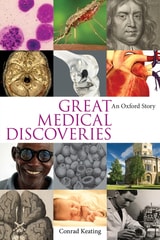
Great Medical Discoveries
An Oxford StoryConrad Keating
Bodleian Library Publishing, 2013
Great Medical Discoveries offers a short illustrated history of the city’s contribution to the medical sciences, from the medieval period to the present day, when it is home to some of the world’s leading large scientific institutions. In charting this remarkable history, the book showcases twenty discoveries across the centuries. In the mid-twentieth century, for instance, Oxford led the field of experimental medicine, and William Harvey, Thomas Willis, and Thomas Sydenham all gained eponymous status with their pioneering research into the workings of the human body. In the mid-seventeenth century, Dorothy Hodgkin’s development of x-ray crystallography earned her a Nobel Prize in Chemistry. Meanwhile, the work of epidemiologist Richard Doll saved millions of lives by making clear the long-term dangers of smoking and the benefits of quitting.
Great Medical Discoveries traces these and other examples of groundbreaking research—from the scientific application of anesthetics to new treatments for hemophilia and life-saving advances in neurosurgery—and shows how they form part of a wider tapestry of work that has helped shape the medical sciences and improve human health.
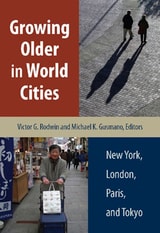
Growing Older in World Cities
New York, London, Paris, and TokyoVictor G. Rodwin
Vanderbilt University Press, 2006
New York, London, Paris, and Tokyo are the four largest cities among the wealthiest, most developed nations of the world. The essays commissioned for this volume compare what it is like to grow older in these cities with respect to health care, quality of life, housing, and long-term care. The contributors look beyond aggregate national data to highlight the importance of how local authorities implement policies.

Guarding the Golden Gate
A History of the U.S. Quarantine Station in San Francisco BayJ. Gordon Frierson, MD
University of Nevada Press, 2022
Guarding the Golden Gate covers not only the creation and operation of the station, which is integral to San Francisco’s history, but also discusses the challenges of life on Angel Island—a small, exposed, and nearly waterless landmass on the north side of the Bay. The book reveals the steps taken to prevent the spread of diseases not only into the United States but also into other ports visited by ships leaving San Francisco; the political struggles over the establishment of a national quarantine station; and the day-to-day life of the immigrants and staff inhabiting the island. With the advancement of the understanding of infectious diseases and the development of treatments, the quarantine station’s activities declined in the 1930s, and the facility ultimately shuttered its doors in 1949.
While Angel Island is now a California state park, it remains as a testament to an influential period in the nation’s history that offers rich insights into efforts to maintain the public’s safety during health crises.
Guide for Mental Health Workers
Armando R. Favazza, M.D., Barbara Starks Favazza, M.D., and Philip M. Margolis, M.D.
University of Michigan Press, 1970