Results by title
321 books match the query 'Mexican Americans' and 5 start with g

Gabriel's Fire
A MemoirLuis Gabriel Aguilera
University of Chicago Press, 2000
Aguilera's memoir is not just an account of race relations and street life in the inner city, nor of the plight of the immigrant and the dilemma of class identity for a "minority" family. Gabriel's Fire also movingly recounts the peculiarly daunting and inspiring moments of a particular age, riddled with confusion, desires, and duties and recorded by an exceptionally observant and articulate young man. Aguilera writes that he "grew into" the English language when he was eleven or twelve, and his recollections reflect his newfound delight with words—the conversations, arguments, taunts, song lyrics, and casual interchanges of his youth are rendered here with an immediacy and directness rare in contemporary memoirs.
Both a picture of American culture of the 1980s and 1990s and a coming-of-age story, Gabriel's Fire counters mainstream and mass-mediated images of the inner city, Hispanic culture, and troubled youth. In its honesty and energy, it is a poignant and compelling story of one man's formative years.
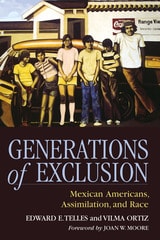
Generations of Exclusion
Mexican-Americans, Assimilation, and RaceEdward E. Telles
Russell Sage Foundation, 2008
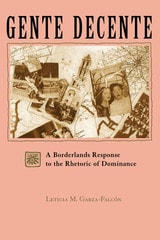
Gente Decente
A Borderlands Response to the Rhetoric of DominanceBy Leticia Magda Garza-Falcón
University of Texas Press, 1998
In his books The Great Plains, The Great Frontier, and The Texas Rangers, historian Walter Prescott Webb created an enduring image of fearless, white, Anglo male settlers and lawmen bringing civilization to an American Southwest plagued with "savage" Indians and Mexicans. So popular was Webb's vision that it influenced generations of historians and artists in all media and effectively silenced the counter-narratives that Mexican American writers and historians were concurrently producing to claim their standing as "gente decente," people of worth.
These counter-narratives form the subject of Leticia M. Garza-Falcón's study. She explores how prominent writers of Mexican descent-such as Jovita González, Américo Paredes, María Cristina Mena, Fermina Guerra, Beatriz de la Garza, and Helena María Viramontes -have used literature to respond to the dominative history of the United States, which offered retrospective justification for expansionist policies in the Southwest and South Texas. Garza-Falcón shows how these counter-narratives capture a body of knowledge and experience excluded from "official" histories, whose "facts" often emerged more from literary techniques than from objective analysis of historical data.

Giraffe on Fire
Juan Felipe Herrera
University of Arizona Press, 2001
A poetic collage of voices, genres, and time-spaces. A display of power over language and rhythm. A postmodern performance of naked figures hanging in the nebulae of a militarized universe. A new millennium cubist manifesto against decrepit political machines. A mystic song in search of birth and love. In this new collection of poems, Juan Felipe Herrera's natural talent for capturing the raw dimensions of reality merges with his wild imagination and technical prowess.
Things, names, places, histories, herstories, desires, wills, minds, and their effects and progeny are re-mixed, re-mastered, and re-cast into a new narrative theater. Characters in a constant and stubborn rush, appearance, disappearance, and flow—with, against, and for each other—create the fire and give birth to the hallucinatory spotted and leaf-eating, long-necked child. Exciting and original, cutting-edge and risk-taking, Giraffe on Fire is a breathtaking addition to a respected body of work by a poet not afraid to speak out about how poetry reflects the raw beauty and truth of life.
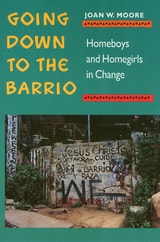
Going Down To The Barrio
Homeboys and Homegirls in ChangeJoan W. Moore
Temple University Press, 1991
In this illuminating look at two Chicano gangs in East Los Angeles, Joan W. Moore examines the changes and continuities among three generations of barrio gangs. As a sequel to the author's award-winning study, Homeboys (Temple, 1979), this book returns to the same neighborhoods to chart the development of gang behavior, especially in terms of violence and drug use, and to compare experiences of male and female gang members.
In a remarkable research collaborative effort, Moore and gang members worked together to develop an understanding of both male and female gangs and an internal vision of gang members' lives. By using excerpts from individual interviews, the author depicts more about the gangs than simply their life together as a unit; she gives them a voice. Gang members discuss their personal reaction to violence, drug using and selling, family relations and intra-gang dating; they share intimacies that reveal varying levels of loyalty to and dependency on their affiliations, which often become a family substitute.
After maintaining neighborhood ties for 17 years, Moore's research group has established a relationship with these communities that gives her a rare perspective. This is a fascinating and informative book for anyone interested in sociology, criminology, youth behavior and deviance, and ethnic studies.