Results by title
364 books match the query 'Michigan' and 11 start with g

Geology of Michigan
John A. Dorr, Jr. and Donald F. Eschman
University of Michigan Press, 1970

Germans in Michigan
Jeremy W. Kilar
Michigan State University Press, 2002
Germans are the largest ancestral group in Michigan, representing over 2.6 million descendants or 22% of the state’s population. Yet, unlike other immigrant groups, Germans have not retained their linguistic and cultural traditions as part of a distinct ethnic identity. The Bavarian villages of Frankenmuth and Gaylord stand as testaments to the once proud and vigorous German communities that dotted both rural and urban Michigan landscapes. Jeremy W. Kilar explores the social forces that transformed Germans from inward-looking immigrants to citizens in the cultural mainstream. Germans in Michigan is a story of assimilation and renewal and as such reveals the complexities of Americanization and immigration as social forces.

Giving It All Away
The Story of William W. Cook and His Michigan Law QuadrangleMargaret A. Leary
University of Michigan Press, 2011
“Margaret Leary's carefully researched book illuminates a complex man who marked his university in a truly enduring way."
---Francis X. Blouin Jr., Director, Bentley Historical Library, and Professor, School of Information and Department of History, University of Michigan
“Generations of Michigan Law grads have passed on myths about their generous but eccentric benefactor. . . . Now Margaret Leary has given us the real story, and it reads like a gripping whodunit."
---Theodore J. St. Antoine, James E. and Sarah A. Degan Professor Emeritus of Law and Past Dean, University of Michigan Law School
“In an absorbing book, Margaret Leary unstintingly investigates unpublished, archival material to unravel enigmas surrounding William Wilson Cook. She brings to life Cook's brilliant interactions with powerful moguls of the early twentieth century as she traces his lofty, philanthropic mission to elevate the legal profession."
---Ilene H. Forsyth, Arthur F. Thurnau Professor of the History of Art, emerita, University of Michigan
William W. Cook, born in 1858 and a graduate of the University of Michigan and of its law school, made his fortune by investing in the burgeoning telegraph and communications industry, as well as in representing the Mackay Company in their frequent tumultuous battles with Western Union and the U.S. government. Though Cook entered New York society and never returned to Michigan after receiving his law degree, he decided not just to give his alma mater the finest physical facility of any existing law school, but to donate permanent resources that would permit the law school to engage in groundbreaking legal research. However, his generosity proved controversial and eventually very litigious. Margaret A. Leary places Cook's story in the rich social and cultural context of his time and paints a fascinating portrait of a complex figure whose legacy continues to shape the University of Michigan.
Cover photographs: (left) Gregory Fox Photography; (right) Ann B. Cook collection, photo by Russell R. Serbay

Gleason's Plants of Michigan
A Field GuideRevised by Richard K. Rabeler
University of Michigan Press, 1998
“For every plant enthusiast in the Great Lakes State, and . . . in the adjoining ones as well.”
—John J. Pipoly III, SIDA
“A very handy field guide . . . this book will be of use to anyone in northeastern North America.”
—C. Barre Hellquist, Rhodora
“It can be used to identify most of the plants . . . in Michigan and adjacent areas.”
—James E. Eckenwalder, Wildflower
Gleason’s Plants of Michigan is a major revision and expansion of The Plants of Michigan by Henry A. Gleason—the 1918 classic field guide to the flowering plants and trees found in Michigan, neighboring Great Lakes States, and southern Ontario. Richard K. Rabeler has completely updated the family descriptions and added easy-to-use keys. Information on habitats and geographical distribution is now included as well as a comprehensive index of plant names, an illustrated section on terminology, a glossary, and an introduction to botany in Michigan.
Gleason’s Plants of Michigan will be useful to naturalists, environmental specialists, botanists, and everyone who loves the wildflowers and native flora of Michigan and the surrounding areas.

Good Boat Speaks For Itself
Isle Royale Fisherman and Their BoatsTimothy Cochrane
University of Minnesota Press, 2002

Government of Michigan
Robert W. Carr, Ph.D.
University of Michigan Press, 1990

Great Lake
An Unnatural History of Lake MichiganTheodore J. Karamanski
University of Michigan Press, 2026
Great Lake is a comprehensive survey of the manifold ways Americans, from the first Native American communities to the present age, have abused, nurtured, loved, and neglected this massive freshwater resource. Extending 307 miles from north to south, the lake cuts across climatic, environmental, and physiographic zones, from the prairies of Illinois to the boreal forests of the north. Bordered by large cities like Chicago and Milwaukee as well as smaller Wisconsin resorts and northern Michigan mines and mill towns, the lake touches people in urban centers and countryside. Thus, the history of Lake Michigan combines the history of frontier resource extraction, agricultural abundance, industrialization, and dense urbanization in the American heartland. Great Lake is the story of the ever-escalating and divergent demands Americans have placed on Lake Michigan, how the lake’s ecosystem responded to those changes, and how together they have shaped the modern American Midwest.
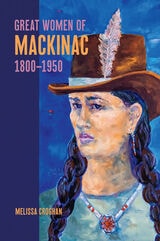
Great Women of Mackinac, 1800-1950
Melissa Croghan
Michigan State University Press, 2023

Greeks in Michigan
Stavros K. Frangos
Michigan State University Press, 2004
The influence of Greek culture on Michigan began long before the first Greeks arrived. The American settlers of the Old Northwest Territory had definite notions of Greeks and Greek culture. America and its developing society and culture were to be the "New Athens," a locale where the resurgence in the values and ideals of classical Greece were to be reborn. Stavros K. Frangos describes how such preconceptions and the competing desires to retain heritage and to assimilate have shaped the Greek experience in Michigan. From the padrone system to the church communities, Greek institutions have both exploited and served Greek immigrants, and from scattered communities across the state to enclaves in Detroit, Greek immigrants have retained and celebrated Greek culture.

Grit, Noise, and Revolution
The Birth of Detroit Rock 'n' RollDavid A. Carson
University of Michigan Press, 2011
---Marshall Crenshaw
From the early days of John Lee Hooker to the heyday of Motown and beyond, Detroit has enjoyed a long reputation as one of the crucibles of American pop music. In Grit, Noise, and Revolution, David Carson turns the spotlight on those hard-rocking, long-haired musicians-influenced by Detroit's R&B heritage-who ultimately helped change the face of rock 'n' roll.
Carson tells the story of some of the great garage-inspired, blue-collar Motor City rock 'n' roll bands that exemplified the Detroit rock sound: The MC5, Iggy Pop and the Stooges, Mitch Ryder and the Detroit Wheels, SRC, the Bob Seger System, Ted Nugent and the Amboy Dukes, and Grand Funk Railroad.
An indispensable guide for rock aficionados, Grit, Noise, and Revolution features stories of these groundbreaking groups and is the first book to survey Detroit music of the 1960s and 70s-a pivotal era in rock music history.
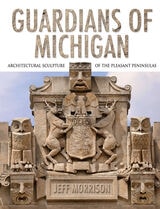
Guardians of Michigan
Architectural Sculpture of the Pleasant PeninsulasJeff Morrison
University of Michigan Press, 2022
The buildings profiled in Guardians of Michigan range from county courthouses, churches, and government buildings constructed during the 1800s, to skyscrapers with intricate sculptural decoration too far above street level for passersby to see. As a result, the book highlights examples of Gothic, Romanesque Revival, Beaux Arts, as well as Art Deco and Art Moderne. Guardians of Michigan is a loving tribute to the architecture of the state, preserving forgotten stories and beautiful buildings for all readers to enjoy.