Results by title
100 books match the query 'Microeconomics' and 3 start with g

Game and Economic Theory
Selected Contributions in Honor of Robert J. AumannSergiu Hart and Abraham Neyman, Editors
University of Michigan Press, 1995
Game and Economic Theory studies the interactions of decision makers whose decisions affect each other. The analysis is from a rational viewpoint: every participant would like to obtain the outcome that he prefers most. However, each one has to take into account that the others are doing the same--trying to get what they prefer most. At times this leads to fierce competition; at other times, to mutually beneficial cooperation; and in general, to an appropriate combination of these two extreme behaviors. Game theory, which may be viewed as a sort of "unified field" theory for the rational side of social science, develops the theoretical foundations for the analysis of such multi-person interactive situations, and then applies these to many disciplines: economics, political science, biology, psychology. computer science, statistics and law. Foremost among these is economic theory, where game theory is playing a central role.
This volume consists of twenty-two selected contributions to various areas of game and economic theory. These important and pathbreaking contributions are all by former students of Robert J. Aumann, to whom this volume is dedicated. The volume will no doubt shed light on the far-reaching pertinence of game theory and its application to economics, and also on the monumental impact of Aumann on this discipline.
Sergiu Hart is Alice Kusiel de Vorreuter Professor of Mathematical Economics and Director of the Center for Rationality and Interactive Decision Theory, The Hebrew University of Jerusalem. Abraham Neyman is Professor of Mathematics, The Hebrew University of Jerusalem, and Leading Professor of Economics and Mathematics, State University of New York at Stony Brook.
[more]
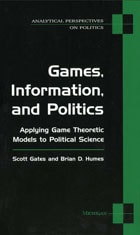
Games, Information, and Politics
Applying Game Theoretic Models to Political ScienceScott Gates and Brian D. Humes
University of Michigan Press, 1997
To study the strategic interaction of individuals, we can use game theory. Despite the long history shared by game theory and political science, many political scientists remain unaware of the exciting game theoretic techniques that have been developed over the years. As a result they use overly simple games to illustrate complex processes. Games, Information, and Politics is written for political scientists who have an interest in game theory but really do not understand how it can be used to improve our understanding of politics. To address this problem, Gates and Humes write for scholars who have little or no training in formal theory and demonstrate how game theoretic analysis can be applied to politics. They apply game theoretic models to three subfields of political science: American politics, comparative politics, and international relations. They demonstrate how game theory can be applied to each of these subfields by drawing from three distinct pieces of research. By drawing on examples from current research projects the authors use real research problems--not hypothetical questions--to develop their discussion of various techniques and to demonstrate how to apply game theoretic models to help answer important political questions. Emphasizing the process of applying game theory, Gates and Humes clear up some common misperceptions about game theory and show how it can be used to improve our understanding of politics.
Games, Information, and Politics is written for scholars interested in understanding how game theory is used to model strategic interactions. It will appeal to sociologists and economists as well as political scientists.
Scott Gates is Assistant Professor of Political Science, Michigan State University. Brian D. Humes is Associate Professor of Political Science, University of Nebraska-Lincoln.
[more]
Generalized Microeconomics
Jirí Hlavácek and Michal Hlavácek
Karolinum Press, 2013
The generalization of microeconomics enables model descriptions of economic rationality, even in fields that standard microeconomics more or less avoids, like nonprofit sectors of market economies, altruism, or externalities. Here, the authors broaden the scope of microeconomics while treating standard profit maximization as a special case. They argue, ultimately, that the generalizing criterion is a Darwinian maximization of the probability of survival.
[more]