Results by title
60 books match the query 'Middle Eastern Studies' and 2 start with g
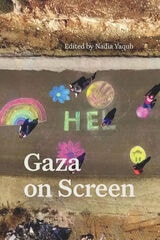
Gaza on Screen
Nadia Yaqub, editor
Duke University Press, 2023
Gaza’s long association with resistance and humanitarian need has generated a complex and ever shifting range of visual material, comprising not just news reports and documentaries, but also essay, experimental, and fiction films, militant videos, and solidarity images. Contributors to Gaza on Screen, who include scholars and Gazan filmmakers, explore the practice, production, and impact of film and videos from and about the Gaza Strip. Conceptualizing screens—both large and small—as tools for mediation that are laden with power, the volume explores Gazan film and video in relation to humanitarianism and human rights, care, community, environment, mobility and confinement, and decolonization. The volume includes visual material ranging from solidarity broadcasts on Lebanese television, mid-twentieth-century British Pathé newsreels, and fiction films to breaking news, visuals of contemporary militant resistance, documentaries, and found footage films, arguing for a visual ecosystem in which differing types of film and video affect and inform each other. Throughout, Gaza on Screen demonstrates that screens shape and sustain relationships between Gaza and the world, and help to sustain the possibility of a different future.
Contributors. Nayrouz Abu Hatoum, Shahd Abusalama, Samirah Alkassim, Basma Alsharif, Hadeel Assali, Azza El-Hassan, Hatim El-Hibri, Mohamed Jabaly, Ahmed Mansour, Arab Nasser, Tarzan Nasser, Kamran Rastegar, Viviane Saglier, Abdelsalam Shehada, Yaron Shemer, Rebecca L. Stein, Helga Tawil-Souri, Shaira Vadasaria, Nadia Yaqub
Contributors. Nayrouz Abu Hatoum, Shahd Abusalama, Samirah Alkassim, Basma Alsharif, Hadeel Assali, Azza El-Hassan, Hatim El-Hibri, Mohamed Jabaly, Ahmed Mansour, Arab Nasser, Tarzan Nasser, Kamran Rastegar, Viviane Saglier, Abdelsalam Shehada, Yaron Shemer, Rebecca L. Stein, Helga Tawil-Souri, Shaira Vadasaria, Nadia Yaqub
[more]
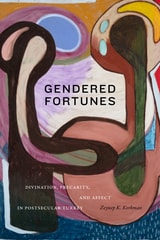
Gendered Fortunes
Divination, Precarity, and Affect in Postsecular TurkeyZeynep K. Korkman
Duke University Press, 2023
In Gendered Fortunes, Zeynep K. Korkman examines Turkey’s commercial fortunetelling cafés where secular Muslim women and LGBTIQ individuals navigate the precarities of twenty-first-century life. Criminalized by long-standing secularist laws and disdained by contemporary Islamist government, fortunetelling cafés proliferate in part because they offer shelter from the conservative secularist, Islamist, neoliberal, and gender pressures of the public sphere. Korkman shows how fortunetelling is a form of affective labor through which its participants build intimate feminized publics in which they share and address their hopes and fears. Korkman uses feeling—which is how her interlocutors describe the divination process—as an analytic to view the shifting landscape of gendered vulnerability in Turkey. In so doing, Korkman foregrounds “feeling” as a feminist lens to explore how those who are pushed to the margins feel their way through oppressive landscapes to create new futures.
[more]