Results by title
210 books match the query 'Missouri' and 10 start with g
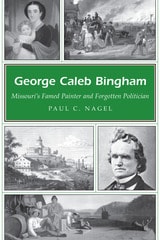
George Caleb Bingham
Missouri's Famed Painter and Forgotten PoliticianPaul C. Nagel
University of Missouri Press, 2005
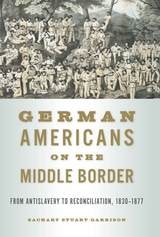
German Americans on the Middle Border
From Antislavery to Reconciliation, 1830–1877Zachary Stuart Garrison
Southern Illinois University Press, 2020
Liberal German immigrants, having escaped the European aristocracy who undermined their revolution and the formation of a free nation, viewed slaveholders as a specter of European feudalism. During the antebellum years, many liberal German Americans feared slavery would inhibit westward progress, and so they embraced the Free Soil and Free Labor movements and the new Republican Party. Most joined the Union ranks during the Civil War.
After the war, in a region largely opposed to black citizenship and Radical Republican rule, German Americans were seen as dangerous outsiders. Facing a conservative resurgence, liberal German Republicans employed the same line of reasoning they had once used to justify emancipation: A united nation required the end of both federal occupation in the South and special protections for African Americans. Having played a role in securing the Union, Germans largely abandoned the freedmen and freedwomen. They adopted reconciliation in order to secure their place in the reunified nation. Garrison’s unique transnational perspective to the sectional crisis, the Civil War, and the postwar era complicates our understanding of German Americans on the middle border.
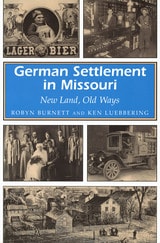
German Settlement in Missouri
New Land, Old WaysRobyn Burnett & Ken Luebbering
University of Missouri Press, 1996
German immigrants came to America for two main reasons: to seek opportunities in the New World, and to avoid political and economic problems in Europe. In German Settlement in Missouri, Robyn Burnett and Ken Luebbering demonstrate the crucial role that the German immigrants and their descendants played in the settlement and development of Missouri's architectural, political, religious, economic, and social landscape. Relying heavily on unpublished memoirs, letters, diaries, and official records, the authors provide important new narratives and firsthand commentary from the immigrants themselves.
Between 1800 and 1919, more than 7 million people came to the United States from German-speaking lands. The German immigrants established towns as they moved up the Missouri River into the frontier, resuming their traditional ways as they settled. As a result, the culture of the frontier changed dramatically. The Germans farmed differently from their American neighbors. They started vineyards and wineries, published German-language newspapers, and entered Missouri politics.
The decades following the Civil War brought the golden age of German culture in the state. The populations of many small towns were entirely German, and traditions from the homeland thrived. German-language schools, publications, and church services were common. As the German businesses in St. Louis and other towns flourished, the immigrants and their descendants prospered. The loyalty of the Missouri Germans was tested in World War I, and the anti-immigrant sentiment during the war and the period of prohibition after it dealt serious blows to their culture. However, German traditions had already found their way into mainstream American life.
Informative and clearly written, German Settlement in Missouri will be of interest to all readers, especially those interested in ethnic history.

Gibson's Last Stand
The Rise, Fall, and Near Misses of the St. Louis Cardinals, 1969-1975Doug Feldmann
University of Missouri Press, 2013

Gillioz "Theatre Beautiful"
Celebrating Springfield's Theatre History, 1926-2006James Baumlin
Moon City Press, 2006

Goin' to Kansas City
Nathan W. Pearson, Jr.
University of Illinois Press, 1987

Gone Goose
The Remaking of an American Town in the Age of Climate ChangeBraden T. Leap
Temple University Press, 2019
Sumner, MO, pop. 102, near the Swan Lake National Wildlife Refuge, proclaims itself “The Wild Goose Capital of the World.” It even displays Maxie, the World’s largest goose: a 40-foot tall fiberglass statue with a wingspan stretching more than 60 feet. But while the 200,000 Canada geese that spent their falls and winters at Swan Lake helped generate millions of dollars for the local economy—with hunting and the annual Goose Festival—climate change, as well as environmental and land use issues, have caused the birds to disappear. The economic loss of the geese and the activities they inspired served as key building blocks in the rural identities residents had developed and treasured.
In his timely and topical book, Gone Goose, Braden Leap observes how members of this rural town adapted, reorganized, and reinvented themselves in the wake of climate change—and how they continued to cultivate respect and belonging in their community. Leap conducted interviews with residents and participated in various community events to explore how they reimagine their relationships with each other as well as their community’s relationship with the environment, even as they wish the geese would return.
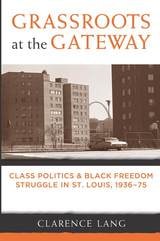
Grassroots at the Gateway
Class Politics and Black Freedom Struggle in St. Louis, 1936-75Clarence Lang
University of Michigan Press, 2010
"This is a theoretically sophisticated and thoroughly documented historical case study of the movements for African American liberation in St. Louis. Through detailed analysis of black working class mobilization from the depression years to the advent of Black Power, award-winning historian Clarence Lang describes how the advances made in earlier decades were undermined by a black middle class agenda that focused on the narrow aims of black capitalists and politicians. The book is a major contribution to our understanding of the black working class insurgency that underpinned the civil rights and Black Power campaigns of the twentieth century."
---V. P. Franklin, University of California, Riverside
"A major work of scholarship that will transform historical understanding of the pivotal role that class politics played in both civil rights and Black Power activism in the United States. Clarence Lang's insightful, engagingly written, and well-researched study will prove indispensable to scholars and students of postwar American history."
---Peniel Joseph, Brandeis University
Breaking new ground in the field of Black Freedom Studies, Grassroots at the Gateway reveals how urban black working-class communities, cultures, and institutions propelled the major African American social movements in the period between the Great Depression and the end of the Great Society. Using the city of St. Louis in the border state of Missouri as a case study, author Clarence Lang undermines the notion that a unified "black community" engaged in the push for equality, justice, and respect. Instead, black social movements of the working class were distinct from---and at times in conflict with---those of the middle class. This richly researched book delves into African American oral histories, records of activist individuals and organizations, archives of the black advocacy press, and even the records of the St. Louis' economic power brokers whom local black freedom fighters challenged. Grassroots at the Gateway charts the development of this race-class divide, offering an uncommon reading of not only the civil rights movement but also the emergence and consolidation of a black working class.
Clarence Lang is Assistant Professor in African American Studies and History at the University of Illinois at Urbana-Champaign.
Photo courtesy Western Historical Manuscript Collection, University of Missouri, St. Louis
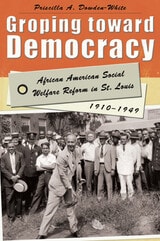
Groping toward Democracy
African American Social Welfare Reform in St. Louis, 1910-1949Priscilla A. Dowden-White
University of Missouri Press, 2011
In Groping toward Democracy: African American Social Welfare Reform in St. Louis, 1910–1949, historian Priscilla A. Dowden-White presents an on-the-ground view of local institution building and community organizing campaigns initiated by African American social welfare reformers. Through extensive research, the author places African American social welfare reform efforts within the vanguard of interwar community and neighborhood organization, reaching beyond the “racial uplift” and “behavior” models of the studies preceding hers. She explores one of the era’s chief organizing principles, the “community as a whole” idea, and deliberates on its relationship to segregation and the St. Louis black community’s methods of reform. Groping toward Democracy depicts the dilemmas organizers faced in this segregated time, explaining how they pursued the goal of full, uncontested black citizenship while still seeking to maximize the benefits available to African Americans in segregated institutions. The book’s nuanced mapping of the terrain of social welfare offers an unparalleled view of the progress brought forth by the early-twentieth-century crusade for democracy and equality.
By delving into interrelated developments in health care, education, labor, and city planning, Dowden-White deftly examines St. Louis’s African American interwar history. Her in-depth archival research fills a void in the scholarship of St. Louis’s social development, and her compelling arguments will be of great interest to scholars and teachers of American urban studies and social welfare history.
Guide to Missouri Confederate Units, 1861-1865
James E. McGhee
University of Arkansas Press, 2010