Results by title
95 books match the query 'Money' and 3 start with g
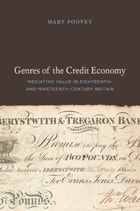
Genres of the Credit Economy
Mediating Value in Eighteenth- and Nineteenth-Century BritainMary Poovey
University of Chicago Press, 2008
How did banking, borrowing, investing, and even losing money—in other words, participating in the modern financial system—come to seem likeroutine activities of everydaylife? Genres of the Credit Economy addressesthis question by examining the history of financial instruments and representations of finance in eighteenth- and nineteenth-century Britain.
Chronicling the process by which some of our most important conceptual categories were naturalized, Mary Poovey explores complex relationships among forms of writing that are not usually viewed together, from bills of exchange and bank checks, to realist novels and Romantic poems, to economic theory and financial journalism. Taking up all early forms of financial and monetarywriting, Poovey argues that these genres mediated for early modern Britons the operations of a market system organized around credit and debt. By arguing that genre is a critical tool for historical and theoretical analysis and an agent in the events that formed the modern world, Poovey offers a new way to appreciate the character of the credit economy and demonstrates the contribution historians and literary scholars can make to understanding its operations.
Much more than an exploration of writing on and around money, Genres of the Credit Economy offers startling insights about the evolution of disciplines and the separation of factual and fictional genres.
[more]
Good Money, Part 1
The New WorldF. A. Hayek
University of Chicago Press, 1999
The two volumes of Good Money concentrate on Hayek's work on money and monetary policy. Published in the centenary of his birth, these volumes bring forth some of the economist's most distinguished articles on monetary policy and offer another vital addition to the collection of Hayek's life work.
Good Money, Part I: The New World includes seven of Hayek's articles from the 1920s that were written largely in reaction to the work of Irving Fisher and W. C. Mitchell. Hayek encountered Fisher's work on the quantity theory of money and Mitchell's studies on business cycles during a U.S. visit in 1923-24. These articles attack the idea that price stabilization was consistent with the stabilization of foreign exchange and foreshadow Hayek's general critique that the whole of an economy is not simply the sum of its parts.
Good Money, Part II: The Standard offers five more of Hayek's articles that advance his ideas about money. In these essays, Hayek investigates the consequences of the "predicament of composition." This principle works on the premise that the entire society cannot simultaneously increase liquidity by selling property or services for cash. This analysis led Hayek to make what was perhaps his most controversial proposal: that governments should be denied a monopoly on the coining of money.
Taken together, these volumes present a comprehensive chronicle of Hayek's writings on monetary policy and offer readers an invaluable reference to some of his most profound thoughts about money.
"Each new addition to The Collected Works of F. A. Hayek, the University of Chicago's painstaking series of reissues and collections, is a gem."— Liberty on Volume IX of The Collected Works of F. A. Hayek
"Intellectually [Hayek] towers like a giant oak in a forest of saplings."—Chicago Tribune
"One of the great thinkers of our age who . . . revolutionized the world's intellectual and political life."—Former President George Herbert Walker Bush
[more]
Good Money, Part 2
The StandardF. A. Hayek
University of Chicago Press, 1999
The two volumes of Good Money concentrate on Hayek's work on money and monetary policy. Published in the centenary of his birth, these volumes bring forth some of the economist's most distinguished articles on monetary policy and offer another vital addition to the collection of Hayek's life work.
Good Money, Part I: The New World includes seven of Hayek's articles from the 1920s that were written largely in reaction to the work of Irving Fisher and W. C. Mitchell. Hayek encountered Fisher's work on the quantity theory of money and Mitchell's studies on business cycles during a U.S. visit in 1923-24. These articles attack the idea that price stabilization was consistent with the stabilization of foreign exchange and foreshadow Hayek's general critique that the whole of an economy is not simply the sum of its parts.
Good Money, Part II: The Standard offers five more of Hayek's articles that advance his ideas about money. In these essays, Hayek investigates the consequences of the "predicament of composition." This principle works on the premise that the entire society cannot simultaneously increase liquidity by selling property or services for cash. This analysis led Hayek to make what was perhaps his most controversial proposal: that governments should be denied a monopoly on the coining of money.
Taken together, these volumes present a comprehensive chronicle of Hayek's writings on monetary policy and offer readers an invaluable reference to some of his most profound thoughts about money.
"Each new addition to The Collected Works of F. A. Hayek, the University of Chicago's painstaking series of reissues and collections, is a gem."— Liberty on Volume IX of The Collected Works of F. A. Hayek
"Intellectually [Hayek] towers like a giant oak in a forest of saplings."—Chicago Tribune
"One of the great thinkers of our age who . . . revolutionized the world's intellectual and political life."—Former President George Herbert Walker Bush
Good Money, Part I: The New World includes seven of Hayek's articles from the 1920s that were written largely in reaction to the work of Irving Fisher and W. C. Mitchell. Hayek encountered Fisher's work on the quantity theory of money and Mitchell's studies on business cycles during a U.S. visit in 1923-24. These articles attack the idea that price stabilization was consistent with the stabilization of foreign exchange and foreshadow Hayek's general critique that the whole of an economy is not simply the sum of its parts.
Good Money, Part II: The Standard offers five more of Hayek's articles that advance his ideas about money. In these essays, Hayek investigates the consequences of the "predicament of composition." This principle works on the premise that the entire society cannot simultaneously increase liquidity by selling property or services for cash. This analysis led Hayek to make what was perhaps his most controversial proposal: that governments should be denied a monopoly on the coining of money.
Taken together, these volumes present a comprehensive chronicle of Hayek's writings on monetary policy and offer readers an invaluable reference to some of his most profound thoughts about money.
"Each new addition to The Collected Works of F. A. Hayek, the University of Chicago's painstaking series of reissues and collections, is a gem."— Liberty on Volume IX of The Collected Works of F. A. Hayek
"Intellectually [Hayek] towers like a giant oak in a forest of saplings."—Chicago Tribune
"One of the great thinkers of our age who . . . revolutionized the world's intellectual and political life."—Former President George Herbert Walker Bush
[more]