Results by title
99 books match the query 'Motion picture producers and directors' and 4 start with g
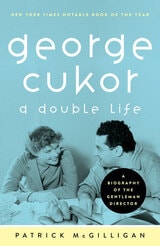
George Cukor
A Double LifePatrick McGilligan
University of Minnesota Press, 2013
One of the highest-paid studio contract directors of his time, George Cukor was nominated five times for an Academy Award as Best Director. In publicity and mystique he was dubbed the “women’s director” for guiding the most sensitive leading ladies to immortal performances, including Greta Garbo, Ingrid Bergman, Judy Garland, and—in ten films, among them The Philadelphia Story and Adam’s Rib—his lifelong friend and collaborator Katharine Hepburn. But behind the “women’s director” label lurked the open secret that set Cukor apart from a generally macho fraternity of directors: he was a homosexual, a rarity among the top echelon. Patrick McGilligan’s biography reveals how Cukor persevered within a system fraught with bigotry while becoming one of Hollywood’s consummate filmmakers.
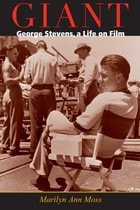
Giant
George Stevens, a Life on FilmMarilyn Ann Moss
University of Wisconsin Press, 2015
Moss documents Stevens’s role as a powerful director who often had to battle the heads of major studios to get his films made his way. She traces the four decades Stevens was a major Hollywood player and icon, from his earliest days at the Hal Roach Studios—where he learned to be a cameraman, writer, and director for Laurel and Hardy features—up to when his films made millions at the box office and were graced by actors such as Elizabeth Taylor, James Dean, Alan Ladd, and Montgomery Clift.
Glasnost—Soviet Cinema Responds
By Nicholas Galichenko
University of Texas Press, 1991
With the coming of glasnost to the Soviet Union, filmmakers began to explore previously forbidden themes, and distributors released films that were suppressed by pre-glasnost-era censors. Soviet cinema underwent a revolution, one that mirrors and helps interpret the social revolution that took place throughout the USSR. Glasnost—Soviet Cinema Responds is the first overall survey of the effects of this revolution on the work of Soviet filmmakers and their films.
The book is structured as a series of three essays and a filmography of the directors of glasnost cinema. The first essay, "The Age of Perestroika," describes the changes that occurred in Soviet cinema as it freed itself from the legacy of Stalinism and socialist realism. It also considers the influence of film educator and director Mikhail Romm. "Youth in Turmoil" takes a sociological look at films about youth, the most dynamic and socially revealing of glasnost-era productions. "Odysseys in Inner Space" charts a new direction in Soviet cinema as it focuses on the inner world of individuals.
The filmography includes thirty-three of the most significant glasnost-era directors, including Tengiz Abuladze, Karen Shakhnazarov, and Sergei Soloviev, with a comprehensive list of their films. Discussions of many individual films, such as Repentance, The Messenger Boy, and The Wild Pigeon, and interviews with the directors reveal the effects that glasnost and perestroika have had on the directors' lives and art.
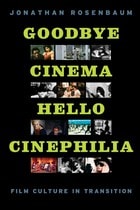
Goodbye Cinema, Hello Cinephilia
Film Culture in TransitionJonathan Rosenbaum
University of Chicago Press, 2010
The esteemed film critic Jonathan Rosenbaum has brought global cinema to American audiences for the last four decades. His incisive writings on individual filmmakers define film culture as a diverse and ever-evolving practice, unpredictable yet subject to analyses just as diversified as his own discriminating tastes. For Rosenbaum, there is no high or low cinema, only more interesting or less interesting films, and the pieces collected here, from an appreciation of Marilyn Monroe’s intelligence to a classic discussion on and with Jean-Luc Godard, amply testify to his broad intellect and multi-faceted talent. Goodbye Cinema, Hello Cinephilia gathers together over fifty examples of Rosenbaum’s criticism from the past four decades, each of which demonstrates his passion for the way we view movies, as well as how we write about them. Charting our changing concerns with the interconnected issues that surround video, DVDs, the Internet, and new media, the writings collected here also highlight Rosenbaum’s polemics concerning the digital age. From the rediscovery and recirculation of classic films, to the social and aesthetic impact of technological changes, Rosenbaum doesn’t disappoint in assembling a magisterial cast of little-known filmmakers as well as the familiar faces and iconic names that have helped to define our era.
As we move into this new decade of moviegoing—one in which Hollywood will continue to feel the shockwaves of the digital age—Jonathan Rosenbaum remains a valuable guide. Goodbye Cinema, Hello Cinephilia is a consummate collection of his work, not simply for fans of this seminal critic, but for all those open to the wide variety of films he embraces and helps us to elucidate.