Results by title
618 books match the query 'Motion pictures' and 14 start with g

Gender and Society in Contemporary Brazilian Cinema
By David William Foster
University of Texas Press, 1999
"Gender is an absolute ground zero for most human societies," writes David William Foster, "an absolute horizon of social subjectivity." In this book, he examines gender issues in thirteen Brazilian films made (with one exception) after the 1985 return to constitutional democracy and elimination of censorship to show how these issues arise from and comment on the sociohistorical reality of contemporary Brazilian society.
Foster organizes his study around three broad themes: construction of masculinity, constructions of feminine and feminist identities, and same-sex positionings and social power. Within his discussions of individual films ranging from Jorge um brasileiro to A hora da estrela to Beijo no asfalto, he offers new ways of understanding national ideals and stereotypes, sexual dissidence (homoeroticism and transgenderism), heroic models, U.S./Brazilian relations, revolutionary struggle, and human rights violations. As the first study of Brazilian cinematic representations of gender ideology in English or Portuguese, this book will be important reading in film and cultural studies.
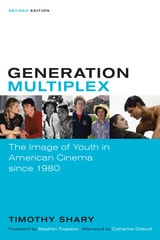
Generation Multiplex
The Image of Youth in American Cinema since 1980By Timothy Shary
University of Texas Press, 2014
Generation Multiplex (2002) was the first comprehensive study of the representation of teenagers in American cinema since David Considine’s Cinema of Adolescence in 1985. This updated and expanded edition reaffirms the idea that films about youth constitute a legitimate genre worthy of study on its own terms. Identifying four distinct subgenres—school, delinquency, horror, and romance—Timothy Shary explores hundreds of representative films while offering in-depth discussion of movies that constitute key moments in the genre, including Fast Times at Ridgemont High, A Nightmare on Elm Street, The Breakfast Club, Say Anything . . . , Boyz N the Hood, Scream, American Pie, Napoleon Dynamite, Superbad, The Twilight Saga, and The Hunger Games. Analyzing developments in teen films since 2002, Shary covers such topics as the increasing availability of movies on demand, which has given teens greater access to both popular and lesser-seen films; the recent dominance of supernatural and fantasy films as a category within the genre; and how the ongoing commodification of teen images in media affects real-life issues such as school bullying, athletic development, sexual identity, and teenage pregnancy.
Generation X Rocks
Contemporary Peninsular Fiction, Film, and Rock CultureChristine Henseler
Vanderbilt University Press, 2007
Geographies of Relation
Diasporas and Borderlands in the AmericasTheresa Delgadillo
University of Michigan Press, 2024
Not only does Delgadillo offer a rare extended analysis of Black Latinidades in Chicanx literature and theory, but she also considers over a century’s worth of literary, cinematic, and performative texts to support her argument about the significance of these cultural sites and overlaps. Chapters illuminate the significance of Toña La Negra in the Golden Age of Mexican cinema, reconsider feminist theorist Gloria Anzaldúa’s work in revising exclusionary Latin American ideologies of mestizaje, delve into the racial and gender frameworks Sandra Cisneros attempts to rewrite, unpack encounters between African Americans and Black Puerto Ricans in texts by James Baldwin and Marta Moreno Vega, explore the African diaspora in colonial and contemporary Peru through Daniel Alarcón’s literature and the documentary Soy Andina, and revisit the centrality of Black power in ending colonialism in Cuban narratives. Geographies of Relation demonstrates the long histories of networks and exchanges across the Americas as well as the interrelationships among Indigenous, Black, African American, mestizx, Chicanx, and Latinx peoples. It offers a compelling argument that geographies of relation are as significant as national frameworks in structuring cultural formation and change in this hemisphere.

German Film after Germany
Toward a Transnational AestheticRandall Halle
University of Illinois Press, 2007
Ghostly Desires
Queer Sexuality and Vernacular Buddhism in Contemporary Thai CinemaArnika Fuhrmann
Duke University Press, 2016

Gilles Deleuze's Time Machine
D. N. Rodowick
Duke University Press, 1997
Rodowick illuminates the connections between Deleuze’s writings on visual and scientific texts and describes the formal logic of his theory of images and signs. Revealing how Deleuzian views on film speak to the broader network of philosophical problems addressed in Deleuze’s other books—including his influential work with Félix Guattari—Rodowick shows not only how Deleuze modifies the dominant traditions of film theory, but also how the study of cinema is central to the project of modern philosophy.
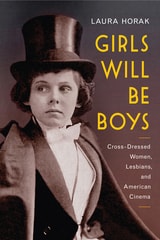
Girls Will Be Boys
Cross-Dressed Women, Lesbians, and American Cinema, 1908-1934Horak, Laura
Rutgers University Press, 2016
Finalist for 2016 Richard Wall Memorial Award from the Theatre Library Association
Long-listed for the 2017 Best Photography Book Award from the Kraszna-Krausz Foundation
Marlene Dietrich, Greta Garbo, and Katharine Hepburn all made lasting impressions with the cinematic cross-dressing they performed onscreen. What few modern viewers realize, however, is that these seemingly daring performances of the 1930s actually came at the tail end of a long wave of gender-bending films that included more than 400 movies featuring women dressed as men.
Laura Horak spent a decade scouring film archives worldwide, looking at American films made between 1908 and 1934, and what she discovered could revolutionize our understanding of gender roles in the early twentieth century. Questioning the assumption that cross-dressing women were automatically viewed as transgressive, she finds that these figures were popularly regarded as wholesome and regularly appeared onscreen in the 1910s, thus lending greater respectability to the fledgling film industry. Horak also explores how and why this perception of cross-dressed women began to change in the 1920s and early 1930s, examining how cinema played a pivotal part in the representation of lesbian identity.
Girls Will Be Boys excavates a rich history of gender-bending film roles, enabling readers to appreciate the wide array of masculinities that these actresses performed—from sentimental boyhood to rugged virility to gentlemanly refinement. Taking us on a guided tour through a treasure-trove of vintage images, Girls Will Be Boys helps us view the histories of gender, sexuality, and film through fresh eyes.
Glasnost—Soviet Cinema Responds
By Nicholas Galichenko
University of Texas Press, 1991
With the coming of glasnost to the Soviet Union, filmmakers began to explore previously forbidden themes, and distributors released films that were suppressed by pre-glasnost-era censors. Soviet cinema underwent a revolution, one that mirrors and helps interpret the social revolution that took place throughout the USSR. Glasnost—Soviet Cinema Responds is the first overall survey of the effects of this revolution on the work of Soviet filmmakers and their films.
The book is structured as a series of three essays and a filmography of the directors of glasnost cinema. The first essay, "The Age of Perestroika," describes the changes that occurred in Soviet cinema as it freed itself from the legacy of Stalinism and socialist realism. It also considers the influence of film educator and director Mikhail Romm. "Youth in Turmoil" takes a sociological look at films about youth, the most dynamic and socially revealing of glasnost-era productions. "Odysseys in Inner Space" charts a new direction in Soviet cinema as it focuses on the inner world of individuals.
The filmography includes thirty-three of the most significant glasnost-era directors, including Tengiz Abuladze, Karen Shakhnazarov, and Sergei Soloviev, with a comprehensive list of their films. Discussions of many individual films, such as Repentance, The Messenger Boy, and The Wild Pigeon, and interviews with the directors reveal the effects that glasnost and perestroika have had on the directors' lives and art.
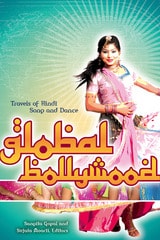
Global Bollywood
Travels of Hindi Song and DanceSangita Gopal
University of Minnesota Press, 2008
Bollywood movies and their signature song-and-dance spectacles are an aesthetic familiar to people around the world, and Bollywood music now provides the rhythm for ads marketing goods such as computers and a beat for remixes and underground bands. These musical numbers have inspired scenes in Western films such as Vanity Fair and Moulin Rouge.
Global Bollywood shows how this currency in popular culture and among diasporic communities marks only the latest phase of the genre’s world travels. This interdisciplinary collection describes the many roots and routes of the Bollywood song-and-dance spectacle. Examining the reception of Bollywood music in places as diverse as Indonesia and Israel, the essays offer a stimulating redefinition of globalization, highlighting the cultural influence of Hindi film music from its origins early in the twentieth century to today.
Contributors: Walter Armbrust, Oxford U; Anustup Basu, U of Illinois, Urbana-Champaign; Nilanjana Bhattacharjya, Colorado College; Edward K. Chan, Kennesaw State U; Bettina David, Hamburg U; Rajinder Dudrah, U of Manchester; Shanti Kumar, U of Texas, Austin; Monika Mehta, Binghamton U; Anna Morcom, Royal Holloway College; Ronie Parciack, Tel Aviv U; Biswarup Sen, U of Oregon; Sangita Shrestova; Richard Zumkhawala-Cook, Shippensburg U.
Sangita Gopal is assistant professor of English at the University of Oregon. Sujata Moorti is professor of women’s and gender studies at Middlebury College.
Global Cinema Networks
Gorfinkel, Elena
Rutgers University Press, 2018
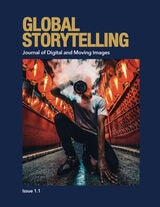
Global Storytelling, vol. 1, no. 1
Journal of Digital and Moving ImagesYing Zhu
Michigan Publishing Services, 2021
In this issue
Letter from the Editor Ying Zhu Hong Kong and Social MovementsHong Kong Unraveled: Social Media and the 2019 Protest Movement
Anonymous
Unleashing the Sounds of Silence: Hong Kong’s Story in Troubled Times
Andrea Riemenschnitter
Tragedy of Errors at Warp Speed
Sam Ho
Imagining a City-Based Democracy: Review of The Appearing Demos: Hong Kong During and After the Umbrella Movement by Laikwan Pang, University of Michigan Press, 2020
Enoch Tam
China and the Film Festival
Richard Peña
Nationalism from Below: State Failures, Nollywood, and Nigerian Pidgin Jonathan Haynes Collective Memory and the Rhetorical Power of the Historical Fiction Film
Carl Plantinga
From Nations to Worlds: Chris Marker’s Si j’avais quatre dromadaires
Michael Walsh
American Factory and the Difficulties of Documenting Neoliberalism
Peter Hitchcock
R.I.P. Soft Power: China’s Story Meets the Reset Button: Review of Soft Power with Chinese Characteristics: China’s Campaign for Hearts and Minds edited by Kingsley Edney, Stanley Rosen, and Ying Zhu, Routledge, 2019
Robert A. Kapp
Review: On Epidemics, Epidemiology, and Global Storytelling
Carlos Rojas
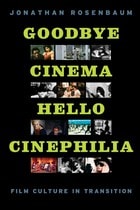
Goodbye Cinema, Hello Cinephilia
Film Culture in TransitionJonathan Rosenbaum
University of Chicago Press, 2010
The esteemed film critic Jonathan Rosenbaum has brought global cinema to American audiences for the last four decades. His incisive writings on individual filmmakers define film culture as a diverse and ever-evolving practice, unpredictable yet subject to analyses just as diversified as his own discriminating tastes. For Rosenbaum, there is no high or low cinema, only more interesting or less interesting films, and the pieces collected here, from an appreciation of Marilyn Monroe’s intelligence to a classic discussion on and with Jean-Luc Godard, amply testify to his broad intellect and multi-faceted talent. Goodbye Cinema, Hello Cinephilia gathers together over fifty examples of Rosenbaum’s criticism from the past four decades, each of which demonstrates his passion for the way we view movies, as well as how we write about them. Charting our changing concerns with the interconnected issues that surround video, DVDs, the Internet, and new media, the writings collected here also highlight Rosenbaum’s polemics concerning the digital age. From the rediscovery and recirculation of classic films, to the social and aesthetic impact of technological changes, Rosenbaum doesn’t disappoint in assembling a magisterial cast of little-known filmmakers as well as the familiar faces and iconic names that have helped to define our era.
As we move into this new decade of moviegoing—one in which Hollywood will continue to feel the shockwaves of the digital age—Jonathan Rosenbaum remains a valuable guide. Goodbye Cinema, Hello Cinephilia is a consummate collection of his work, not simply for fans of this seminal critic, but for all those open to the wide variety of films he embraces and helps us to elucidate.

Guidelines on Subject Access to Individual Works of Fiction, Drama, Etc.
American Library Association, 2000