Results by title
209 books match the query 'Mystery & Detective' and 5 start with g

Gichigami
A NovelLindsey Steffes
University of Massachusetts Press, 2025
Winner, Edna Ferber Fiction Book Award
An eerie coming-of-age story of a young girl’s quest for her absent mother across the frozen terrain of Lake Superior
One December evening, when 13-year-old Marta crosses the frozen Lake Superior and reaches the home she shares with her father, she finds a woman standing at their door. As Marta approaches, she realizes the woman, who looks like a tropical bird caught in the snow, is her mother who’d abruptly left them six years before. Marta hopes this is a turning point, that her mother will stay this time—despite hating this town, this island, and their creaky, towering Victorian house. But not everyone in town is thrilled with her mother’s arrival, least of all her dad.
Almost as soon as she arrives, however, Marta’s mother abruptly vanishes again, nowhere to be found, leaving Marta with more questions than answers. Her father denies her mother was ever there and Marta is left with the mystery of her mother’s homecoming. She begins to wonder if he is lying, or if there is a deeper secret being kept from her by the entire tight-knit community. As Marta delves into her mother's sudden reappearance and subsequent disappearance, she seeks answers, visiting places that were significant to her mother and questioning people she knew. Desperate for answers that will shed light on the mystery, this quest leads her to uncover a web of secrets that threaten to unravel everything she thought she knew about her family and herself.
Gichigami is an eerie coming-of-age novel, weaving between Marta and the person desperately trying to keep Marta and her mother apart. This poignant exploration of the lives of women and girls of the Midwest shines a light on the struggles of absent mothers, runaway daughters, and those who yearn for more than life has offered them. With rich prose and vivid imagery, Lindsey Steffes spins a tale of loss, longing, and betrayal set against the backdrop of the harsh yet beautiful landscape of Lake Superior.
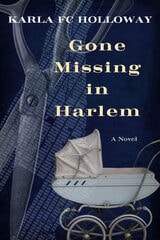
Gone Missing in Harlem
A NovelKarla FC Holloway
Northwestern University Press, 2021
The family arrives as Harlem staggers under the flu pandemic that follows the First World War. DeLilah Mosby and her daughter, Selma, meet difficulties with backbone and resolve to make a home for themselves in the city, and Selma has a baby, Chloe. As the Great Depression creeps across the world at the close of the twenties, however, the farsighted see hard times coming.
The panic of the early thirties is embodied in the kidnapping and murder of the infant son of the nation’s dashing young aviator, Charles Lindbergh. A transfixed public follows the manhunt in the press and on the radio. Then Chloe goes missing—but her disappearance does not draw the same attention. Wry and perceptive Weldon Haynie Thomas, the city’s first “colored” policeman, takes the case.
The urgent investigation tests Thomas’s abilities to draw out the secrets Harlem harbors, untangling the color-coded connections and relationships that keep company with greed, ghosts, and grief. With nuanced characters, lush historical detail, and a lyrical voice, Gone Missing in Harlem affirms the restoring powers of home and family.

Good Knights
Ralph McInerny
St. Augustine's Press, 2010
These stories represent an intermediate stage in the evolution of the Knight brothers in Ralph McInerny’s fiction. In The Noonday Devil, Phil, in his capacity as private detective, was fairly close to the action, but by no means the major character. Roger, his blimp-sized brother, entered obliquely into the story but ended by starring in the finale.
Readers liked them, in particular Roger. So McInerny brought them back in Easeful Death, where they are far more central and Roger occupies much space, physically and narratively. And so it might have remained. When McInerny was asked to do a Notre Dame series of mysteries, he decided to bring Roger to South Bend as the Huneker Professor of Catholic Studies, accompanied by the semi-retired Phil, who has the full menu of Notre Dame sports to keep him occupied. Prior to starting the series, McInerny wanted to reacquaint himself with the Knights and hit upon the idea of doing a series of Knight brothers stories in Crisis, a magazine he founded with Michael Novak. Before moving them to South Bend, he wanted to see them in action, working out of New York, always driving in the specially designed van, never flying, to the cities were their client lived.
Good Knights is the result of putting these eight Knights brothers’ stories together. Call them finger exercises in character. The response to them in the magazine was gratifying, and with them behind him, McInerny launched the Notre Dame series, with On This Rockne in 1996, thirteen years and thirteen novels ago. But the origins of that successful series is seen here.
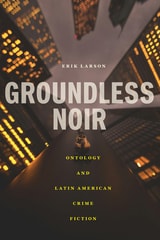
Groundless Noir
Ontology and Latin American Crime FictionErik Larson
Bucknell University Press, 2026
This philosophical study of Latin American noir fiction poses the question, What if precarity and uncertainty aren’t just themes of the genre but ways of being in the world? Emerging from a region immersed in violence, trauma, and political instability, the novela negra reveals not just disillusionment but a desire to adapt to, even dwell within, chaos. In the hands of writers like Ricardo Piglia, Roberto Bolaño, and Patricia Melo, savvy detectives and antiheroes navigate a world in which meaning constantly shifts and certainty is elusive. Blending literary analysis with philosophical inquiry, Larson draws on Heideggerian ontology to demonstrate how the noir novel becomes a mode of existence—grounded in its very groundlessness. Rather than offering resolution, these novels embody a paradoxical desire: to engage crisis while also adapting to it. In doing so, they become both ideological and pedagogical—existential fiction for an uncertain world.
Published by Bucknell University Press. Distributed worldwide by Rutgers University Press.
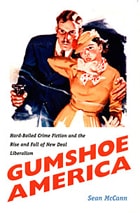
Gumshoe America
Hard-Boiled Crime Fiction and the Rise and Fall of New Deal LiberalismSean McCann
Duke University Press, 2000
Gumshoe America traces the way those problems surfaced in hard-boiled crime fiction from the1920s through the 1960s. Beginning by using a forum on the KKK in the pulp magazine Black Mask to describe both the economic and political culture of pulp fiction in the early twenties, McCann locates the origins of the hard-boiled crime story in the genre’s conflict with the racist antiliberalism prominent at the time. Turning his focus to Dashiell Hammett’s career, McCann shows how Hammett’s writings in the late 1920s and early 1930s moved detective fiction away from its founding fables of social compact to the cultural alienation triggered by a burgeoning administrative state. He then examines how Raymond Chandler’s fiction, unlike Hammett’s, idealized sentimental fraternity, echoing the communitarian appeals of the late New Deal. Two of the first crime writers to publish original fiction in paperback—Jim Thompson and Charles Willeford—are examined next in juxtaposition to the popularity enjoyed by their contemporaries Mickey Spillane and Ross Macdonald. The stories of the former two, claims McCann, portray the decline of the New Deal and the emergence of the rights-based liberalism of the postwar years and reveal new attitudes toward government: individual alienation, frustration with bureaucratic institutions, and dissatisfaction with the growing vision of America as a meritocracy. Before concluding, McCann turns to the work of Chester Himes, who, in producing revolutionary hard-boiled novels, used the genre to explore the changing political significance of race that accompanied the rise of the Civil Rights movement in the late 1950s and the 1960s.
Combining a striking reinterpretation of the hard-boiled crime story with a fresh view of the political complications and cultural legacies of the New Deal, Gumshoe America will interest students and fans of the genre, and scholars of American history, culture, and government.