Results by title
405 books match the query 'Natural history' and 9 start with g
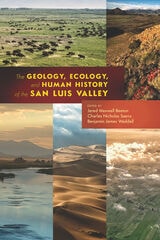
Geology, Ecology, and Human History of the San Luis Valley
Jared Maxwell Beeton
University Press of Colorado, 2020
The first section, “The Geology and Ecology of the San Luis Valley,” surveys the geomorphology, hydrology, animal and plant life, conservation, management, and mining of the valley’s varied terrain. The second section, “Human History of the San Luis Valley,” recounts the valley’s human visitation and settlement, from early indigenous life to Spanish exploration to Hispanic and Japanese settlements. This section introduces readers to the region’s wide range of religious identities—Catholic, Latter-day Saint, Buddhist, Jehovah’s Witness, Amish, and Mennonite—and diverse linguistic traditions, including Spanish, English, Dutch, Danish, Japanese, and Mayan. The final section, “Travel Itineraries,” addresses recreation, specifically fly-fishing and rock climbing.
The book provides a comprehensive overview of the endemic flora and fauna, human history of indigenous lifeways, and diverse settlement patterns that have shaped the region. The Geology, Ecology, and Human History of the San Luis Valley will appeal to students and scholars of geology, ecology, environmental history, and cultural history, as well as residents and tourists seeking to know more about this fascinating and integral part of Colorado and New Mexico.
Contributors:
Benjamin Armstrong, Timothy Armstrong, Deacon Aspinwall, Robert Benson, Lorrie Crawford, Kristy Duran, Jeff Elison, Eric Harmon, Devin Jenkins, Bradley G. Johnson, Robert M. Kirkham, Bessie Konishi, Angie Krall, Richard D. Loosbrock, Richard Madole, A. W. Magee, Victoria Martinez, James McCalpin, Mark Mitchell, R. Nathan Pipitone, Andrew Valdez, Rio de la Vista, Damián Vergara Wilson
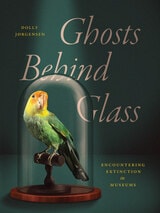
Ghosts Behind Glass
Encountering Extinction in MuseumsDolly Jørgensen
University of Chicago Press, 2025
While it’s no longer possible to encounter a dodo in the wild, we can still come face-to-face with them in museums. The remains of extinct species—whether taxidermied, skeletal, drawn, or sculpted—stare back at us from display cases.
In this moving meditation on what’s lost and what endures, environmental historian Dolly Jørgensen visits natural history collections worldwide—from Shanghai to Philadelphia, from Edinburgh to Hobart, Australia—to understand the many ways that museums tell stories about extinction. She encounters extinct animals that are framed as cultural artifacts and as rare valuables, that are memorialized with lists, and that are brought to life through augmented reality. She draws our attention to creatures with prominent afterlives—passenger pigeons, giant moas, thylacines—as well as those that are less likely to be discussed or displayed. Throughout, Jørgensen examines the relationship between museums and the natural world, so readers can look more closely at exhibits about extinction, studying the displays for what is there, as well as what is missing. During a period of rapid species loss driven by humanity’s environmental impact, Ghosts Behind Glass asks what we can learn about our world from the presence of the extinct.
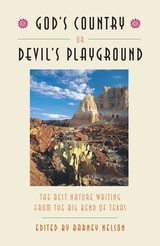
God's Country or Devil's Playground
The Best Nature Writing from the Big Bend of TexasEdited by Barney Nelson
University of Texas Press, 2002
The dramatic desert landscapes of the Big Bend country along the Texas-Mexico border reminded historian Walter Prescott Webb of "an earth-wreck in which a great section of country was shaken down, turned over, blown up, and set on fire." By contrast, naturalist Aldo Leopold considered the region a mountainous paradise in which even the wild Mexican parrots had no greater concern than "whether this new day which creeps slowly over the canyons is bluer or golder than its predecessors, or less so." Whether it impresses people as God's country or as the devil's playground, the Big Bend typically evokes strong responses from almost everyone who lives or visits there.
In this anthology of nature writing, Barney Nelson gathers nearly sixty literary perspectives on the landscape and life of the Big Bend region, broadly defined as Trans-Pecos Texas and northern Chihuahua, Mexico. In addition to Leopold and Webb, the collection includes such well-known writers as Edward Abbey, Mary Austin, Roy Bedichek, and Frederick Olmsted, as well as a wide range of voices that includes explorers, trappers, cowboys, ranch wives, curanderos, college presidents, scientists, locals, tourists, historians, avisadores, and waitresses. Following a personal introduction by Barney Nelson, the pieces are grouped thematically to highlight the distinctive ways in which writers have responded to the Big Bend.
God's Providence and Randomness in Nature
Scientific and Theological PerspectivesRobert John Russell
Templeton Press, 2019
In October 2014, a group of mathematicians, physicists, ecologists, philosophers, and theologians gathered at a special conference in Berkeley, California, to present the results of a two-year research program dubbed “Project SATURN.” This program explored many rich avenues of thought at the intersection of modern science and Christian theology. Chief among them is the possibility that specific processes might be so complex that they do not have sufficient physical causes. Known as “ontological indeterminism,” this idea has profound implications for theology. Specifically, it allows God to be thought of as acting providentially within nature without violating the laws and processes of nature.
Such a momentous insight could influence how we understand free will, natural evil, suffering in nature, and the relation between divine providence and human evolution. The essays collected here discussed these topics and were initially presented at the 2014 conference. Part I establishes the scientific basis for conceptualizing specific processes in the universe as inherently random and possibly indeterministic. Part II discusses the philosophical and theological issues that spring from this understanding. Together they represent the cutting edge of thought in the increasingly productive dialogue between science and theology.
Short for the “Scientific and Theological Understandings of Randomness in Nature,” Project SATURN was created by the Center for Theology and the Natural Sciences, a Program of the Graduate Theological Union, Berkeley. It was funded with a grant administered by Calvin College and provided by the John Templeton Foundation.
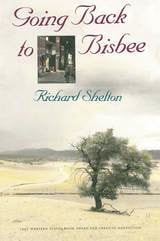
Going Back to Bisbee
Richard Shelton
University of Arizona Press, 1992
Couched within the narrative of his journey are passages revealing Shelton's deep familiarity with the region's natural and human history. Whether conveying the mystique of tarantulas or describing the mountain-studded topography, he brings a poet's eye to this seemingly desolate country. His observations on human habitation touch on Tombstone, "the town too tough to die," on ghost towns that perhaps weren't as tough, and on Bisbee itself, a once prosperous mining town now an outpost for the arts and a destination for tourists. What he finds there is both a broad view of his past and a glimpse of that city's possible future.
Going Back to Bisbee explores a part of America with which many readers may not be familiar. A rich store of information embedded in splendid prose, it shows that there are more than miles on the road to Bisbee.
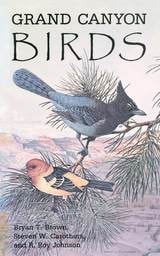
Grand Canyon Birds
Historical Notes, Natural History and EcologyBryan T. Brown
University of Arizona Press, 1987
"Will benefit all amateur naturalists because of its survey of the life zone patterns in [the] southwestern United States." —Science Books & Films
"The subtitle accurately reflects the contents of this excellent book on the birds of a unique natural wonder and national treasure. . . . An annotated checklist discusses the status and abundance of each of the over 300 species of birds known to have occurred in the Grand Canyon region, which is defined here as the river between Glen Canyon Dam and Lake Mead and the contiguous plateaus to the north and south." —Journal of Arizona History
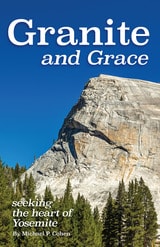
Granite and Grace
Seeking the Heart of YosemiteMichael P. Cohen
University of Nevada Press, 2019
Drawing together the humanistic and scientific significance of the wild landscapes he traverses, Michael uncovers relationships between people and places and meaning and substance, rendering this text part memoir—but also considerably more. On-the-rock encounters by hand and foot open up a dialogue between the heart of a philosopher and the mind of a geologist. Michael adds a literary softness to this hard landscape, blending excursions with exposition and literature with science. It is through his graceful representations that the geological becomes metaphorical, while the science turns mythological.
This high country, where in 1889 John Muir and Robert Underwood Johnson planned what would become Yosemite National Park, is significant for cultural as well as natural reasons. Discoursing on everything from Camus’s “Myths of Sisyphus” to the poems of Gary Snyder, Michael adds depth to an already splendorous landscape. Premier early geologists, such as François Matthes, shaped the language of Yosemite’s landscape. Even though Yosemite has changed over half a century, the rock has not. As Michael explores the beauty and grace of his familiar towering vistas, he demonstrates why, of the many aspects of the world to which one might get attached, the most secure is granite.
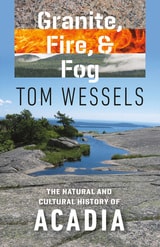
Granite, Fire, and Fog
The Natural and Cultural History of AcadiaTom Wessels
University Press of New England, 2017

Gunflint
Reflections on the TrailJustine Kerfoot
University of Minnesota Press, 1991
“The best way to get to know Justine Kerfoot would be to explore a northern forest with her. The next best way to know ‘Just’ is on these pages. Here Justine is at her best, sharing with us her romantic and colorful, and sometimes a tad dangerous, life.” —Les Blacklock
Step off the Gunflint Trail, stride to a high point, and savor the view. Only the dark, cool waters and the rugged granite shores interrupt the panorama of the sweeping forest. In this engaging memoir, local pioneer Justine Kerfoot chronicled a year’s worth of experiences and insights while living on the legendary Gunflint Trail. The unique month-by-month chapters of Gunflint and Kerfoot’s rich memories provide a year-round view of a wilderness life that most of us glimpse only in all-too-short weekend interludes.
Justine Kerfoot (1906–2001) lived on Minnesota’s remote Gunflint Trail for more than six decades. She wrote of her adventures and travel in a weekly column for the Cook County News-Herald for forty-five years and is the author of Woman of the Boundary Waters (Minnesota, 1994).