Results by title
337 books match the query 'North America' and 5 start with g

Gay Print Culture
A Transnational History of North AmericaJuan Carlos Mezo González
Duke University Press, 2026
In Gay Print Culture, Juan Carlos Mezo González investigates the relationship between transnational gay liberation politics, periodicals, and images in Mexico, the United States, and Canada from the early 1970s through the mid-1990s. Mezo González examines the production, content, circulation, and reception of leading gay periodicals published in these countries, including community-based gay liberation publications and commercially oriented gay lifestyle and erotic magazines. He demonstrates how they aimed to visualize the political goals of gay liberation, particularly those concerning the liberation and celebration of homoerotic desires. Mezo González contends that visualizing these goals allowed activists, editors, publishers, and artists to foster the formation of gay communities and identities while advancing gay liberation movements at the local, national, and international levels. In so doing, he furthers understandings of the transnational nature of gay periodicals, the relationship between gay liberation politics and visual culture, and the existing tensions between the liberation of some and the oppression of others across the American continent.
[more]

Giant Sloths and Sabertooth Cats
Extinct Mammals and the Archaeology of the Ice Age Great BasinDonald K. Grayson
University of Utah Press, 2016
As the Ice Age came to an end, North America lost a stunning variety of animals. Mammoths, mastodon, llamas, ground-dwelling sloths the size of elephants, beavers the size of bears, pronghorn antelope the size of poodles, and carnivores to chase them—sabertooth cats, dire wolves, American lions and cheetahs; these and many more were gone by 10,000 years ago. Giant Sloths and Sabertooth Cats surveys all these animals, with a particular focus on the Great Basin. The book also explores the major attempts to explain the extinctions. Because some believe that they were due to the activities of human hunters, the author also reviews the archaeological evidence left by the earliest known human occupants of the Great Basin, showing that people were here at the same time and in the same places as many of the extinct animals.
Were these animals abundant in the Great Basin? A detailed analysis of the distinctive assemblages of plants that now live in this region leads to a surprising, and perhaps controversial, conclusion about those abundances.
If you are interested in Ice Age mammals or in the Ice Age archaeology of North America, if you are interested in the natural history of the Great Basin or the ways in which the plants of today’s landscapes might be used to understand the deeper past, you will be fascinated by this book.
[more]

Green Corn Ceremonialism in the Eastern Woodlands
John Witthoft
University of Michigan Press, 1949
Many tribes of the United States, including the Algonquin, Delaware, Iroquois, and Cherokee, held a festival to celebrate the time of year when corn was first ready to eat. John Witthoft here describes the green corn ceremonies as they were practiced by these and other tribes, based on the notes and records of early European observers.
[more]

Guitar Makers
The Endurance of Artisanal Values in North AmericaKathryn Marie Dudley
University of Chicago Press, 2014
It whispers, it sings, it rocks, and it howls. It expresses the voice of the folk—the open road, freedom, protest and rebellion, youth and love. It is the acoustic guitar. And over the last five decades it has become a quintessential American icon. Because this musical instrument is significant to so many—in ways that are emotional, cultural, and economic—guitar making has experienced a renaissance in North America, both as a popular hobby and, for some, a way of life.
In Guitar Makers, Kathryn Marie Dudley introduces us to builders of artisanal guitars, their place in the art world, and the specialized knowledge they’ve developed. Drawing on in-depth interviews with members of the lutherie community, she finds that guitar making is a social movement with political implications. Guitars are not simply made—they are born. Artisans listen to their wood, respond to its liveliness, and strive to endow each instrument with an unforgettable tone. Although professional luthiers work within a market society, Dudley observes that their overriding sentiment is passion and love of the craft. Guitar makers are not aiming for quick turnover or the low-cost reproduction of commodities but the creation of singular instruments with unique qualities, and face-to-face transactions between makers, buyers, and dealers are commonplace.
In an era when technological change has pushed skilled artisanship to the margins of the global economy, and in the midst of a capitalist system that places a premium on ever faster and more efficient modes of commerce, Dudley shows us how artisanal guitar makers have carved out a unique world that operates on alternative, more humane, and ecologically sustainable terms.
[more]
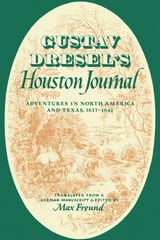
Gustav Dresel's Houston Journal
Adventures in North America and Texas, 1837-1841By Gustav Dresel
University of Texas Press, 1954
This is the travel diary of a young German businessman who came to Texas and worked for several years in Houston and the surrounding areas. His diary, originally published in German as Texanisches Tagebuch, gives a fascinating view of life in the Texas republic.
[more]