Results by title
92 books match the query 'Notes' and 4 start with g

Globalization and the Post-Creole Imagination
Notes on Fleeing the PlantationMichaeline A. Crichlow
Duke University Press, 2009
Engaging with the thought of Michel Foucault, Michel Rolph-Trouillot, Achille Mbembe, Henri Lefebvre, Margaret Archer, Saskia Sassen, Pierre Bourdieu, and others, Crichlow argues for understanding creolization as a continual creative remaking of past and present moments to shape the future. She draws on sociology, philosophy, postcolonial studies, and cultural studies to illustrate how national histories are lived personally and how transnational experiences reshape individual lives and collective spaces. Critically extending Bourdieu’s idea of habitus, she describes how contemporary Caribbean subjects remake themselves in and beyond the Caribbean region, challenging, appropriating, and subverting older, localized forms of creolization. In this book, Crichlow offers a nuanced understanding of how Creole citizens of the Caribbean have negotiated modern economies of power.

Go Ahead in the Rain
Notes to A Tribe Called QuestBy Hanif Abdurraqib
University of Texas Press, 2019
A New York Times Best Seller
2019 National Book Award Longlist, Nonfiction
2019 Kirkus Book Prize Finalist, Nonfiction
A February IndieNext Pick
Named A Most Anticipated Book of 2019 by Buzzfeed, Nylon, The A. V. Club, CBC Books, and The Rumpus, and a Winter's Most Anticipated Book by Vanity Fair and The Week
Starred Reviews: Kirkus and Booklist
"Warm, immediate and intensely personal."—New York Times
How does one pay homage to A Tribe Called Quest? The seminal rap group brought jazz into the genre, resurrecting timeless rhythms to create masterpieces such as The Low End Theory and Midnight Marauders. Seventeen years after their last album, they resurrected themselves with an intense, socially conscious record, We Got It from Here . . . Thank You 4 Your Service, which arrived when fans needed it most, in the aftermath of the 2016 election. Poet and essayist Hanif Abdurraqib digs into the group’s history and draws from his own experience to reflect on how its distinctive sound resonated among fans like himself. The result is as ambitious and genre-bending as the rap group itself.
Abdurraqib traces the Tribe's creative career, from their early days as part of the Afrocentric rap collective known as the Native Tongues, through their first three classic albums, to their eventual breakup and long hiatus. Their work is placed in the context of the broader rap landscape of the 1990s, one upended by sampling laws that forced a reinvention in production methods, the East Coast–West Coast rivalry that threatened to destroy the genre, and some record labels’ shift from focusing on groups to individual MCs. Throughout the narrative Abdurraqib connects the music and cultural history to their street-level impact. Whether he’s remembering The Source magazine cover announcing the Tribe’s 1998 breakup or writing personal letters to the group after bandmate Phife Dawg’s death, Abdurraqib seeks the deeper truths of A Tribe Called Quest; truths that—like the low end, the bass—are not simply heard in the head, but felt in the chest.

Goatfoot Milktongue Twinbird
Interviews, Essays, and Notes on Poetry, 1970-76Donald Hall
University of Michigan Press, 1978
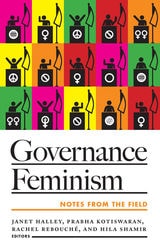
Governance Feminism
Notes from the FieldJanet Halley
University of Minnesota Press, 2019
An interdisciplinary, multifaceted look at feminist engagements with governance across the global North and global South
Governance Feminism: Notes from the Field brings together nineteen chapters from leading feminist scholars and activists to critically describe and assess contemporary feminist engagements with state and state-like power. Gathering examples from North America, South America, Europe, Asia, and the Middle East, it complements and expands on the companion volume Governance Feminism: An Introduction. Its chapters argue that governance feminism (GF) is institutionally diverse and globally distributed—emerging from traditional sites of state power as well as from various forms of governance and operating at the grassroots level, in the private sector, in civil society, and in international relations.
The book begins by confronting the key role that crime and punishment play in GFeminist projects. Here, contributors explore the ideological and political conditions under which this branch of GF became so robust and rethink the carceral turn. Other chapters speak to another face of GFeminism: feminists finding, in mundane and seemingly unspectacular bureaucratic tools, leverage to bring about change in policy and governance practices. Several contributions highlight the political, strategic, and ethical challenges that feminists and LGBT activists must negotiate to play on the governmental field. The book concludes with a focus on feminist interventions in postcolonial legal and political orders, looking at new policy spaces opened up by conflict, postconflict, and occupation.
Providing a clear, cross-cutting, critical lens through which to map developments in feminist governance around the world, Governance Feminism: Notes from the Field makes sense of the costs and benefits of current feminist realities to reimagine feminist futures.
Contributors: Libby Adler, Northeastern U; Aziza Ahmed, Northeastern U; Elizabeth Bernstein, Barnard College; Amy J. Cohen, Ohio State U; Karen Engle, U of Texas at Austin; Jacob Gersen, Harvard U; Leigh Goodmark, U of Maryland; Aeyal Gross, Tel Aviv U; Aya Gruber, U of Colorado, Boulder; Janet Halley, Harvard U; Rema Hammami, Birzeit U, Palestine; Vanja Hamzić, U of London; Isabel Cristina Jaramillo-Sierra; Prabha Kotiswaran, King’s College London; Maleiha Malik, King’s College London; Vasuki Nesiah, New York U; Dianne Otto, Melbourne Law School; Helen Reece; Darren Rosenblum, Pace U; Jeannie Suk Gersen, Harvard U; Mariana Valverde, U of Toronto.