Results by title
137 books match the query 'Patients' and 4 start with g

Gary In Your Pocket
Stories and Notebooks of Gary FisherGary Fisher
Duke University Press, 1996
A uniquely intimate, unflinching testimony of the experience of a young, African American gay man in the AIDS emergency, Gary in Your Pocket includes an introduction by Don Belton that describes Fisher’s achievement in the context of other work by Black gay men such as Marlon Riggs and Essex Hemphill, and a biographical afterword by Eve Kosofsky Sedgwick.

Genius
A NovelThomas Rayfiel
Northwestern University Press, 2016
Kara Bell spent her youth plotting escape from Witch’s Falls, Arkansas. Relentless focus and the spurning of all emotional attachment led to the doctoral program in philosophy at Columbia University. But Kara’s careful plans are upended by cancer, and suddenly she is home again, where she finds herself subject to her mother’s suffocating care, her brother’s puzzling love life, the local doctor’s meddling, and the strong gravitational pull of her old friend and obsession, Christy Lee. Will Kara find health and sanity? Will she learn what really happened to her father? Can she escape Witch’s Falls a second time, or will she succumb to the slow poison of local kindness and Snickers Salad?
In Genius, Thomas Rayfiel finds both poignancy and dark humor in deathly illness, family secrets, organized religion, parenting, abortion, gossip, senility, and the mysterious rhythms of small-town life.
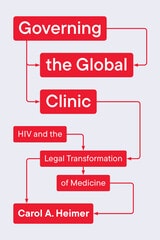
Governing the Global Clinic
HIV and the Legal Transformation of MedicineCarol A. Heimer
University of Chicago Press, 2025
A deep examination of how new, legalistic norms affected the trajectory of global HIV care and altered the practice of medicine.
HIV emerged in the world at a time when medicine and healthcare were undergoing two major transformations: globalization and a turn toward legally inflected, rule-based ways of doing things. It accelerated both trends. While pestilence and disease are generally considered the domain of biological sciences and medicine, social arrangements—and law in particular—are also crucial.
Drawing on years of research in HIV clinics in the United States, Thailand, South Africa, and Uganda, Governing the Global Clinic examines how growing norms of legalized accountability have altered the work of healthcare systems and how the effects of legalization vary across different national contexts. A key feature of legalism is universalistic language, but, in practice, rules are usually imported from richer countries (especially the United States) to poorer ones that have less adequate infrastructure and fewer resources with which to implement them. Challenging readers to reconsider the impulse to use law to organize and govern social life, Governing the Global Clinic poses difficult questions: When do rules solve problems, and when do they create new problems? When do rules become decoupled from ethics, and when do they lead to deeper moral commitments? When do rules reduce inequality? And when do they reflect, reproduce, and even amplify inequality?

Grace Period
A NovelGerald W. Haslam
University of Nevada Press, 2006
A masterpiece by one of the West’s best-loved authorsJust when Sacramento journalist Marty Martinez thinks his life can’t get any worse, it does. His beloved son has died of AIDS, his wife has divorced him and joined a cult, and his daughter blames him for the disintegration of their family. Then a chance medical examination reveals that he has prostate cancer. Marty faces his new role as a cancer patient with awkward grit and desperation. He is a sympathetic, utterly convincing character seeking faith in a Catholic Church as troubled as he is. He brings increased intensity to his career as he investigates a far-reaching political scandal, reunites his family in unexpected ways, and finds love with a fellow cancer patient. Grace Period is a profound and sometimes hilarious novel about living with serious illness. Marty copes with fear and the painful, sometimes embarrassing, treatment of his disease, but instead of winding down his life he finds fresh purpose and a joyful new love. Haslam brilliantly depicts the complexities of everyday life and the intricate, sometimes tortured bonds of family and friendship. In Grace Period, Haslam shows us that existence at the precarious edge of life offers not only pain and loss but hope, a chance at redemption, love, and even happiness. Grace Period is his masterwork.