Results by title
283 books match the query 'Phenomenology' and 7 start with g
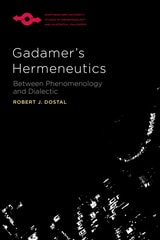
Gadamer’s Hermeneutics
Between Phenomenology and DialecticRobert J. Dostal
Northwestern University Press, 2022
The book situates Gadamer’s hermeneutics in three important ways: in relation to the contestability of the legacy of the Enlightenment project; in relation to the work of his mentor, Martin Heidegger; and in relation to Gadamer’s reading of Plato and Aristotle. Dostal explores both Gadamer’s claim on the Enlightenment and his ambivalence toward it. He considers Gadamer’s dependence on Heidegger’s accomplishment while pointing out the ways in which Gadamer charted his own course, rejecting his teacher’s reading of Plato and his antihumanism. Dostal points out notable differences in the philosophers’ politics as well. Finally, Dostal mediates between Gadamer’s hermeneutics and what might be called philological hermeneutics. His analysis defends the civic humanism that is the culmination of the philosopher’s hermeneutics, a humanism defined by moral education, common sense, judgment, and taste. Supporters and critics of Gadamer’s philosophy will learn much from this major achievement.
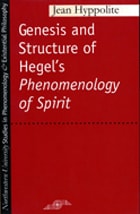
Genesis and Structure of Hegel's "Phenomenology of Spirit"
Jean Hyppolite
Northwestern University Press, 1979

Gerda Walther
A Life in PhenomenologyAntonio Calcagno
Northwestern University Press, 2027
Exploring the rich phenomenological and psychological insights of Gerda Walther
This is the first major study of Gerda Walther (1897–1977), an important but underappreciated figure in the early phenomenological movement and one of the founding members of the coeducational Freiburg Phenomenological Society. Walther saw herself, along with Hedwig Conrad Martius and Edith Stein, as a student of the phenomenological movement charged with the preservation of its philosophical legacy and the extension of its practice. As Antonio Calcagno elucidates in this learned but accessible biographical account, she served as an important bridge between the Freiburg school of phenomenology, marked by Edmund Husserl’s idealism, and the realist branch that emerged in Munich, where she completed her studies with Alexander Pfänder. Her work has remained little known, however, especially to English-language readers.
Calcagno provides a comprehensive picture of Walther’s philosophical corpus and ideas, from her early investigations to her later writings, while highlighting the originality of her own phenomenological work. He shows how she challenged certain key claims of phenomenology and provided unique solutions to the problems she encountered. The phenomenology that Walther leaves us with is deeply marked by her emphasis on the importance of psyche, spirit, and personhood for achieving a phenomenological methodology and understanding. We find in her work a rich phenomenological psychology that explores not only the limit phenomena of the discipline but also the deep structure of inner psychic life framed in personalist terms.

Gestures
Vilém Flusser
University of Minnesota Press, 2014
Throughout his career, the influential new media theorist Vilém Flusser kept the idea of gesture in mind: that people express their being in the world through a sweeping range of movements. He reconsiders familiar actions—from speaking and painting to smoking and telephoning—in terms of particular movement, opening a surprising new perspective on the ways we share and preserve meaning. A gesture may or may not be linked to specialized apparatus, though its form crucially affects the person who makes it.
These essays, published here as a collection in English for the first time, were written over roughly a half century and reflect both an eclectic array of interests and a durable commitment to phenomenological thought. Defining gesture as “a movement of the body or of a tool attached to the body for which there is no satisfactory causal explanation,” Flusser moves around the topic from diverse points of view, angles, and distances: at times he zooms in on a modest, ordinary movement such as taking a photograph, shaving, or listening to music; at others, he pulls back to look at something as vast and varied as human “making,” embracing everything from the fashioning of simple tools to mass manufacturing. But whatever the gesture, Flusser analyzes it as the expression of a particular form of consciousness, that is, as a particular relationship between the world and the one who gestures.
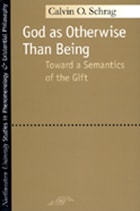
God as Otherwise Than Being
Toward a Semantics of the GiftCalvin O. Schrag
Northwestern University Press, 2002
Schrag draws with grace, ease, and precision upon the history of Western metaphysics, from Plato and Aristotle through Nietzsche and Heidegger. Most important to his central question of God as "otherwise than Being," however, are such influential post-Heideggerian thinkers as Jean-Luc Marion, Jacques Derrida, and Emmanuel Levinas. Schrag's inquiry engages these thinkers at a serious level and also expands recent discussions by relating them to the work of figures hitherto overlooked or underplayed, most notably Paul Tillich.
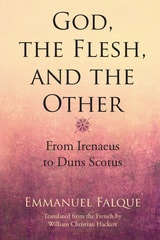
God, the Flesh, and the Other
From Irenaeus to Duns ScotusEmmanuel Falque Translated from the French by William Christian Hackett
Northwestern University Press, 2015
In God, the Flesh, and the Other, the philosopher Emmanuel Falque joins the ongoing debate about the role of theology in phenomenology. An important voice in the second generation of French philosophy’s “theological turn,” Falque examines philosophically the fathers of the Church and the medieval theologians on the nature of theology and the objects comprising it. Falque works phenomenology itself into the corpus of theology. Theological concepts thus translate into philosophical terms that phenomenology should legitimately question: concepts from contemporary phenomenology such as onto-theology, appearance, reduction, body/flesh, inter-corporeity, the genesis of community, intersubjectivity, and the singularity of the other find penetrating analogues in patristic and medieval thought forged through millennia of Christological and Trinitarian debate, mystical discourses, and speculative reflection. Through Falque’s wide-ranging interpretive path, phenomenology finds itself interrogated—and renewed.
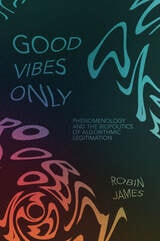
Good Vibes Only
Phenomenology and the Biopolitics of Algorithmic LegitimationRobin James
Duke University Press, 2026