Results by title
130 books match the query 'Philosophers' and 5 start with g
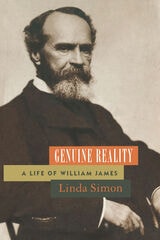
Genuine Reality
A Life of William JamesLinda Simon
University of Chicago Press, 1999
"William James . . . has never seemed so vulnerably human as in Linda Simon's biography. . . . [S]he vivifies James in such a way that his life and thought come freshly alive for the modern reader."—David S. Reynolds, New York Times Book Review
"Superb. . . . Genuine Reality is recommended reading for all soul-searchers."—George Gurley, Chicago Tribune
"Ms. Simon . . . has provided an ideal pathway for James's striding. . . . [Y]ou become engaged in his struggles as if they were your own."—Christopher Lehmann-Haupt, New York Times
"[A]n excellent narrative biography at once sensitively told and lucidly written."—John Patrick Diggins, Wall Street Journal
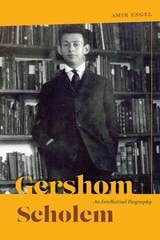
Gershom Scholem
An Intellectual BiographyAmir Engel
University of Chicago Press, 2017
As Engel shows, in his search for the truth of Jewish mysticism Scholem molded the vast literature of Jewish mystical lore into a rich assortment of stories that unveiled new truths about the modern condition. Positioning Scholem’s work and life within early twentieth-century Germany, Palestine, and later the state of Israel, Engel intertwines Scholem’s biography with his historiographical work, which stretches back to the Spanish expulsion of Jews in 1492, through the lives of Rabbi Isaac Luria and Sabbatai Zevi, and up to Hasidism and the dawn of the Zionist movement. Through parallel narratives, Engel touches on a wide array of important topics including immigration, exile, Zionism, World War One, and the creation of the state of Israel, ultimately telling the story of the realizations—and failures—of a dream for a modern Jewish existence.
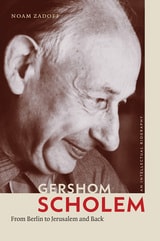
Gershom Scholem
From Berlin to Jerusalem and BackNoam Zadoff
Brandeis University Press, 2017
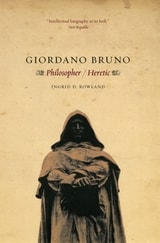
Giordano Bruno
Philosopher / HereticIngrid D. Rowland
University of Chicago Press, 2009
Giordano Bruno (1548–1600) is one of the great figures of early modern Europe, and one of the least understood. Ingrid D. Rowland’s biography establishes him once and for all as a peer of Erasmus, Shakespeare, and Galileo—a thinker whose vision of the world prefigures ours.
Writing with great verve and erudition, Rowland traces Bruno’s wanderings through a sixteenth-century Europe where every certainty of religion and philosophy has been called into question, and reveals how he valiantly defended his ideas to the very end, when he was burned at the stake as a heretic on Rome’s Campo de’ Fiori.
“A loving and thoughtful account of [Bruno’s] life and thought, satires and sonnets, dialogues and lesson plans, vagabond days and star-spangled nights. . . . Ingrid D. Rowland has her reasons for preferring Bruno to Copernicus, Tycho Brahe, Johannes Kepler, even Galileo and Leonardo, and they’re good ones.”—John Leonard, Harper’s
“Whatever else Bruno was, he was wild-minded and extreme, and Rowland communicates this, together with a sense of the excitement that his ideas gave him. . . . It’s that feeling for the explosiveness of the period, and [Rowland’s] admiration of Bruno for participating in it—indeed, dying for it—that is the central and most cherishable quality of the biography.”—Joan Acocella, New Yorker
“Rowland tells this great story in moving, vivid prose, concentrating as much on Bruno’s thought as on his life. . . . His restless mind, as she makes clear, not only explored but transformed the heavens.”—Anthony Grafton, New York Review of Books
“[Bruno] seems to have been an unclassifiable mixture of foul-mouthed Neapolitan mountebank, loquacious poet, religious reformer, scholastic philosopher, and slightly wacky astronomer.”—Anthony Gottlieb, New York Times Book Review
“A marvelous feat of scholarship. . . . This is intellectual biography at its best.”—Peter N. Miller, New Republic
“An excellent starting point for anyone who wants to rediscover the historical figure concealed beneath the cowl on Campo de’ Fiori.”—Paula Findlen, Nation
Guy Debord
Revolution in the Service of PoetryVincent Kaufmann
University of Minnesota Press, 2010
Instead of providing a conventional day-to-day account of Debord's life, Kaufmann deftly locates his subject within the historical and intellectual context of the radical social, political, and artistic movements in which he participated. He traces Debord's development as an intellectual: his involvement with the lettrist movement in the early 1950s, his central role in the Situationist International from 1957 to 1971 and in the events of May 1968, and the productive and frequently misunderstood period between the dissolution of the situationists and his suicide, during which time Debord clarified the rules of his war against inauthenticity.
As Kaufmann makes clear, for Debord political thought and action were inseparable from aesthetics and poetic expression. Whether envisioning the recovery of a lost, protocommunist age of authenticity and transparency in The Society of the Spectacle or critically assessing the possibility of revolution against postmodern capitalism two decades later, Debord advocated and practiced an art of defiance, a concurrently martial and melancholic poetics. Avoiding the mythologies about Debord that both admirers and critics have cultivated, Kaufmann provides a groundbreaking and generous assessment of Debord and his uncompromising struggle against a corrupt civilization.