Results by title
4917 books match the query 'Philosophy' and 86 start with g

G. W. F. Hegel
The Philosophical SystemHoward P. Kainz
Ohio University Press, 1998
Georg Wilhelm Friedrich Hegel, perhaps the most influential of all German philosophers, made one of the last great attempts to develop philosophy as an all-embracing scientific system. This system places Hegel among the “classical” philosophers—Aristotle, Aquinas, Spinoza—who also attempted to build grand conceptual edifices.
In this study, available for the first time in paperback, Howard P. Kainz emphasizes the uniqueness of Hegel’s system by focusing on his methodology, terminology, metaphorical and paradoxical language, and his special contributions to metaphysics, the philosophy of nature, philosophical anthropology, and other areas.
Kainz focuses on Hegel’s system as a whole and its seminal ideas, making generous use of representative texts. He gives special attention to the interrelationship between dialectical methodology and paradoxical propositions; the prevalence of metaphor in the philosophy of nature; and the close interrelationship between Christian doctrine and Hegelian speculation. A rich array of diagrams and tables further elucidates Kainz’s analyses.
An ideal text for the student of philosophy coming to Hegel for the first time, G. W. F. Hegel provides the reader with useful insights into Hegel’s work and illuminates Hegel’s enduring significance in the late twentieth century.
GANGS IN THE GLOBAL CITY
Alternatives to Traditional CriminologyEdited by John M. Hagedorn
University of Illinois Press, 2006
Although they were originally considered an American phenomenon, gangs today have grown and transformed into global enterprises. Despite these changes, criminologists have not yet reassessed worldwide gangs in terms of the other changes associated with globalization.
John M. Hagedorn aims to correct this oversight by incorporating important theoretical advances in urban political economy and understanding changes in gangs around the world as a result of globalization and the growth of the information economy. Contrary to older conceptions, today’s gangs are international, are often institutionalized, and may be explicitly concerned with race and ethnicity. Gangs in the Global City presents the work of an assortment of international scholars that challenges traditional approaches to problems in criminology from many different perspectives and includes theoretical discussions, case studies, and examinations of gang members’ identities. The contributors consider gangs not as fundamentally a crime problem but as variable social organizations in poor communities that are transitioning to the new economy.
Gadamer’s Hermeneutics
Between Phenomenology and DialecticRobert J. Dostal
Northwestern University Press, 2022
The book situates Gadamer’s hermeneutics in three important ways: in relation to the contestability of the legacy of the Enlightenment project; in relation to the work of his mentor, Martin Heidegger; and in relation to Gadamer’s reading of Plato and Aristotle. Dostal explores both Gadamer’s claim on the Enlightenment and his ambivalence toward it. He considers Gadamer’s dependence on Heidegger’s accomplishment while pointing out the ways in which Gadamer charted his own course, rejecting his teacher’s reading of Plato and his antihumanism. Dostal points out notable differences in the philosophers’ politics as well. Finally, Dostal mediates between Gadamer’s hermeneutics and what might be called philological hermeneutics. His analysis defends the civic humanism that is the culmination of the philosopher’s hermeneutics, a humanism defined by moral education, common sense, judgment, and taste. Supporters and critics of Gadamer’s philosophy will learn much from this major achievement.
Gaian Systems
Lynn Margulis, Neocybernetics, and the End of the AnthropoceneBruce Clarke
University of Minnesota Press, 2020
A groundbreaking look at Gaia theory’s intersections with neocybernetic systems theory
Often seen as an outlier in science, Gaia has run a long and varied course since its formulation in the 1970s by atmospheric chemist James Lovelock and microbiologist Lynn Margulis. Gaian Systems is a pioneering exploration of the dynamic and complex evolution of Gaia’s many variants, with special attention to Margulis’s foundational role in these developments.
Bruce Clarke assesses the different dialects of systems theory brought to bear on Gaia discourse. Focusing in particular on Margulis’s work—including multiple pieces of her unpublished Gaia correspondence—he shows how her research and that of Lovelock was concurrent and conceptually parallel with the new discourse of self-referential systems that emerged within neocybernetic systems theory. The recent Gaia writings of Donna Haraway, Isabelle Stengers, and Bruno Latour contest its cybernetic status. Clarke engages Latour on the issue of Gaia’s systems description and extends his own systems-theoretical synthesis under what he terms “metabiotic Gaia.” This study illuminates current issues in neighboring theoretical conversations—from biopolitics and the immunitary paradigm to NASA astrobiology and the Anthropocene. Along the way, he points to science fiction as a vehicle of Gaian thought.
Delving into many issues not previously treated in accounts of Gaia, Gaian Systems describes the history of a theory that has the potential to help us survive an environmental crisis of our own making.

Galileo, Science and the Church
Jerome J. Langford
University of Michigan Press, 1992
Jerome J. Langford's Galileo, Science, and the Church is widely recognized as a classic, balanced account of Galileo Galilei’s legendary 1633 confrontation with the Roman Catholic Inquisition. Moving past the overly polarized arguments of traditional polemicists and apologists, Langford contextualizes the "Galileo Affair" within its proper 17th-century historical, theological, and philosophical milieu. The book meticulously explores how the clash was less a fundamental war between science and faith, and more a complex dispute over scriptural interpretation, ecclesiastical authority, and the academic rigidities of Aristotelian philosophy. Through objective research, Langford demonstrates that this momentous historical drama still serves as a timeless case study on the enduring friction between institutional authority and the freedom of individual thought and expression.

Gaming
Essays On Algorithmic CultureAlexander R. Galloway
University of Minnesota Press, 2006
In Gaming, Alexander Galloway instead considers the video game as a distinct cultural form that demands a new and unique interpretive framework. Drawing on a wide range of disciplines, particularly critical theory and media studies, he analyzes video games as something to be played rather than as texts to be read, and traces in five concise chapters how the “algorithmic culture” created by video games intersects with theories of visuality, realism, allegory, and the avant-garde. If photographs are images and films are moving images, then, Galloway asserts, video games are best defined as actions.
Using examples from more than fifty video games, Galloway constructs a classification system of action in video games, incorporating standard elements of gameplay as well as software crashes, network lags, and the use of cheats and game hacks. In subsequent chapters, he explores the overlap between the conventions of film and video games, the political and cultural implications of gaming practices, the visual environment of video games, and the status of games as an emerging cultural form.
Together, these essays offer a new conception of gaming and, more broadly, of electronic culture as a whole, one that celebrates and does not lament the qualities of the digital age.
Alexander R. Galloway is assistant professor of culture and communication at New York University and author of Protocol: How Control Exists after Decentralization.
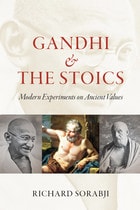
Gandhi and the Stoics
Modern Experiments on Ancient ValuesRichard Sorabji
University of Chicago Press, 2012
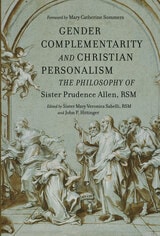
Gender Complementarity and Christian Personalism
The Philosophy of Sister Prudence Allen, RSMSister Mary Veronica Sabelli, RSM
Catholic University of America Press, 2025
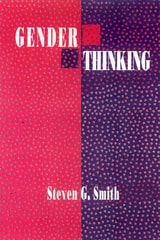
Gender Thinking
Steven G. Smith
Temple University Press, 1992
How can we accept the gender system in view of its ills? Yet, are we really at liberty to abolish gender differences, "when the gender system gives us benchmarks of personal identity and worth along with primary channels in which to pursue the rewards of love?" With this double question, Steven G. Smith introduces his inquiry into the idea of gender and how it is implicated in love, respect, equality, and personal character. Gender Thinking is the first comprehensive philosophical exploration of the concept of gender Asking the question, what is gender?—that is, what sort of thing do we take femininity and masculinity to be?—Smith considers how gender thinking is interwoven with ideas about human nature. He suggests ways in which ideas about race, class, culture age, temperament, and sexual orientation can be understood from clues found in gender thinking. And he calls for a renegotiated procreative partnership between women and men as the key to the redemption of gender.
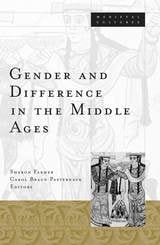
Gender and Difference in the Middle Ages
Sharon Farmer
University of Minnesota Press, 2002
Exposes complex intersections between genders and other identities in medieval cultures.
Nothing less than a rethinking of what we mean when we talk about "men" and "women" of the medieval period, this volume demonstrates how the idea of gender-in the Middle Ages no less than now-intersected in subtle and complex ways with other categories of difference. Responding to the insights of postcolonial and feminist theory, the authors show that medieval identities emerged through shifting paradigms-that fluidity, conflict, and contingency characterized not only gender, but also sexuality, social status, and religion. This view emerges through essays that delve into a wide variety of cultures and draw on a broad range of disciplinary and theoretical approaches. Scholars in the fields of history as well as literary and religious studies consider gendered hierarchies in western Christian, Jewish, Byzantine, and Islamic areas of the medieval world.
Contributors: Daniel Boyarin, U of California, Berkeley; Ruth Mazo Karras, U of Minnesota; Mathew Kuefler, San Diego State U; Martha Newman, U of Texas; Kathryn M. Ringrose, U of California, San Diego; Elizabeth Robertson, U of Colorado; Everett Rowson, U of Pennsylvania; Michael Uebel, U of Kentucky; Ulrike Wiethaus, Wake Forest U.
Gender and the Science of Difference
Cultural Politics of Contemporary Science and MedicineFisher, Jill A
Rutgers University Press, 2011
How does contemporary science contribute to our understanding about what it means to be women or men? What are the social implications of scientific claims about differences between "male" and "female" brains, hormones, and genes? How does culture influence scientific and medical research and its findings about human sexuality, especially so-called normal and deviant desires and behaviors? Gender and the Science of Difference examines how contemporary science shapes and is shaped by gender ideals and images.
Prior scholarship has illustrated how past cultures of science were infused with patriarchal norms and values that influenced the kinds of research that was conducted and the interpretation of findings about differences between men and women. This interdisciplinary volume presents empirical inquiries into today's science, including examples of gendered scientific inquiry and medical interventions and research. It analyzes how scientific and medical knowledge produces gender norms through an emphasis on sex differences, and includes both U.S. and non-U.S. cases and examples.
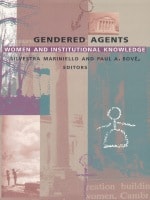
Gendered Agents
Women and Institutional KnowledgeSilvestra Mariniello and Paul A. Bové, eds.
Duke University Press, 1998
Gathered from various issues of the journal boundary 2, the essays in Gendered Agents seek to transform the model of Western academic knowledge by restructuring its priorities and values. In the introduction, Mariniello urges feminists to begin anew but take as their starting place the achievements of feminism and feminist theory: an understanding of language that considers the implications of silence, the motivation to decompartmentalize experience, and the acknowledgement that everything is political. Challenging both a canonical organization of knowledge and the persistently self-referential "ghettoization" of feminism, contributors subsequently tackle subjects as diverse as pre-Marxist France, the American fetus, black intellectuals, queer nationality, and the art of literary interpretation.
Contributors. Lauren Berlant, Karen Brennan, Margaret Cohen, Nancy Fraser, Elizabeth Freeman, Carol Jacobs, Silvestra Mariniello, Larysa Mykyta, Laura Rice, Ivy Schweitzer, Doris Sommer, Hortense J. Spillers, Gayatri Chakravorty Spivak, Judith Wilt

Genealogy Of Queer Theory
William Turner
Temple University Press, 2000
Turner shows how Michal Foucault's work contributed to feminists' investigations into the ways that power relates to identity. In the last decades of the twentieth century, feminists were the first to challenge the assumption that a claim to universal identity -- the white male citizen -- should serve as the foundation of political thought and action. Difference matters. Race, ethnicity, class, gender, and sexuality interact, producing a wide array of identities that resist rigid definition and are mutable. By understanding the notion of transhistorical categories -- woman, man, homosexual, and so forth -- feminist and gay male scholars launched queer theoretical work as a new way to think about the politics of gender and sexuality.
A Geneology of Queer Theory probes the fierce debates among scholars and activists, weighing the charges that queer readings of texts and identity politics do not constitute and might inhibit radical social change. Written by a historian, it considers the implications of queer theory for historical inquiry and the distinction between philosophy and history. As such, the book will interest readers of gay/lesbian/bisexual/transgender studies, intellectual history, political theory, and the history of gender/sexuality.
Generalized Galois Logics
Relational Semantics of Nonclassical Logical CalculiKatlin Bimbó and J. Michael Dunn
CSLI, 2008

Generations
Vilém Flusser
University of Minnesota Press, 2027
A vision of modern humanity trapped inside the system it has created
Written in the 1960s and unpublished until 2017, Generations is Vilém Flusser’s largest work and the foundation for many of his later theories on media and post-history. In this ambitious study of the Modern Age, Flusser traces a devastating shift in Western civilization that ultimately leads to the modern “apparatus”: the impersonal, cybernetic system of self-programmed objectification that has become our reality.
Flusser presents history as a recurring struggle between generations, with each new generation overturning the values of the former and eventually drifting into a state of existential avoidance. This cycle becomes the basis for a powerful diagnosis of the modern condition. Flusser identifies a critical shift toward self-worship and collective will in humanity’s understanding of progress and divinity during the Renaissance. This shift foregrounded our path toward an automated world driven by apathetic functionaries serving the apparatus and widespread fascist irrationalism, catastrophically realized during the Holocaust.
With surprising relevance to the digital present that gradually empties the world of its grounded reality, Generations offers a striking account of humanity’s relationship to technology, algorithms, and systems of control. Flusser’s concept of the “apparatus” anticipates the modern experience of being shaped by social media, bureaucratic systems, and oppressive technologies. Arguing that contemporary humanity exists in a state of slow existential stagnation rather than dramatic apocalypse, the book asks and answers a pressing question: how did we get here?
Retail e-book files for this title are screen-reader friendly.

Genes And Human Self-Knowledge
Reflections On Modern GeneticsRobert F. Weir
University of Iowa Press, 1994
Contemporary developments in human genetics are profoundly meaningful, both for the rapidity of scientific discoveries and for their personal and social implications. The Human Genome Project, a worldwide effort to map the 50,000 to 100,000 genes making up the human blueprint, is creating new ways of understanding ourselves as individuals, as parents, as members of a family, an ethnic group, a species. Almost every day yet another medical detective finds a genetic clue to the long-running mystery of human identity.
In 1992, the University of Iowa Humanities Symposium provided a public forum to examine the issues—moral, conceptual, legal, and practical—in modern genetics that are crucial to all of us. This strong, challenging volume is a collection of the major essays presented by historians, philosophers, and other academic humanists to a multidisciplinary audience of molecular and clinical geneticists, genetic counselors, humanists, and members of the public. The essays explore the historical background, philosophical implications, and ethical issues related to the Human Genome Project as well as other developments in modern genetics.
The questions raised in these essays are dramatic and troubling. What kind of knowledge is being produced by molecular geneticists? Do individual human genomes differ significantly from each other? How much do females and males differ from each other at the molecular level? Is there any genetic basis for distinguishing among racial or ethical groups? Can current practices in genetics counseling be compared to the earlier eugenics movement? Will current research lead to updated views on genetic “normalcy” or even “superiority”?
Genesis Redux
Essays in the History and Philosophy of Artificial LifeEdited by Jessica Riskin
University of Chicago Press, 2007
Since antiquity, philosophers and engineers have tried to take life’s measure by reproducing it. Aiming to reenact Creation, at least in part, these experimenters have hoped to understand the links between body and spirit, matter and mind, mechanism and consciousness. Genesis Redux examines moments from this centuries-long experimental tradition: efforts to simulate life in machinery, to synthesize life out of material parts, and to understand living beings by comparison with inanimate mechanisms.
Jessica Riskin collects seventeen essays from distinguished scholars in several fields. These studies offer an unexpected and far-reaching result: attempts to create artificial life have rarely been driven by an impulse to reduce life and mind to machinery. On the contrary, designers of synthetic creatures have generally assumed a role for something nonmechanical. The history of artificial life is thus also a history of theories of soul and intellect.
Taking a historical approach to a modern quandary, Genesis Redux is essential reading for historians and philosophers of science and technology, scientists and engineers working in artificial life and intelligence, and anyone engaged in evaluating these world-changing projects.
Genesis and Development of a Scientific Fact
Ludwik Fleck
University of Chicago Press, 1981
"To many scientists just as to many historians and philosophers of science facts are things that simply are the case: they are discovered through properly passive observation of natural reality. To such views Fleck replies that facts are invented, not discovered. Moreover, the appearance of scientific facts as discovered things is itself a social construction, a made thing. A work of transparent brilliance, one of the most significant contributions toward a thoroughly sociological account of scientific knowledge."—Steven Shapin, Science
Genesis and Structure of Hegel's "Phenomenology of Spirit"
Jean Hyppolite
Northwestern University Press, 1979
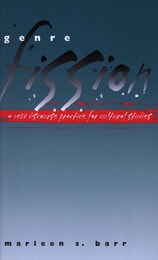
Genre Fission
A New Discourse Practice for Culture StudiesMarleen S. Barr
University of Iowa Press, 2000
Barr expands postmodern assumptions about cultural studies by suggesting that "genre fission" is occurring among discrete literary and cultural "types" of events--mainstream novels, science fiction, historical narratives, film, paintings, and museum displays. For her literary insights, Barr turns her attention to such mainstream authors as Saul Bellow, John Updike, Marge Piercy, and John Barth as well as science fiction writers Ursula Le Guin and Octavia Butler and Hispanic American writers Julia Alvarez, Ana Castillo, and Cristina García, among others.
Barr moves from literary to culture studies by addressing such phenomena from contemporary mass culture as the urban landscapes of New York and Los Angeles, Jackie Kennedy, the Star Trek industry, Lynn Redgrave, Amsterdam's red light district, Lorena Bobbitt, and the Apollo astronauts--to provide only a few of the relevant examples. Thus Genre Fission attains what Barr herself designates (in describing the art of Judy Chicago and Lee Bontecou) as "utopian interweavings of difference," crossing numerous boundaries in order to frame a larger territory for exploration.
Genre, Race, and the Production of Subjectivity in German Romanticism
Stephanie Galasso
Northwestern University Press, 2024
Late Enlightenment philosophers and writers like Herder, Goethe, and Schiller broke with conventions of form and genre to prioritize an idealized, and racially coded, universality. Newly translated literatures from colonial contexts served as the basis for their evaluations of how to contribute to a distinctly “German” national literary tradition, one that valorized modernity and freedom and thus fortified crucial determinants of modern concepts of whiteness. Through close readings of both canonical and less-studied Romantic texts, Stephanie Galasso examines the intimately entwined histories of racialized subjectivity and aesthetic theory and shows how literary genre is both symptomatic and generative of the cultural violence that underpinned the colonial project.
Poetic expression and its generic conventions continue to exert pressure on the framing and reception of the stories that can be told about interpersonal and structural experiences of oppression. Genre, Race, and the Production of Subjectivity in German Romanticism explores how white subjectivity is guarded by symbolic and material forms of violence.
Genuine Individuals and Genuine Communities
A Roycean Public PhilosophyJacqueline Ann K. Kegley
Vanderbilt University Press, 1997
The continuing vitality of American thought stems, to a large extent, from the application of its historical roots embedded in contemporary problems and issues. Yet for some time the signal contributions of Josiah Royce (1855-1916) have been overlooked in the formulation and shaping of critical areas of public policy. In this brilliantly articulated new book, ethicist Jacquelyn Kegley carefully explicates and enlarges the scope of Roycean thought and shows that Royce's views on public philosophy have direct and valuable application to current social problems.
Working from the assumption that issues of family, education, and health care are not merely exigent political tempests but areas of genuine, long-lasting concern, Kegley opens fresh perspectives on Royce's philosophy by introducing and applying his ideas to discussions of how we care for ourselves and our society today. She analyzes Roycean criteria that can be successfully used to nourish developmental stages within families, promote intellectual and social growth in schooling and scholarship, and sustain physical and mental well-being throughout the life cycle.
Genuine Individuals and Genuine Communities should be a springboard for the reassessment of contemporary public policy and the reapplication of the American philosophical legacy to current issues and decisions. Kegley's work serves as a solid contribution both to public philosophy and to the continued vitality of American thought, and it extends the range of both.
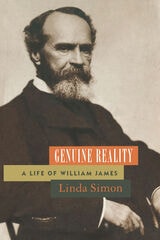
Genuine Reality
A Life of William JamesLinda Simon
University of Chicago Press, 1999
"William James . . . has never seemed so vulnerably human as in Linda Simon's biography. . . . [S]he vivifies James in such a way that his life and thought come freshly alive for the modern reader."—David S. Reynolds, New York Times Book Review
"Superb. . . . Genuine Reality is recommended reading for all soul-searchers."—George Gurley, Chicago Tribune
"Ms. Simon . . . has provided an ideal pathway for James's striding. . . . [Y]ou become engaged in his struggles as if they were your own."—Christopher Lehmann-Haupt, New York Times
"[A]n excellent narrative biography at once sensitively told and lucidly written."—John Patrick Diggins, Wall Street Journal
Geography Unbound
French Geographic Science from Cassini to HumboldtAnne Marie Claire Godlewska
University of Chicago Press, 1999
Anne Godlewska examines this crisis, the often conservative reactions of geographers to it, and the work of researchers at the margins of the field who helped chart its future course. She tells her story partly through the lives and careers of individuals, from the deposed cabinet geographer Cassini IV to Volney, von Humboldt, and Letronne (innovators in human, physical, and historical geography), and partly through the institutions with which they were associated such as the Encyclopédie and the Jesuit and military colleges.
Geography Unbound presents an insightful portrait of a crucial period in the development of modern geography, whose unstable disciplinary status is still very much an issue today.
Geography and Revolution
Edited by David N. Livingstone and Charles W. J. Withers
University of Chicago Press, 2005
David N. Livingstone and Charles W. J. Withers assemble a set of essays that are themselves revolutionary in uncovering not only the geography of revolutions but the role of geography in revolutions. Here, scientific revolutions—Copernican, Newtonian, and Darwinian—ordinarily thought of as placeless, are revealed to be rooted in specific sites and spaces. Technical revolutions—the advent of print, time-keeping, and photography—emerge as inventions that transformed the world's order without homogenizing it. Political revolutions—in France, England, Germany, and the United States—are notable for their debates on the nature of political institutions and national identity.
Gathering insight from geographers, historians, and historians of science, Geography and Revolution is an invitation to take the where as seriously as the who and the when in examining the nature, shape, and location of revolutions.
Geography's Inner Worlds
Pervasive Themes in Contemporary American GeographyAbler, Ronald F
Rutgers University Press, 1992
Twenty-six leading American geographers meditate on the themes that unify contemporary geography. They emphasize the concepts and methods that run through all geography's sub-disciplines and give it a distinctive place among both the natural and social sciences.
Prepared under the sponsorship of the American Association of Geographers for the International Geographical Congress 1992, these insightful essays on the character of the discipline and its future will be required reading for every student of the field.
Geography's Quantitative Revolutions
Edward A. Ackerman and the Cold War Origins of Big DataElvin Wyly
West Virginia University Press, 2019
Do you have a smartphone? Billions of people on the planet now navigate their daily lives with the kind of advanced Global Positioning System capabilities once reserved for the most secretive elements of America’s military-industrial complex. But when so many people have access to the most powerful technologies humanity has ever devised for the precise determination of geographical coordinates, do we still need a specialized field of knowledge called geography?
Just as big data and artificial intelligence promise to automate occupations ranging from customer service and truck driving to stock trading and financial analysis, our age of algorithmic efficiency seems to eliminate the need for humans who call themselves geographers—at the precise moment when engaging with information about the peoples, places, and environments of a diverse world is more popular than ever before. How did we get here? This book traces the recent history of geography, information, and technology through the biography of Edward A. Ackerman, an important but forgotten figure in geography’s “quantitative revolution.” It argues that Ackerman’s work helped encode the hidden logics of a distorted philosophical heritage—a dangerous, cybernetic form of thought known as militant neo-Kantianism—into the network architectures of today’s pervasive worlds of surveillance capitalism.

Geontologies
A Requiem to Late LiberalismElizabeth A. Povinelli
Duke University Press, 2016
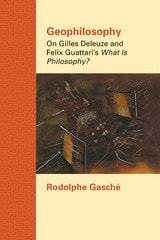
Geophilosophy
On Gilles Deleuze and Felix Guattari's What Is Philosophy?Rodolphe Gasché
Northwestern University Press, 2014
Gasché also intimates that, rather than a marginal issue of their conception of philosophy, geocentrism is a central dimension of their thinking. Indeed, Gasché argues, if all the principal traits that constitute philosophy according to What is Philosophy?—autochthony, philia, and doxa—imply in an essential manner a concern with Earth, it follows that what Deleuze and Guattari have been doing while engaging in philosophy has been marked by this concern from the start.
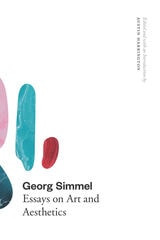
Georg Simmel
Essays on Art and AestheticsGeorg Simmel
University of Chicago Press, 2020
Fascinated by the relationship between culture, society, and economic life, Simmel took an interest in myriad phenomena of aesthetics and the arts. A friend of writers and artists such as Auguste Rodin, Rainer Maria Rilke, and Stefan George, he wrote dozens of pieces engaging with topics such as the work of Michelangelo, Rembrandt, and Rodin, Japanese art, naturalism and symbolism, Goethe, “art for art’s sake”, art exhibitions, and the aesthetics of the picture frame.
This is the first collection to bring together Simmel’s finest writing on art and aesthetics, and many of the items appear in English in this volume for the first time. The more than forty essays show the protean breadth of Simmel’s reflections, covering landscape painting, portraiture, sculpture, poetry, theater, form, style, and representation. An extensive introduction by Austin Harrington gives an overview of Simmel’s themes and elucidates the significance of his work for the many theorists who would be inspired by his ideas.
Something of an outsider to the formal academic world of his day, Simmel wrote creatively with the flair of an essayist. This expansive collection of translations preserves the narrative ease of Simmel’s prose and will be a vital source for readers with an interest in Simmel’s trailblazing ideas in modern European philosophy, sociology, and cultural theory.
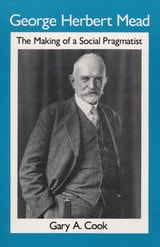
George Herbert Mead
THE MAKING OF A SOCIAL PRAGMATISTGary A. Cook
University of Illinois Press, 1993

Gerda Walther
A Life in PhenomenologyAntonio Calcagno
Northwestern University Press, 2027
Exploring the rich phenomenological and psychological insights of Gerda Walther
This is the first major study of Gerda Walther (1897–1977), an important but underappreciated figure in the early phenomenological movement and one of the founding members of the coeducational Freiburg Phenomenological Society. Walther saw herself, along with Hedwig Conrad Martius and Edith Stein, as a student of the phenomenological movement charged with the preservation of its philosophical legacy and the extension of its practice. As Antonio Calcagno elucidates in this learned but accessible biographical account, she served as an important bridge between the Freiburg school of phenomenology, marked by Edmund Husserl’s idealism, and the realist branch that emerged in Munich, where she completed her studies with Alexander Pfänder. Her work has remained little known, however, especially to English-language readers.
Calcagno provides a comprehensive picture of Walther’s philosophical corpus and ideas, from her early investigations to her later writings, while highlighting the originality of her own phenomenological work. He shows how she challenged certain key claims of phenomenology and provided unique solutions to the problems she encountered. The phenomenology that Walther leaves us with is deeply marked by her emphasis on the importance of psyche, spirit, and personhood for achieving a phenomenological methodology and understanding. We find in her work a rich phenomenological psychology that explores not only the limit phenomena of the discipline but also the deep structure of inner psychic life framed in personalist terms.
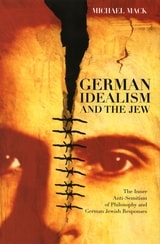
German Idealism and the Jew
The Inner Anti-Semitism of Philosophy and German Jewish ResponsesMichael Mack
University of Chicago Press, 2003
Offering the first analytical account of the connection between anti-Semitism and philosophy, Mack begins his exploration by showing how the fundamental thinkers in the German idealist tradition—Kant, Hegel, and, through them, Feuerbach and Wagner—argued that the human world should perform and enact the promises held out by a conception of an otherworldly heaven. But their respective philosophies all ran aground on the belief that the worldly proved incapable of transforming itself into this otherworldly ideal. To reconcile this incommensurability, Mack argues, philosophers created a construction of Jews as symbolic of the "worldliness" that hindered the development of a body politic and that served as a foil to Kantian autonomy and rationality.
In the second part, Mack examines how Moses Mendelssohn, Heinrich Heine, Franz Rosenzweig, and Freud, among others, grappled with being both German and Jewish. Each thinker accepted the philosophies of Kant and Hegel, in varying degrees, while simultaneously critiquing anti-Semitism in order to develop the modern Jewish notion of what it meant to be enlightened—a concept that differed substantially from that of Kant, Hegel, Feuerbach, and Wagner. By speaking the unspoken in German philosophy, this book profoundly reshapes our understanding of it.
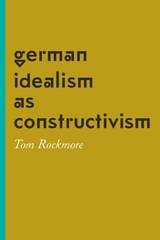
German Idealism as Constructivism
Tom Rockmore
University of Chicago Press, 2016
Since ancient Greece philosophers have tried to know the world in itself, an effort that Kant believed had failed. His alternative strategy—which came to be known as the Copernican revolution—was that the world as we experience and know it depends on the mind. Rockmore shows that this project was central to Kant’s critical philosophy and the later German idealists who would follow him. He traces the different ways philosophers like Fichte, Schelling, and Hegel formulated their own versions of constructivism. Offering a sweeping but deeply attuned analysis of a crucial part of the legacy of German idealism, Rockmore reinvigorates this school of philosophy and opens up promising new avenues for its study.
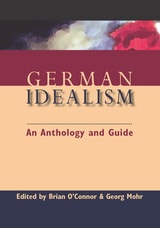
German Idealism
An Anthology and GuideEdited by Brian O'Connor and Georg Mohr
University of Chicago Press, 2007
Beginning with the publication of Kant’s Critique of Pure Reason and extending through to Hegel’s death, the period known as German Idealism signaled the end of an epoch of rationalism, empiricism, and enlightenment—and the beginning of a new “critical” period of philosophy. The most comprehensive anthology of this vital tradition to date, German Idealism brings together an expansive selection of readings from the tradition’s major figures like Kant, Hegel, Fichte, and Schelling.
Arranged thematically into sections on topics such as the relationships between self and knowledge, freedom and morality, law and state, and nature and science, to name a few, German Idealism discloses many of the contrasts that helped to differentiate each of the tradition’s key thinkers. Each expertly translated text comes with an editorial introduction to guide readers through many of the problems the texts specifically deal with, as well as their historical context.
The most accessible and expansive introduction to German Idealism ever, this anthology will be hailed by instructors and scholars as the most dependable guide to the tradition for years to come.

Germany's Wild East
Constructing Poland as Colonial SpaceKristin Kopp
University of Michigan Press, 2012
While conventional definitions locate colonial space overseas, Kristin Kopp argues that it was possible to understand both distant continents and adjacent Eastern Europe as parts of the same global periphery dependent upon Western European civilizing efforts. However, proximity to the source of aid translated to greater benefits for Eastern Europe than for more distant regions.
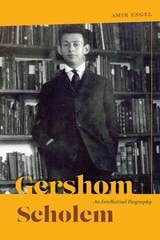
Gershom Scholem
An Intellectual BiographyAmir Engel
University of Chicago Press, 2017
As Engel shows, in his search for the truth of Jewish mysticism Scholem molded the vast literature of Jewish mystical lore into a rich assortment of stories that unveiled new truths about the modern condition. Positioning Scholem’s work and life within early twentieth-century Germany, Palestine, and later the state of Israel, Engel intertwines Scholem’s biography with his historiographical work, which stretches back to the Spanish expulsion of Jews in 1492, through the lives of Rabbi Isaac Luria and Sabbatai Zevi, and up to Hasidism and the dawn of the Zionist movement. Through parallel narratives, Engel touches on a wide array of important topics including immigration, exile, Zionism, World War One, and the creation of the state of Israel, ultimately telling the story of the realizations—and failures—of a dream for a modern Jewish existence.

Gershom Scholem
From Berlin to Jerusalem and BackNoam Zadoff
Brandeis University Press, 2017
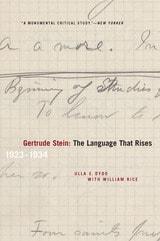
Gertrude Stein
The Language That Rises: 1923-1934Ulla E. Dydo
Northwestern University Press, 2008
The first extensive examination of Stein's notebooks, manuscripts and letters, prepared over a period of twenty years, Gertrude Stein: The Language That Rises asks new questions and explores new ways of reading Stein. This definitive study give us a finely detailed, deeply felt understanding of Stein, the great modernist, throughout one of her most productive periods. From "An Elucidation" in 1923 to Lectures In America in 1934, Ulla E. Dydo examines the process of the making and remaking of Stein's texts as they move from notepad to notebook to manuscript, from an idea to the ultimate refinement of the author's intentions. The result is an unprecedented view of the development of Stein's work, word by word, text by text, and over time.

Geschlecht III
Sex, Race, Nation, HumanityJacques Derrida
University of Chicago Press, 2020
Amid new revelations about Heidegger’s anti-Semitism and the contemporary context of nationalist resurgence, this third piece of the Geschlecht series is timelier and more necessary than ever. Meticulously edited and expertly translated, this volume brings Derrida’s mysterious and much awaited text to light.
Gesture and Thought
David McNeill
University of Chicago Press, 2005
Gesture and Thought expands on McNeill’s acclaimed classic Hand and Mind. While that earlier work demonstrated what gestures reveal about thought, here gestures are shown to be active participants in both speaking and thinking. Expanding on an approach introduced by Lev Vygotsky in the 1930s, McNeill posits that gestures are key ingredients in an “imagery-language dialectic” that fuels both speech and thought. Gestures are both the “imagery” and components of “language.” The smallest element of this dialectic is the “growth point,” a snapshot of an utterance at its beginning psychological stage. Utilizing several innovative experiments he created and administered with subjects spanning several different age, gender, and language groups, McNeill shows how growth points organize themselves into utterances and extend to discourse at the moment of speaking.
An ambitious project in the ongoing study of the relationship of human communication and thought, Gesture and Thought is a work of such consequence that it will influence all subsequent theory on the subject.

Gestures
Vilém Flusser
University of Minnesota Press, 2014
Throughout his career, the influential new media theorist Vilém Flusser kept the idea of gesture in mind: that people express their being in the world through a sweeping range of movements. He reconsiders familiar actions—from speaking and painting to smoking and telephoning—in terms of particular movement, opening a surprising new perspective on the ways we share and preserve meaning. A gesture may or may not be linked to specialized apparatus, though its form crucially affects the person who makes it.
These essays, published here as a collection in English for the first time, were written over roughly a half century and reflect both an eclectic array of interests and a durable commitment to phenomenological thought. Defining gesture as “a movement of the body or of a tool attached to the body for which there is no satisfactory causal explanation,” Flusser moves around the topic from diverse points of view, angles, and distances: at times he zooms in on a modest, ordinary movement such as taking a photograph, shaving, or listening to music; at others, he pulls back to look at something as vast and varied as human “making,” embracing everything from the fashioning of simple tools to mass manufacturing. But whatever the gesture, Flusser analyzes it as the expression of a particular form of consciousness, that is, as a particular relationship between the world and the one who gestures.

Getting It Right
Language, Literature, and EthicsGeoffrey Galt Harpham
University of Chicago Press, 1992
Gewirth's Ethical Rationalism
Critical Essays with a Reply by Alan GewirthEdited by Edward Regis Jr.
University of Chicago Press, 1984
Ghost Image
Hervé Guibert
University of Chicago Press, 2014
Both a memoir and an exploration of the artistic process, Ghost Image not only reveals Guibert’s particular experience as a gay artist captivated by the transience and physicality of his media and his life, but also his thoughts on the more technical aspects of his vocation. In one essay, Guibert searches through a cardboard box of family portraits for clues—answers, or even questions—about the lives of his parents and more distant relatives. Rifling through vacation snapshots and the autographed images of long-forgotten film stars, Guibert muses, “I don’t even recognize the faces, except occasionally that of an aunt or great-aunt, or the thin, fair face of my mother as a young girl.” In other essays, he explains how he composes his photographs, and how—in writing—he seeks to escape and correct the inherent limits of his technique, to preserve those images lost to his technical failings as a photographer.
With strains of Jean Genet and recurring themes that speak to the work of contemporary artists across a range of media, Guibert’s Ghost Image is a beautifully written, melancholic ode to existence and art forms both fleeting and powerful—a unique memoir at the nexus of family, memory, desire, and photography.
Ghostly Matters
Haunting and the Sociological ImaginationAvery F. Gordon
University of Minnesota Press, 2008
“Avery Gordon’s stunningly original and provocatively imaginative book explores the connections linking horror, history, and haunting. ” —George Lipsitz
“The text is of great value to anyone working on issues pertaining to the fantastic and the uncanny.” —American Studies International
“Ghostly Matters immediately establishes Avery Gordon as a leader among her generation of social and cultural theorists in all fields. The sheer beauty of her language enhances an intellectual brilliance so daunting that some readers will mark the day they first read this book. One must go back many more years than most of us can remember to find a more important book.” —Charles Lemert
Drawing on a range of sources, including the fiction of Toni Morrison and Luisa Valenzuela (He Who Searches), Avery Gordon demonstrates that past or haunting social forces control present life in different and more complicated ways than most social analysts presume. Written with a power to match its subject, Ghostly Matters has advanced the way we look at the complex intersections of race, gender, and class as they traverse our lives in sharp relief and shadowy manifestations.
Avery F. Gordon is professor of sociology at the University of California, Santa Barbara.
Janice Radway is professor of literature at Duke University.
Gilles Deleuze and the Fabulation of Philosophy
Powers of the False, Volume 1Gregory Flaxman
University of Minnesota Press, 2011
Although much has been written about Deleuze’s engagement with the arts, Gilles Deleuze and the Fabulation of Philosophy concerns the art of his philosophy. Gregory Flaxman suggests that Deleuze’s notorious rejection of representation gives rise to a singular task—to create new concepts and invent new means of philosophical expression. Tracing this task throughout Deleuze’s vast oeuvre, Flaxman argues that Deleuze’s ambition to think and write “otherwise” constitutes the fabulation of philosophy itself.
For Flaxman, Deleuze’s philosophy is organized around the notion of the friend (philos). This book dramatizes the practice of friendship in Deleuze’s intimate affairs with philosophers—including Plato, Aristotle, Spinoza, Kant, and Foucault—and close encounters with a range of writers, including Homer, More, Kafka, Woolf, and Borges. Flaxman traces Deleuze’s relationship with Nietzsche, the friend from whom he learned to write “in his own name,” to explain how apprenticeship becomes the initial condition of Deleuze’s philosophical method. Detailing the transformation of Nietzsche’s genealogy into “geophilosophy,” Flaxman goes on to show how Deleuze’s philosophy of the earth precipitates his return to ancient Greece and induces his resolution to overturn Platonism. In this spirit, the book demonstrates Deleuze’s evocation of the “powers of the false” by examining how, in his battle against representation, he makes fiction the basis for a minor philosophy. This first volume draws to a close with a timely elaboration of Deleuze’s avowed, if enigmatic, “style as politics” in an age when capitalism and communication challenge the claims of philosophy as never before.
A stunning and original contribution, Flaxman’s book restores the question of aesthetics to Deleuze’s thinking and writing. Gilles Deleuze and the Fabulation of Philosophy not only revitalizes our sense of the philosopher but revises the sense of his philosophy, provoking critical problems and novel possibilities with which readers will wrestle for years to come.

Gilles Deleuze's Time Machine
D. N. Rodowick
Duke University Press, 1997
Rodowick illuminates the connections between Deleuze’s writings on visual and scientific texts and describes the formal logic of his theory of images and signs. Revealing how Deleuzian views on film speak to the broader network of philosophical problems addressed in Deleuze’s other books—including his influential work with Félix Guattari—Rodowick shows not only how Deleuze modifies the dominant traditions of film theory, but also how the study of cinema is central to the project of modern philosophy.
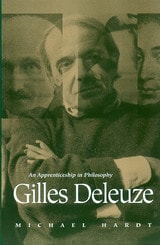
Gilles Deleuze
An Apprenticeship in PhilosophyMichael Hardt
University of Minnesota Press, 1993
The key to understanding Deleuze's complete body of work.
"A coherent and systematic reading of a philosopher who has consistently courted the incoherent and systematic. What we must avoid are encounters with those who cultivate sad passions (the men of ressentiment in the Nietzschean formulation); and we must increase our power to compose new relationships with compatible bodies with whom we share a common notion. Hardt's exceptional book is one such joyful encounter." -Times Literary Supplement"An excellent book. The project of Gilles Deleuze is to situate Deleuze squarely in the camp of those who seek to deepen and transform our philsophical understanding and political situation. Hardt seems to me to be directly on target." -Substance"Both for its object and its method of study, here is a work that will mark the future of the field of Deleuzian studies." -Eric Alliez, Critique"Hardt's reading of Deleuze is complex and precise. He follows the intricacies of the argument and of the shifting positions with considerable skill, thus providing us with a study not only of the Deleuzian way of doing philosophy, but of Deleuzian reading-of the selectivity of its targets, of its agonistic approach to philosophy, through indirect attack on one main opponent. Reading Hardt reading Deleuze reading, we can understand, for instance, why Deleuze's exposition usually takes the form not of a dialectic but of a correlation, of a system of differences." -Radical Philosophy"How can we forget the dialectic? How an we affirm a constitutive ontology? Through its efforts to respond to these questions, Gilles Deleuze's philosophical apprenticeship presents the Bildungsroman of any contemporary philosophy that wants to break away from the destiny of modernity. Michael Hardt unravels the guiding thread of this philosophy of the future." -Antonio Negri"Hardt's interpretations are exceptionally well-grounded in the history of philosophical discourse, a discourse he exercises with discipline and rare insight. As the only major work on Deleuze in English, this book will undoubtedly set the standard for any future study of one of France's most important thinkers-and it is a very high standard, indeed." -Peggy Kamuf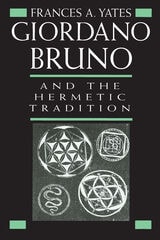
Giordano Bruno and the Hermetic Tradition
Frances A. Yates
University of Chicago Press, 1990
"Among those who have explored the intellectual world of the sixteenth century no one in England can rival Miss Yates. Wherever she looks, she illuminates. Now she has looked on Bruno. This brilliant book takes time to digest, but it is an intellectual adventure to read it. Historians of ideas, of religion, and of science will study it. Some of them, after reading it, will have to think again. . . . For Miss Yates has put Bruno, for the first time, in his tradition, and has shown what that tradition was."—Hugh Trevor-Roper, New Statesman
"A decisive contribution to the understanding of Giordano Bruno, this book will probably remove a great number of misrepresentations that still plague the tormented figure of the Nolan prophet."—Giorgio de Santillana, American Historical Review
"Yates's book is an important addition to our knowledge of Giordano Bruno. But it is even more important, I think, as a step toward understanding the unity of the sixteenth century."—J. Bronowski, New York Review of Books