Results by title
230 books match the query 'Physics' and 10 start with g
General Relativity
Robert. M. Wald
University of Chicago Press, 1984
Robert M. Wald's book has been a staple of physics teaching for decades. It offers straightforward, rigorous analyses of current understandings of all the central questions and problems of the field, giving each the complexity it requires while making every effort to keep the whole accessible to a student who is embarking on the study of this subject for the first time.
General Relativity from A to B
Robert Geroch
University of Chicago Press, 1981
"An imaginative and convincing new presentation of Einstein's theory of general relativity. . . . The treatment is masterful, continual emphasis being placed on careful discussion and motivation, with the aim of showing how physicists think and develop their ideas."—Choice

Geometrical Theory of Diffraction
V.A. Borovikov
The Institution of Engineering and Technology, 1994
Geometrical Vectors
Gabriel Weinreich
University of Chicago Press, 1998
Geometrical Vectors introduces a more sophisticated approach, which not only brings together many loose ends of the traditional treatment, but also leads directly into the practical use of vectors in general curvilinear coordinates by carefully separating those relationships which are topologically invariant from those which are not. Based on the essentially geometric nature of the subject, this approach builds consistently on students' prior knowledge and geometrical intuition.
Written in an informal and personal style, Geometrical Vectors provides a handy guide for any student of vector analysis. Clear, carefully constructed line drawings illustrate key points in the text, and problem sets as well as physical examples are provided.
Geysers of Yellowstone, Fourth Edition
T. Scott Bryan
University Press of Colorado, 2008
Gravity's Ghost and Big Dog
Scientific Discovery and Social Analysis in the Twenty-First CenturyHarry Collins
University of Chicago Press, 2013
Gravity's Ghost
Scientific Discovery in the Twenty-first CenturyHarry Collins
University of Chicago Press, 2010
In theory, at least, gravitational waves do exist. We are constantly bathed in gravitational radiation, which is generated when stars explode or collide and a portion of their mass becomes energy that ripples out like a disturbance on the surface of a serene pond. But unfortunately no gravitational wave has ever been directly detected even though the search has lasted more than forty years.
As the leading chronicler of the search for gravitational waves, Harry Collins has been right there with the scientists since the start. The result of his unprecedented access to the front lines of physical science is Gravity’s Ghost, a thrilling chronicle of high-stakes research and cutting-edge discovery. Here, Collins reveals that scientific discovery and nondiscovery can turn on scientific traditions and rivalries, that ideal statistical analysis rests on impossible procedures and unattainable knowledge, and that fact in one place is baseless assumption in another. He also argues that sciences like gravitational wave detection, in exemplifying how the intractable is to be handled, can offer scientific leadership a moral beacon for the twenty-first century. In the end, Gravity’s Ghost shows that discoveries are the denouements of dramatic scientific mysteries.
Gravity's Shadow
The Search for Gravitational WavesHarry Collins
University of Chicago Press, 2004
Gravitational wave detection involves recording the collisions, explosions, and trembling of stars and black holes by evaluating the smallest changes ever measured. Because gravitational waves are so faint, their detection will come not in an exuberant moment of discovery but through a chain of inference; for forty years, scientists have debated whether there is anything to detect and whether it has yet been detected. Sociologist Harry Collins has been tracking the progress of this research since 1972, interviewing key scientists and delineating the social process of the science of gravitational waves.
Engagingly written and authoritatively comprehensive, Gravity's Shadow explores the people, institutions, and government organizations involved in the detection of gravitational waves. This sociological history will prove essential not only to sociologists and historians of science but to scientists themselves.
Groups of Circle Diffeomorphisms
Andrés Navas
University of Chicago Press, 2011
In recent years scholars from a variety of branches of mathematics have made several significant developments in the theory of group actions. Groups of Circle Diffeomorphisms systematically explores group actions on the simplest closed manifold, the circle. As the group of circle diffeomorphisms is an important subject in modern mathematics, this book will be of interest to those doing research in group theory, dynamical systems, low dimensional geometry and topology, and foliation theory. The book is mostly self-contained and also includes numerous complementary exercises, making it an excellent textbook for undergraduate and graduate students.
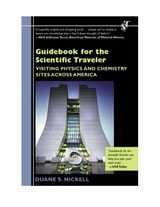
Guidebook for the Scientific Traveler
Visiting Physics and Chemistry Sites Across AmericaNickell, Duane S
Rutgers University Press, 2010
Are you in the mood for a trip to the Titan Missile Museum in Tucson? Want to spend some time at the Fermi National Accelerator Center near Chicago? Perhaps quench your thirst for knowledge and discovery at the Anheuser-Busch Brewery in St. Louis, where brewers are chemists at heart? Set your own pace. As an active participant or living room traveler, you'll be mesmerized as Nickell leads you on a tour of physics and chemistry sites.
Written in an easy-to-read and accessible style, this comprehensive guide is a practical and fun way to promote scientific literacy. You'll meet some of the world's great physicists, engineers, and chemists as you turn pages filled with more than fifty photographs. Organized into chapters on individuals, places, and sites--from universities of science to national laboratories, particle accelerators to energy labs and beyond--Nickell illuminates the history of each topic and paints a panorama of stunning achievements in physics and chemistry.
Whether you're traveling in California or Maine, or taking to the road in Texas or Illinois, Nickell helps complete your trip with a state-by-state list of monumental sites and resources. From the east coast to the west, north by northwest, or south in search of the Florida Solar Power Energy Center, you'll enjoy all your scientific travels with Visiting Physics and Chemistry Sites across America.