Results by title
413 books match the query 'Pictorial works' and 10 start with g
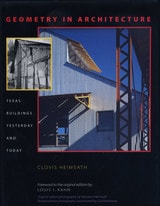
Geometry in Architecture
Texas Buildings Yesterday and TodayBy Clovis Heimsath
University of Texas Press, 2002
Pioneer Texas Buildings opened people's eyes when it was first published in 1968. At a time when "progress" meant tearing down the weathered houses, barns, churches, and stores built by the original settlers of Central Texas, this book taught people to see the beauty, simplicity, and order expressed in the unadorned geometric forms of early Texas buildings. It inspired the preservation and restoration of many of the remaining pioneer buildings, as well as the design of modern buildings that employ the same simple geometries.
This revised edition of Pioneer Texas Buildings juxtaposes the historic structures with works by twenty contemporary architects who are inspired by the pioneer tradition to show how seamlessly the basic geometries translate from one era to another. As in the first edition, sketches and brief commentary by Clovis Heimsath explain how squares, triangles, and circles take shape in the cubic, triangular, and cylindrical forms that comprise houses and other buildings. Then black-and-white photographs, the heart of the book, illustrate these geometric forms in historic and modern buildings. The book also includes two essays in which Heimsath discusses the factors that led him and his wife Maryann to document early Texas buildings and the results in historic preservation and timeless architectural designs that have followed from their efforts.
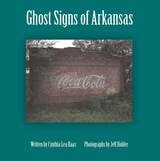
Ghost Signs of Arkansas
Cynthia Haas
University of Arkansas Press, 1997
From the late 1800s to the early 1950s, painted wall signs were a major mode of advertisement for both national companies and local businesses across America. Many of these artistic messages, now faded, peeling, and partially covered, still peek out from the storefronts, barns, alleyways, warehouses, theaters, and even stagecoach stops they once decorated.
Photographer Jeff Holder and author Cynthia Haas explore this often overlooked art form in Arkansas and show us signs that appear mysteriously in the rain, signs that are curiously painted in remote places, images and words now only half decipherable. From Coca-Cola, Dr. Pepper, and Grapette Soda to Kis-Me-Gum, Uneeda Biscuit, and Snowdrift Flour, the logos and slogans are at once familiar and enigmatic. Archival photographs reference the time
when these brightly colored messages covered the facades of downtown buildings. Of particular interest in this book are the profiles of three “wall dogs,” or sign painters, who remember the difficulties and joys of their unusual profession.
Ghost Signs of Arkansas ties us to a gentler past, a time when Main Street was the center of a community’s life, before mass media forced grand-scale advertising from brick walls to the television screen. In documenting a fading but valuable traditional art form, this book fills a gap in both the cultural fabric of Arkansas towns and the history of American art.
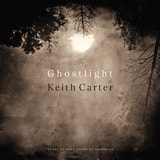
Ghostlight
Photographs by Keith CarterStory by Bret Anthony Johnston
University of Texas Press, 2022
A collection of otherworldly photographs of Southern wetlands featuring an original ghost story.
Southern wetlands, with their moss-draped trees and dark water obscuring mysteries below, are eerily beautiful places, home to ghost stories and haunting, ethereal light. The newest collection from award-winning photographer Keith Carter, Ghostlight captures the otherwordly spirits of swamps, marshes, bogs, baygalls, bayous, and fens in more than a hundred photographs.
From Ossabaw Island, Georgia, to his home ground of East Texas, Carter seeks “the secretive and mysterious” of this often-overlooked landscape: wisps of fog drifting between tree branches; faceless figures contemplating a bog; owls staring directly at the camera lens; infinite paths leading to unknown parts. Similarly, spectral images are evoked in the original short story that opens this book. Ghostlight, writes best-selling author Bret Anthony Johnston, “hovers, darts, disappears. It can be as mean as a cottonmouth, as mischievous aes a child. The closer you get, the farther the light recedes.” A masterpiece of “Bayou Gothic,” Ghostlight challenges our perceptions and invites us to experience the beauty of this elusive world.
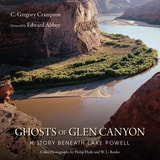
Ghosts of Glen Canyon
History beneath Lake PowellC Gregory Crampton
University of Utah Press, 2009
Author Gregory Crampton led the historical investigations of Glen and San Juan Canyons from 1957 to 1963 under contract with the National Park Service. The objective was to locate and record historical sites that would be lost to the rising waters of the reservoir. This book records that effort.
First published in 1986, this edition has been revised to include several new “ghosts” of Glen Canyon, including a never-before-published foreword by Edward Abbey. It also showcases stunning color photographs by Philip Hyde and includes hundreds of black-and-white photographs taken by the original salvage crews.
This informative guide to the historic treasures of Glen Canyon includes numbered maps keyed to each location. It is a book for both the armchair traveler and the lake enthusiast eager for a journey through the past to a place few had the privilege to know.

Good and Bad Hair
Gaskins, Bill
Rutgers University Press, 1997
In a time when image is indeed everything, our personal appearance has a tremendous effect on nearly every aspect of our lives on a daily basis. Our choice of hairstyle can mean the difference between acceptance and rejection by groups and individuals. The choices made by African Americans are particularly charged, often affecting the wearer and the viewer in unique and sometimes life-altering ways.
Good and Bad Hair emerges out of photographer Bill Gaskins's traveling photo exhibition of the same name. The book features 60 evocative photographs of African American men, women, and children, documenting contemporary black hairstyles and their role as a feature of African American culture.
On one level, the photographs present readers with a variety of popular and personal approaches to wearing one's hair. On another level, they isolate what amounts to a bold, assertive departure from the common definition of American beauty that excludes the physical features of many people of African descent. This narrow definition of beauty has created a race-based measurement for what is considered "good" and "bad" hair. Gaskins's pictures identify African Americans from different regions of the United States who expressively symbolize their sense of self and often their sense of an African or black identity through their hair.

Governors' Mansions of the South
Ann Liberman & Photos by Alise O'Brien
University of Missouri Press, 2008
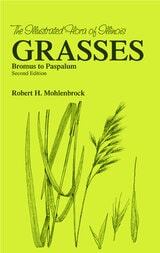
Grasses
Bromus to Paspalum, Second EditionRobert H. Mohlenbrock
Southern Illinois University Press, 2002
Since the publication of the first edition of Grasses: Bromus to Paspalumin 1972, twenty-two additional taxa of grasses have been discovered in Illinois that are properly placed in this volume. In addition, numerous nomenclatural changes have occurred for plants previously discovered, and many distributional records have been added. New keys have been prepared for each genus where additional species from Illinois are known. For new species, full-page illustrations are provided. This second edition updates the status of Illinois grasses. The book features 263 figures from the first edition plus 21 new figures for this edition by Paul W. Nelson.
Genera of grasses included in this work are Aegilops, Agropyron, Agrostis, Aira, Alopecurus, Anthoxanthum, Avena, Beckmannia, Briza, Bromus, Calamagrostis, Cinna, Dactylis, Deschampsia, Elyhordeum, Elymus, Elytrigia, Festuca, Hierochloe, Holcus, Hordeum, Koeleria, Lolium, Milium, Paspalum, Pennisetum, Phalaris, Phleum, Poa, Puccinellia, Sclerochloa, Secale, Sphenopholis, Torreyochloa, Triticum, and Vulpia.
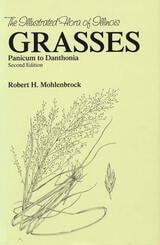
Grasses
Panicum to Danthonia, Second EditionRobert H. Mohlenbrock
Southern Illinois University Press, 2001
Since the publication of the first edition of Grasses: Panicum to Danthonia in 1973, twenty additional taxa of grasses have been discovered in Illinois that are properly placed in this volume. In addition, numerous nomenclatural changes have occurred for plants already known from the state, and many distributional records have been added. This second edition updates the status of grasses in Illinois. Paul W. Nelson has provided illustrations for all of the additions.
Because the nature of grass structures is generally so different from that of other flowering plants, a special terminology is applied to them. In his introduction, Robert H. Mohlenbrock cites these terms, with descriptions that make the identification of unknown specimens possible. Mohlenbrock’s division of the grass family into subfamilies and tribes is a major departure from the sequence usually found in most floristic works in North America.
Synonyms that have been applied to species in the northeastern United States are given under each species. A description based primarily on Illinois material covers the more important features of the species. The common names—Paflic Grass, Billion Dollar Grass or Japanese Millett, Thread Love Grass, and Goose Grass—are the ones used locally in the state. The habitat designation and dot maps showing county distribution of each grass are provided only for grasses in Illinois, but the overall range for each species is also given.
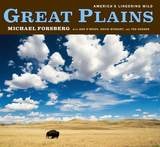
Great Plains
America's Lingering WildMichael Forsberg
University of Chicago Press, 2009
The Great Plains were once among the greatest grasslands on the planet. But as the United States and Canada grew westward, the Plains were plowed up, fenced in, overgrazed, and otherwise degraded. Today, this fragmented landscape is the most endangered and least protected ecosystem in North America. But all is not lost on the prairie. Through lyrical photographs, essays, historical images, and maps, this beautifully illustrated book gets beneath the surface of the Plains, revealing the lingering wild that still survives and whose diverse natural communities, native creatures, migratory traditions, and natural systems together create one vast and extraordinary whole.
Three broad geographic regions in Great Plains are covered in detail, evoked in the unforgettable and often haunting images taken by Michael Forsberg. Between the fall of 2005 and the winter of 2008, Forsberg traveled roughly 100,000 miles across 12 states and three provinces, from southern Canada to northern Mexico, to complete the photographic fieldwork for this project, underwritten by The Nature Conservancy. Complementing Forsberg’s images and firsthand accounts are essays by Great Plains scholar David Wishart and acclaimed writer Dan O’Brien. Each section of the book begins with a thorough overview by Wishart, while O’Brien—a wildlife biologist and rancher as well as a writer—uses his powerful literary voice to put the Great Plains into a human context, connecting their natural history with man’s uses and abuses.
The Great Plains are a dynamic but often forgotten landscape—overlooked, undervalued, misunderstood, and in desperate need of conservation. This book helps lead the way forward, informing and inspiring readers to recognize the wild spirit and splendor of this irreplaceable part of the planet.
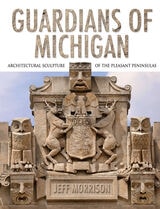
Guardians of Michigan
Architectural Sculpture of the Pleasant PeninsulasJeff Morrison
University of Michigan Press, 2022
The buildings profiled in Guardians of Michigan range from county courthouses, churches, and government buildings constructed during the 1800s, to skyscrapers with intricate sculptural decoration too far above street level for passersby to see. As a result, the book highlights examples of Gothic, Romanesque Revival, Beaux Arts, as well as Art Deco and Art Moderne. Guardians of Michigan is a loving tribute to the architecture of the state, preserving forgotten stories and beautiful buildings for all readers to enjoy.