Results by title
77 books match the query 'Pioneers' and 4 start with g
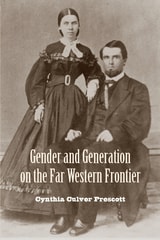
Gender and Generation on the Far Western Frontier
Cynthia Culver Prescott
University of Arizona Press, 2007
In Gender and Generation on the Far Western Frontier, Cynthia Culver Prescott expertly explores the shifting gender roles and ideologies that countless Anglo-American settlers struggled with in Oregon’s Willamette Valley between 1845 and 1900. Drawing on traditional social history sources as well as divorce records, married women’s property records, period photographs, and material culture, Prescott reveals that Oregon settlers pursued a moving target of middle-class identity in the second half of the nineteenth century.
Prescott traces long-term ideological changes, arguing that favorable farming conditions enabled Oregon families to progress from accepting flexible frontier roles to participating in a national consumer culture in only one generation. As settlers’ children came of age, participation in this new culture of consumption and refined leisure became the marker of the middle class. Middle-class culture shifted from the first generation’s emphasis on genteel behavior to a newer genteel consumption.
This absorbing volume reveals the shifting boundaries of traditional women’s spheres, the complicated relationships between fathers and sons, and the second generation’s struggle to balance their parents’ ideology with a changing national sense of class consciousness.
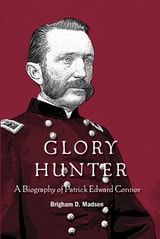
Glory Hunter
A Biography of Patric Edward ConnorBrigham Madsen
University of Utah Press, 1990
The life of Patrick Edward Connor serves as a half-century slice of western American history. After leaving New York City, where he had arrived at the age of twelve as a poor Irish immigrant, the nineteen-year-old youth joined the U.S. Army in 1839. He fought in the war with Mexico and then joined the gold rush in California until marrying and settling down in Stockton in 1854.
The Civil War found him volunteering again, this time as colonel of California troops sent to the Utah Territory to protect the mail lines from Indian attacks. Bitterly anti-Mormon, Connor spent the war years alternately engaging in a war of words with Brigham Young or in fighting Indians in northern Utah and present-day Wyoming. After the Civil War, ex-Major General Connor began mining operations in Utah and Nevada, ventures that went from boom to bust. He spent his final years in straitened financial circumstances.
Patrick Edward Connor was a “Man of the West,” possessing both its prejudices and its democratic, independent spirit. His greatest success lay as a military leader, and he would have agreed that he was made for war, not peace. He left an imprint on the history of the American West, remembered as the founder of Fort Douglas, as the “first gentile in Utah,” the “father of Utah mining,” and the “father of the Liberal Party in Utah.”

Gone to the Swamp
Raw Materials for the Good Life in the Mobile-Tensaw DeltaRobert Leslie Smith
University of Alabama Press, 2008
Normal0falsefalsefalseMicrosoftInternetExplorer4Normal0falsefalsefalseMicrosoftInternetExplorer4
To make a living here, one had to be capable, confident, clever and inventive, know a lot about survival, be able to fashion and repair tools, navigate a boat, fell a tree, treat a snakebite, make a meal from whatever was handy without asking too many questions about it, and get along with folks.
This fascinating and instructive book is the careful and unpretentious account of a man who was artful in all the skills needed to survive and raise a family in an area where most people would be lost or helpless. Smith’s story is an important record of a way of life beginning to disappear, a loss not fully yet realized. We are lucky to have a work that is both instructive and warm-hearted and that preserves so much hard-won knowledge.
Grit and Gold
The Death Valley Jayhawkers of 1849Jean Johnson
University of Nevada Press, 2018
After leaving Salt Lake City to break a road south to the Pacific Coast that would eliminate crossing the snowy Sierra Nevada, the party veered off the Old Spanish Trail in southern Utah to follow a mountaineer’s map portraying a bogus trail that claimed to cut months and hundreds of miles off their route to the gold country. With winter coming, however, they found themselves hopelessly lost in the mountains and dry valleys of southern Nevada and California. Abandoning everything but the shirts on their backs and the few oxen that became their pitiful meals, they turned their dreams of gold to hopes of survival.
Utilizing William Lorton’s 1849 diary of the trek from Illinois to southern Utah, the reminiscences of the Jayhawkers themselves, the keen memory of famed pioneer William Lewis Manly, and the almost daily diary of Sheldon Young, Johnson paints a lively but accurate portrait of guts, grit, and determination.