Results by title
557 books match the query 'Poems' and 12 start with g

GREAT BIRD OF LOVE
POEMSPaul Zimmer
University of Illinois Press, 1989
"The Great Bird of Love brims with a life so intense that it
must be told quietly. The pages are quirky, full of surprise, variety,
humor, and the sustaining reliable voice of a worthy guide to experience.
These poems come from perception informed by sympathy, and the language
is alive with verbal adventure."
-- William Stafford
A book in the National Poetry Series
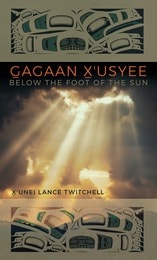
Gagaan X'usyee/Below the Foot of the Sun
PoemsX'unei Lance Twitchell
University of Alaska Press, 2023
The collection is divided into four sections based on how the Lingít talk about g̱agaan—the sun. Featuring some poems in English, some in Lingít, and some that combine the beauty of the two, Gagaan Xʼusyee / Beneath the Foot of the Sun displays an equal dignity in both languages that transcends monolingual constrictions.
Gagaan X'usyee/Below the Foot of the Sun
PoemsX'unei Lance Twitchell
University of Alaska Press, 2023
The collection is divided into four sections based on how the Lingít talk about g̱agaan—the sun. Featuring some poems in English, some in Lingít, and some that combine the beauty of the two, Gagaan Xʼusyee / Beneath the Foot of the Sun displays an equal dignity in both languages that transcends monolingual constrictions.
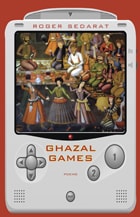
Ghazal Games
PoemsRoger Sedarat
Ohio University Press, 2011
As an Iranian American poet, Roger Sedarat fuses Western and Eastern traditions to reinvent the classicalPersian form of the ghazal. For its humor as well as its spirituality, the poems in this collection can perhapsbest be described as “Wallace Stevens meets Rumi.” Perhaps most striking is the poet’s use of the ancient ghazal form in the tradition of the classical masters like Hafez and Rumi to politically challenge the Islamic Republic of Iran’s continual crackdown on protesters. Not since the late Agha Shahid Ali has a poet translated the letter as well as the spirit of this form into English, using musicality and inventive rhyme to extend the reach of the ghazal in a new language and tradition.
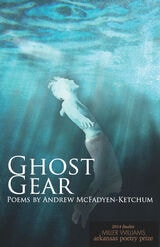
Ghost Gear
PoemsAndrew McFadyen-Ketchum
University of Arkansas Press, 2014
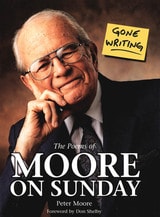
Gone Writing
The Poems of Moore on SundayPeter Moore
University of Minnesota Press, 1999
Humorous poetry from the television program hosted by a beloved Minnesota news anchor.
In the 1950s, Dave Moore, a young actor born and raised in Minneapolis, accepted a newscaster position with the local CBS affiliate, WCCO-TV-a job Walter Cronkite turned down. For the next three decades, until his death in 1998, he delivered the evening news with integrity, conviction, humor, and flair, making him a fixture in Minnesota living rooms.
At the end of his weekly news-in-review program, Moore on Sunday (or, as he liked to call it, “Moron Sunday”), Moore often signed off by reciting a poem. These poems, composed by Moore’s son Peter and collected here for the first time, offer a fresh and funny take on the common and not-so-common stuff of our everyday lives. Reminiscent of Ogden Nash and Tom Lehrer, with a dash of Dr. Seuss, Peter Moore’s verse captures the essence of his father’s wit, common sense, honesty, and warmth.
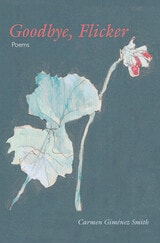
Goodbye, Flicker
PoemsCarmen Giménez Smith
University of Massachusetts Press, 2012
This distinctive collection introduces a new type of mythmaking, daring in its marriage of fairy tale tropes with American mundanities. Conspiratorial, Goodbye, Flicker describes the interior life of a girl whose prince is a deadbeat dad and whose escape into a fantasy world is also an escape into language, beauty, and the surreal.

Goodbye, Silver Sister
PoemsJeanne Foster
Northwestern University Press, 2015
Goodbye, Silver Sister, Jeanne Foster’s second collection of poems, opens with a series of poems about a girl coming of age in pre-Katrina New Orleans, informed and haunted by the magic of the city. The powerful Pearl River forms the dividing line between adulthood and other worlds, both geographic and existential: “death, divorce, and the thousand other ways I would lose faith in the breastplate of love.”
The collection is also an elegy for and tribute to the poet’s parents, who met in the WPA Artists’ Project. Through her poems she keeps them alive and is also able to say good-bye. Like the work of her mentor, James Wright, these poems reach far beyond the personal in their willingness to look at the unseemly sides of being human within the context of a profound spiritual search.
Grains of the Voice
PoemsChristina Pugh
Northwestern University Press, 2013
Christina Pugh’s Grains of the Voice exhibits a pervasive fascination with sound in all its manifestations. The human voice, musical instruments, the sounds produced by the natural and man-made worlds—all serve at one time or another as both the framework of poems and the occasion for their lightning-quick changes of direction, of tone, of point of reference. The poems are eclectic in their allusiveness, filled with echoes—and sometimes the words themselves—of other poets, but just as often of songs both popular and obscure, of the noise of pop culture, and of philosophers’ writings. But Pugh always wears her learning lightly. Beneath the jewellike surfaces of her poems is a strenuous investigation of the nature of and need for communication and a celebration of the endless variety of its forms.
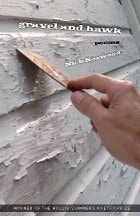
Gravel and Hawk
PoemsNick Norwood
Ohio University Press, 2012
Gravel and Hawk dwells on the physical and cultural landscapes of the Texarkana border region, an area of stark natural beauty and even starker manifestations of its human habitation: oil derricks and pump jacks, logging trucks, chicken houses, come-to-Jesus billboards, and greasy catfish joints, a patchwork of dying farm towns and ragtag municipalities laced together by county roads, state highways, and that treacherous, rust-hued slurry known as the Red River. Gravel and Hawk charts the emotional landscape of a single extended family, its history of loss and gain, and, especially, its encounters with violent death. It is an eminently readable collection, rooted in a distinctly American place and united by a poetic voice that is honest, sophisticated, and persuasive.
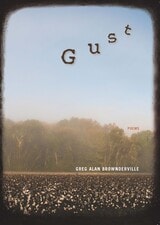
Gust
PoemsGreg Alan Brownderville
Northwestern University Press, 2011
Brownderville commands the complex eloquence of Southerners who love not only local color but also high-flown rhetoric. Instead of reinforcing stereotypes about rural folks' thought and speech, he challenges our assumptions by presenting real life as a festival of mixed diction. Church, as Brownderville enacts it, both quickens and forbids the erotic, whose lightning flashes and crashes everywhere in these poems. Highlights include a press conference with a bizarrely poetic rural sheriff, a Zimbabwean meter never before employed in English, a rock and roll song interrupted by a Walmart intercom, and poems about the exploitation of Italians in Arkansas cotton fields.
At once evoking Yeats and Whitman, Gust recovers the dramatic mode often neglected in contemporary American poetry. Brownderville's uncanny lyricism storms through stories that are both moving and humorous.
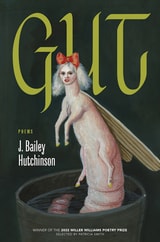
Gut
PoemsJ. Bailey Hutchinson
University of Arkansas Press, 2022
Winner, 2022 Miller Williams Poetry Prize
J. Bailey Hutchinson’s Gut is the dazzling debut of a born storyteller. In Hutchinson’s poems, which explore the substance of personal history, family attains the mysterious stature of folklore, while the vast worlds of nature and of the imagination abound with extraordinary creatures that likewise elude full understanding. For the voracious consciousness at work here, inheritance—what it means to be from a particular place and a particular people, no matter how one might strain against that—lies at the very heart of things.