Results by title
267 books match the query 'Poetics' and 2 start with g
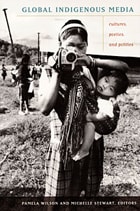
Global Indigenous Media
Cultures, Poetics, and PoliticsPamela Wilson and Michelle Stewart, eds.
Duke University Press, 2008
Global Indigenous Media addresses Indigenous self-representation across many media forms, including feature film, documentary, animation, video art, television and radio, the Internet, digital archiving, and journalism. The volume’s sixteen essays reflect the dynamism of Indigenous media-making around the world. One contributor examines animated films for children produced by Indigenous-owned companies in the United States and Canada. Another explains how Indigenous media producers in Burma (Myanmar) work with NGOs and outsiders against the country’s brutal regime. Still another considers how the Ticuna Indians of Brazil are positioning themselves in relation to the international community as they collaborate in creating a CD-ROM about Ticuna knowledge and rituals. In the volume’s closing essay, Faye Ginsburg points out some of the problematic assumptions about globalization, media, and culture underlying the term “digital age” and claims that the age has arrived. Together the essays reveal the crucial role of Indigenous media in contemporary media at every level: local, regional, national, and international.
Contributors: Lisa Brooten, Kathleen Buddle, Cache Collective, Michael Christie, Amalia Córdova,
Galina Diatchkova, Priscila Faulhaber, Louis Forline, Jennifer Gauthier, Faye Ginsburg, Alexandra Halkin, Joanna Hearne, Ruth McElroy, Mario A. Murillo, Sari Pietikäinen, Juan Francisco Salazar,
Laurel Smith, Michelle Stewart, Pamela Wilson

God of Many Names
Play, Poetry and Power in Hellenic Thought, From Homer to AristotleMihai I. Spariosu
Duke University Press, 1991
Building upon the scholarship of an earlier volume, Dionysus Reborn, Spariosu her continues to draw on Dionysus—the “God of many names,” of both poetic play and sacred power—as a mythical embodiment of the two sides of the classical Greek mentality. Combining philosophical reflection with close textual analysis, the author examines the divided nature of the Hellenic mentality in such primary canonic texts as the Iliad, the Odyssey, the Theogony, Works and Days, the most well-known of the Presocratic fragments, Euripides’ Bacchae, Aristophanes’ The Frogs, Plato’s Republic and Laws, and Aristotle’s Poetics and Politics.
Spariosu’s model illuminates the many of the most enduring questions in contemporary humanistic study and addresses modern questions about the nature of the interrelation of poetry, ethics, and politics.