Results by title
105 books match the query 'Political activists' and 4 start with g

Global Activism, Global Media
Edited by Wilma de Jong, Martin Shaw, and Neil Stammers
Pluto Press, 2005
This book brings together activists and academics in one volume, to explore the theory and practice of global activism's relation to all forms of media, mainstream and otherwise. The contributors examine how global activism is represented in the mainstream press and explain the strategies that activists adopt to spread their own ideas.
Investigating Indymedia and internet activism, they show how transformations in communications technology offer new possibilities, and explain how activists have successfully used and developed their own media. Case studies and topics include the world social forums, an example of a campaign from the NGO Action Aid, a campaign strategy from an internet activist, Greenpeace and the Brent Spar conflict, the World Development Movement and representations in the mainstream press, the Independent Media Centre, transgender activism on the net, Amnesty International, Oxfam and the internet.
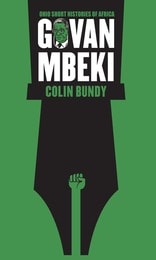
Govan Mbeki
Colin Bundy
Ohio University Press, 2012
Govan Mbeki (1910–2001) was a core leader of the African National Congress, the Communist Party, and the armed wing of the ANC during the struggle against apartheid. Known as a hard-liner, Mbeki was a prolific writer and combined in a rare way the attributes of intellectual and activist, political theorist and practitioner. Sentenced to life in prison in 1964 along with Nelson Mandela and others, he was sent to the notorious Robben Island prison, where he continued to write even as tension grew between himself, Mandela, and other leaders over the future of the national liberation movement. As one of the greatest leaders of the antiapartheid movement, and the father of Thabo Mbeki, president of South Africa from 1999 to 2008, the elder Mbeki holds a unique position in South African politics and history.
This biography by noted historian Colin Bundy goes beyond the narrative details of his long life: it analyzes his thinking, expressed in his writings over fifty years. Bundy helps establish what is distinctive about Mbeki: as African nationalist and as committed Marxist—and more than any other leader of the liberation movement—he sought to link theory and practice, ideas and action.
Drawing on exclusive interviews Bundy did with Mbeki, careful analysis of his writings, and the range of scholarship about his life, this biography is personal, reflective, thoroughly researched, and eminently readable.
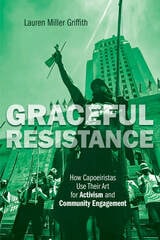
Graceful Resistance
How Capoeiristas Use Their Art for Activism and Community EngagementLauren Miller Griffith
University of Illinois Press, 2023
Capoeira began as a martial art developed by enslaved Afro-Brazilians. Today, the practice incorporates song, dance, acrobatics, and theatrical improvisation—and leads many participants into activism.
Lauren Miller Griffith’s extensive participant observation with multiple capoeira groups informs her ethnography of capoeiristas--both individuals and groups--in the United States. Griffith follows practitioners beyond their physical training into social justice activities that illuminate capoeira’s strong connection to resistance and subversion. As both individuals and communities of capoeiristas, participants march against racial discrimination, celebrate Martin Luther King Jr. Day and Juneteenth, organize professional clothing drives for job seekers, and pursue economic and environmental justice in their neighborhoods. For these people, capoeira becomes a type of serious leisure that contributes to personal growth, a sense of belonging, and an overall sense of self, while also imposing duties and obligations.
An innovative look at capoeira in America, Graceful Resistance reveals how the practicing of an art can catalyze action and transform communities.
Gringolandia
Lyn Miller-Lachmann
Northwestern University Press, 2009
After papá’s arrest in 1980, Daniel’s family fled to the United States. Now Daniel has a new life, playing guitar in a rock band and dating Courtney, a minister’s daughter. He hopes to become a US citizen as soon as he turns eighteen.
When Daniel’s father is released and rejoins his family, they see what five years of prison and torture have done to him. Marcelo is partially paralyzed, haunted by nightmares, and bitter about being exiled to “Gringolandia.” Daniel worries that Courtney’s scheme to start a bilingual human rights newspaper will rake up papá’s past and drive him further into alcohol abuse and self-destruction. Daniel dreams of a real father-son relationship, but he may have to give up everything simply to save his papá’s life.
This powerful coming-of-age story portrays an immigrant teen’s struggle to reach his tortured father and find his place in the world.