Results by title
213 books match the query 'Political parties' and 4 start with g

Germany at the Polls
The Bundestag Elections of the 1980sKarl H. Cerny, ed.
Duke University Press, 1990
Contributors. Kendall L. Baker, Karl H. Cerny, David P. Conradt, Arthur B. Gunlicks, Alice McGillivray, Peter H. Merkl, Ferdinand Muller-Rommel, Helmut Norpoth, Richard M. Scammon, Donald Schoonmaker, Christian Soe
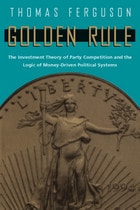
Golden Rule
The Investment Theory of Party Competition and the Logic of Money-Driven Political SystemsThomas Ferguson
University of Chicago Press, 1995
Thomas Ferguson breaks completely with traditional voter centered accounts of party politics. In its place he outlines an "investment approach," in which powerful investors, not unorganized voters, dominate campaigns and elections. Because businesses "invest" in political parties and their candidates, changes in industrial structures—between large firms and sectors—can alter the agenda of party politics and the shape of public policy.
Golden Rule presents revised versions of widely read essays in which Ferguson advanced and tested his theory, including his seminal study of the role played by capital intensive multinationals and international financiers in the New Deal. The chapter "Studies in Money Driven Politics" brings this aspect of American politics into better focus, along with other studies of Federal Reserve policy making and campaign finance in the 1936 election. Ferguson analyzes how a changing world economy and other social developments broke up the New Deal system in our own time, through careful studies of the 1988 and 1992 elections. The essay on 1992 contains an extended analysis of the emergence of the Clinton coalition and Ross Perot's dramatic independent insurgency. A postscript on the 1994 elections demonstrates the controlling impact of money on several key campaigns.
This controversial work by a theorist of money and politics in the U.S. relates to issues in campaign finance reform, PACs, policymaking, public financing, and how today's elections work.

Governing Abroad
Coalition Politics and Foreign Policy in EuropeSibel Oktay
University of Michigan Press, 2022
From Austria to New Zealand, coalition governments often pave the road to foreign policy. In Western Europe, nearly 90 percent of postwar governments include two or more political parties. Israel, the Middle East’s only consolidated democracy according to many, has never experienced single-party rule in its history. Even the United Kingdom, known for its long streak of single-party rule, now navigates multiparty cabinets. Coalitions are everywhere, but we still have little understanding of how they act in foreign affairs. History shows that coalitions can sometime engage in powerful international commitments such as participating in military operations, but at other times, they postpone their decisions, water down their policy positions, or promise to do less than they otherwise would. What explains these differences in behavior?
Governing Abroad unpacks the little-known world of coalition governments to find out. Oktay argues that the specific constellation of parties in government explains why some coalitions can make more assertive foreign policy decisions than others. Building on the rich literature in political science on coalitions, legislatures, and voting behavior, the book weaves together sophisticated statistical analyses of foreign policy events across thirty European countries alongside in-depth case studies from Denmark, the Netherlands, and Finland. It brings political parties back into the study of foreign policy, demonstrating that the size of the coalition, the ideological proximity of the governing parties, and their relationship with the parliamentary opposition together influence the government’s ability to act in the international arena. This book challenges our existing perceptions about the constraints and weaknesses of coalition governments. It sheds new light on the conditions that allow them to act decisively abroad.

Government and Politics in Hungary
András Körösényi
Central European University Press, 1999