Results by title
52 books match the query 'Public administration' and 3 start with g

Going Private
Outsourcing the Administrative StateRachel Augustine Potter
University of Chicago Press, 2027
Shows how the proliferation of contractors within the federal agencies is fundamentally reshaping American governance.
Much of what the federal government does today is carried out by people the public rarely sees. While debates focus on bureaucrats and political appointees, agencies increasingly rely on a vast contractor workforce to perform functions ranging from tech support to policy analysis to regulatory drafting services. This quiet transformation has altered how the government functions while simultaneously preserving the public-facing image of a bureaucracy run by civil servants. The federal government does not keep reliable data on how many contractors it employs, but many estimates suggest that contractors outnumber career bureaucrats.
In Going Private, Rachel Augustine Potter explains how this shift reshapes the everyday operation of the administrative state and coalesces power within the presidency. Easily hired and easily fired, contractors have strong incentives to please their clients, making them malleable to the president’s will. Presidents from both parties have leveraged these features and learned to rely on contractors to advance political priorities, bypass uncooperative bureaucrats, and gain increased control over agency work.
Drawing on new data and interviews, Going Private argues that outsourcing is not merely an administrative convenience. Rather, it is a defining feature of contemporary governance—one that complicates accountability, blurs the boundaries of the administrative state, and alters the exercise of presidential power.
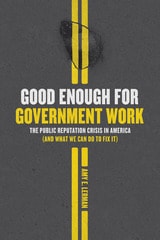
Good Enough for Government Work
The Public Reputation Crisis in America (And What We Can Do to Fix It)Amy E. Lerman
University of Chicago Press, 2019
With Good Enough for Government Work, Lerman uses surveys, experiments, and public opinion data to argue persuasively that the reputation of government is itself an impediment to government’s ability to achieve the common good. In addition to improving its efficiency and effectiveness, government therefore has an equally critical task: countering the belief that the public sector is mired in incompetence. Lerman takes readers through the main challenges. Negative perceptions are highly resistant to change, she shows, because we tend to perceive the world in a way that confirms our negative stereotypes of government—even in the face of new information. Those who hold particularly negative perceptions also begin to “opt out” in favor of private alternatives, such as sending their children to private schools, living in gated communities, and refusing to participate in public health insurance programs. When sufficient numbers of people opt out of public services, the result can be a decline in the objective quality of public provision. In this way, citizens’ beliefs about government can quickly become a self-fulfilling prophecy, with consequences for all. Lerman concludes with practical solutions for how the government might improve its reputation and roll back current efforts to eliminate or privatize even some of the most critical public services.
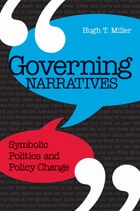
Governing Narratives
Symbolic Politics and Policy ChangeHugh T. Miller
University of Alabama Press, 2012